Welcome to our Organic store Bluswan Indus Pvt Ltd! | +91 9346545670 (Main Office) | +91 7794920404 (Machines)
Welcome to our Organic store Bluswan Indus Pvt Ltd! | +91 9346545670 (Main Office) | +91 7794920404 (Machines)
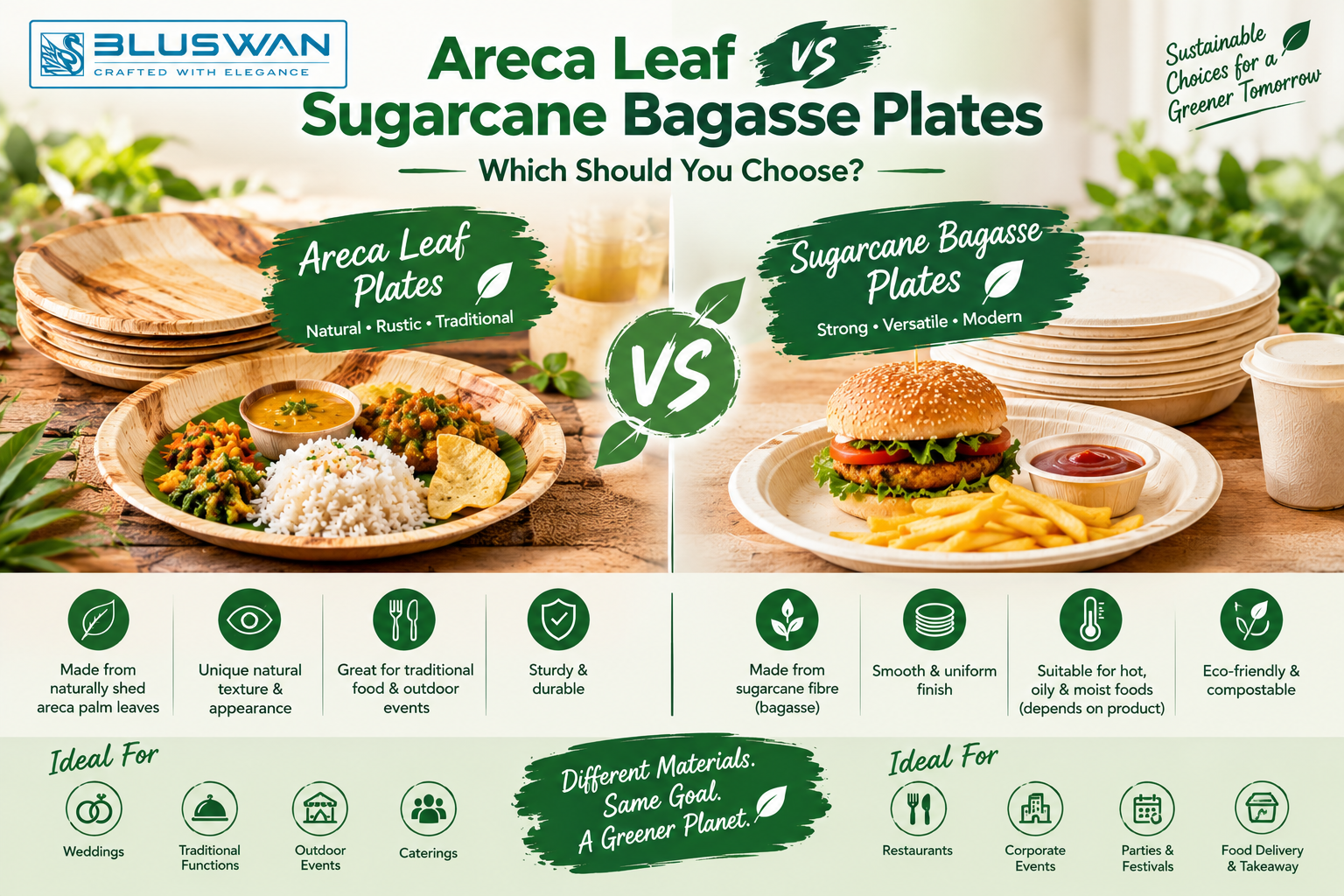
When restaurants, caterers, event organizers, and businesses look for alternatives to conventional disposable plastic plates, two popular options often come up: areca leaf plates and sugarcane bagasse plates.
Both are plant-based tableware options with different materials, manufacturing processes, appearances, and practical characteristics. Choosing between them is not simply about deciding which one is "better." The right option depends on the type of food, event, presentation, quantity, budget, storage, and disposal system.
So, areca leaf vs. bagasse — which should you choose?
In this guide, we compare both options in detail to help restaurants, caterers, wedding planners, event organizers, and food-service businesses make a more informed choice.
Areca leaf plates are made from the naturally shed leaf sheaths of areca palm trees.
The fallen leaf sheaths can be collected, cleaned, dried, and processed into different shapes and sizes of plates, bowls, and serving products.
One of the most recognizable features of areca leaf tableware is its natural appearance. The plates often retain variations in colour and texture because they are made from natural leaf material.
Areca leaf plates are commonly considered for:
Their natural texture can work particularly well with traditional Indian food and rustic or nature-inspired event themes.
Sugarcane bagasse is the fibrous material that remains after sugarcane is processed for juice extraction.
This fibre can be processed into pulp and molded into food-service products such as:
Bagasse plates usually have a clean, uniform appearance and can be manufactured in different shapes and sizes.
They are widely considered for restaurants, catering businesses, food delivery, cafeterias, events, and takeaway applications.
| Feature | Areca Leaf Plates | Sugarcane Bagasse Plates |
|---|---|---|
| Main material | Naturally shed areca palm leaf sheaths | Sugarcane fibre |
| Appearance | Natural, rustic, textured | Smooth, molded, uniform |
| Product options | Plates and bowls | Plates, bowls, trays, containers |
| Food applications | Dry, moist and suitable food applications depending on product | Hot, moist and oily foods depending on product specifications |
| Design options | Natural shapes and textures | Many molded shapes and compartments |
| Events | Weddings, traditional functions, outdoor events | Weddings, catering, restaurants, corporate events |
| Storage | Stackable depending on design | Generally stackable |
| Presentation | Rustic and natural | Clean and modern |
| Sustainability | Plant-based material | Plant-based fibre material |
| Best choice | Natural event presentation | Versatile food-service applications |
The comparison above is a general guide. Actual performance depends on the individual product, manufacturing process, specifications, and intended use.
The biggest difference between the two products is their raw material.
Areca plates use naturally shed areca palm leaf sheaths. The material is collected after naturally falling from the palm and then processed into tableware.
Bagasse comes from sugarcane processing. The fibrous residue left after juice extraction can be converted into pulp and molded into disposable tableware.
Both approaches make use of plant-based materials, but they involve different manufacturing processes.
Appearance can be an important consideration for weddings, restaurants, and events.
Areca leaf plates have a distinctive natural appearance.
They can feature:
This makes them particularly attractive for rustic, traditional, outdoor, and nature-themed events.
Bagasse plates generally have a more consistent appearance.
They can be produced with:
This makes bagasse suitable for modern catering and restaurant environments where consistency is important.
Both areca leaf and bagasse products can be designed for food-service use, but the exact performance depends on the product.
Restaurants serving hot food should always check the supplier's specifications.
Foods may include:
A high-quality food-service plate should maintain sufficient structural integrity under its intended conditions.
However, it is important not to assume that every areca leaf or bagasse plate has the same heat resistance.
Always check the manufacturer's recommended temperature range and intended use.
Oil resistance is another important consideration for restaurants and caterers.
Many Indian foods contain significant amounts of oil, sauces, or gravy.
Examples include:
Bagasse tableware can be manufactured to provide resistance to moisture and oils, making suitable products useful for many food-service applications.
Areca leaf plates can also be used for various moist and oily foods when the specific product is designed for those applications.
The best approach is to test the actual plate with the actual food before purchasing large quantities.
For weddings, the choice often depends on the style of the event.
Areca leaf plates can complement traditional Indian meals and natural event décor.
For large weddings, both can be useful depending on the food and event design.
Restaurants usually focus heavily on practicality.
They may need tableware that is:
Bagasse can offer a broad range of molded products, including plates, bowls, trays, and takeaway containers.
This makes it useful for restaurants with diverse menus.
Areca leaf products can be particularly attractive for restaurants that want a natural or traditional presentation.
The choice should therefore be based on the restaurant's actual menu and serving style.
Catering businesses often need to serve large numbers of people quickly.
A catering company may need:
Bagasse products can be useful because they are available in many molded formats.
Areca leaf plates can also work well for catering, particularly where natural presentation is important.
For a large catering order, the supplier should be able to provide consistent product quality and sufficient quantities.
Food delivery creates different packaging requirements.
A delivery container may need to deal with:
Bagasse is commonly available in food-container and takeaway formats, which can make it suitable for certain delivery applications.
Areca leaf products are more commonly associated with plates and bowls, although the exact product range varies by supplier.
For food delivery, businesses should choose products specifically designed for takeaway use rather than assuming a disposable plate will work as a delivery container.
Strength is important for both products.
Imagine a customer carrying a plate filled with:
The plate needs to remain stable during normal use.
Bagasse plates can be molded into different thicknesses and structural designs.
Areca leaf plates have their own natural fibre structure and can provide a sturdy serving surface when properly manufactured.
However, strength can vary significantly between products.
Before placing a bulk order, test:
This is more reliable than choosing based only on the material name.
This depends on the type of event.
Areca leaf products often have a natural and handcrafted appearance.
They can work well for:
Bagasse products can provide a clean and professional appearance.
They are often suitable for:
Neither material automatically makes an event look more premium. The overall presentation, food, décor, and table setting all contribute.
This question requires some care.
Both are made from plant-based materials, but you can't determine environmental performance simply by looking at the raw material.
A proper comparison can consider:
For compostable products, the availability of appropriate composting infrastructure is also important.
A product labelled biodegradable or compostable should therefore be evaluated according to its certification and disposal requirements.
For businesses, it is better to make specific, verified environmental claims rather than assuming that every plant-based product has the same environmental impact.
Storage is particularly important for caterers.
Both areca leaf and bagasse plates can be supplied in stackable formats.
However, storage efficiency depends on:
Bagasse products with standardized shapes can be convenient for businesses that need large quantities of uniform tableware.
Areca leaf plates may have more natural variation in appearance and shape.
For large orders, always check carton dimensions and stacking requirements before delivery.
Price can vary depending on:
Therefore, there is no universal answer that one material is always cheaper.
Restaurants and caterers should compare the total cost per usable serving, rather than simply comparing the price of one plate.
For example, a cheaper plate may not be economical if it is too small, too weak, or unsuitable for the food being served.
Here is a simple decision guide.
✔ Natural appearance
✔ Rustic presentation
✔ Traditional event styling
✔ Outdoor wedding tableware
✔ Natural leaf texture
✔ Plates and bowls with a distinctive look
✔ Consistent shapes
✔ Multiple sizes
✔ Compartment plates
✔ Plates, bowls and trays
✔ Food-service versatility
✔ Restaurant and catering applications
✔ Modern presentation
Bluswan Indus provides sustainable tableware options including areca leaf plates and sugarcane bagasse products.
Offering different materials gives restaurants, caterers, and event organizers the flexibility to select products according to their specific requirements.
For example:
Wedding → Areca leaf plates for natural presentation
Restaurant → Bagasse plates for consistent food service
Outdoor event → Either option depending on menu and event theme
Catering → Bagasse plates, compartment plates, bowls, or areca leaf products depending on the food
The most important factor is matching the product to the actual application.
There is no single answer for every business.
If your priority is natural appearance and traditional presentation, areca leaf plates may be a suitable option.
If your priority is product variety, uniformity, and versatile food-service formats, bagasse may be more suitable.
For many businesses, the decision can be as simple as matching the material to the event:
Natural & Traditional → Areca Leaf
Modern & Versatile → Bagasse
However, businesses should still check product specifications, food-contact suitability, certifications, temperature limits, and disposal requirements before purchasing.
The areca leaf vs bagasse comparison is not about finding one material that works for everyone.
Both materials have different characteristics and can serve different food-service needs.
Areca leaf plates offer a natural, distinctive appearance that can work particularly well for weddings, traditional functions, outdoor events, and nature-inspired celebrations.
Sugarcane bagasse plates provide a molded plant-fibre option available in various shapes and formats, making them useful for restaurants, catering companies, food-service businesses, and large events.
Before making your choice, consider:
The best tableware is ultimately the one that matches your food, event, operational needs, and responsible disposal plan.
Whether you choose the natural character of areca leaf or the versatility of sugarcane bagasse, selecting the right product can help create a practical and attractive food-service experience.
1. Are areca leaf plates better than bagasse plates?
Neither is universally better. Areca leaf can be attractive for natural and traditional events, while bagasse offers a wide range of molded food-service products.
2. Are bagasse plates suitable for hot food?
Many food-grade bagasse plates are designed for hot-food applications, but temperature suitability should always be confirmed with the supplier.
3. Can areca leaf plates be used for oily food?
Suitable areca leaf plates can be used for many food-service applications, but businesses should verify the product specifications and test it with their actual menu.
4. Which is better for weddings?
Areca leaf works well for natural or traditional wedding themes, while bagasse is useful when you need consistent sizes and different plate formats.
5. Which is better for catering?
Both can be used for catering. The choice depends on the food, presentation, quantity, and product specifications.
6. Are both areca leaf and bagasse biodegradable?
Both are plant-based materials, but businesses should verify the specific product's biodegradability or compostability claims and disposal requirements.
7. Can I use bagasse and areca leaf products at the same event?
Yes. Businesses can select different tableware products for different food items or serving areas based on their requirements.
2026 © All rights reserved by Bluswan indus Pvt Ltd
Powered by : Innoplus TechnologiesYour item has already added in wishlist successfully


