


30 Dec, 2025
Welcome to our Organic store Bluswan Indus Pvt Ltd! | +91 9346545670 (Main Office) | +91 7794920404 (Machines)
Welcome to our Organic store Bluswan Indus Pvt Ltd! | +91 9346545670 (Main Office) | +91 7794920404 (Machines)

Sustainable Living Made Easy with Eco-Friendly Disposable Products: In today’s fast-paced world, convenience often comes at the cost of the environment. Single-use plastic plates, cups, and containers contribute massively to pollution and landfill waste. The good news? Sustainable living doesn’t have to be complicated. By switching to eco-friendly disposable products, you can enjoy convenience while caring for the planet. At BLUSWAN, we believe that small, conscious choices can create a big environmental impact. What Are Eco-Friendly Disposable Products? Eco-friendly disposable products are made from natural, renewable, and biodegradable materials instead of plastic. These products decompose naturally and return to the earth without releasing harmful toxins. Common materials include: Areca (Palm) Leaf Sugarcane Bagasse Rice Bran These materials are compostable, safe for food contact, and perfect for everyday use. Popular Eco-Friendly Disposable Options: Areca Leaf Plates & Bowls: Made from fallen palm leaves, areca leaf products are 100% natural and chemical-free. They are sturdy, elegant, and ideal for serving Indian meals, snacks, and festive dishes. Best for: Homes, restaurants, weddings, temples, and events. Sugarcane Bagasse Plates & Containers: Produced from sugarcane fiber residue, bagasse products are strong, leak-resistant, and compostable. They can handle hot, oily, and wet foods with ease. Best for: Takeaways, catering, food delivery, and outdoor events. Rice Bran Plates & Tea Cups: Rice bran plates are an innovative, sustainable alternative made from agricultural by-products. They are durable, lightweight, and eco-safe. Best for: Daily meals, bulk serving, drinking Tea/Coffee and eco-conscious businesses. 🌱 Why Choose Eco-Friendly Disposables? ✔ Environmentally Responsible They reduce plastic waste and help protect land, water, and wildlife. ✔ Safe for Food No plastic coating or harmful chemicals—safe for hot and cold foods. ✔ Convenient & Hygienic Perfect for busy lifestyles, events, and outdoor dining. ✔ Compostable & Biodegradable Break down naturally, leaving minimal environmental impact. Sustainable Living Starts with Simple Choices: You don’t need to completely change your lifestyle to live sustainably. Replacing plastic disposables with eco-friendly alternatives is one of the easiest steps you can take. Whether you’re hosting a family function, running a food business, or simply enjoying daily meals, eco-friendly disposable products help you serve food responsibly—without sacrificing convenience. Choose BLUSWAN – Crafted with Elegance, Designed for the Planet At BLUSWAN, we offer a wide range of areca leaf plates, bowls, sugarcane bagasse products, and rice bran disposables crafted with quality, elegance, and sustainability in mind. By choosing BLUSWAN, you’re not just choosing disposable products—you’re choosing a cleaner, greener future.

As environmental awareness grows across India, individuals and businesses are actively seeking sustainable alternatives to plastic disposables. One of the most effective and eco-friendly solutions today is sugarcane bagasse products. At BLUSWAN, we are committed to offering high-quality, eco-friendly sugarcane products that combine sustainability, strength, and style—helping you serve responsibly while protecting the planet. What Are Sugarcane Bagasse Products? Sugarcane bagasse is the natural fibrous residue left after extracting juice from sugarcane. Instead of being burned or discarded, this agricultural waste is transformed into biodegradable disposable products such as plates, bowls, trays, and food containers. India, being one of the world’s largest sugarcane producers, generates abundant bagasse—making sugarcane products a truly Made-in-India, sustainable solution. Why Choose Sugarcane Products Over Plastic? 1, 100ìo-Friendly & Biodegradable Sugarcane products naturally decompose within 60–90 days and return to the soil without leaving harmful residues. 2, Plastic-Free & Chemical-Free BLUSWAN sugarcane products are free from plastic, toxins, and harmful coatings, ensuring complete food safety. 3, Perfect for Indian Food Strong and sturdy enough to handle hot, oily, and gravy-based Indian foods such as rice, dal, curries, biryani, sambhar, chaat, and snacks. 4, Heat & Microwave Safe Safe for hot foods and reheating, making them ideal for restaurants, cloud kitchens, and takeaway services. 5, Made from Agricultural Waste By using sugarcane bagasse, we reduce waste and support a circular economy—turning by-products into valuable eco-friendly products. BLUSWAN Sugarcane Product Range At BLUSWAN, we offer a wide range of sustainable sugarcane products designed for both everyday use and large-scale events. Sugarcane Plates Available in round, square, and compartment designs, our plates are strong, leak-proof, and ideal for full meals. Sugarcane Bowls Perfect for curries, gravies, desserts, soups, and snacks—durable and spill-resistant. Sugarcane Trays Designed for thali meals, catering services, schools, corporate events, and mass food distribution. Sugarcane Takeaway Containers Leak-proof and sturdy containers ideal for food delivery, takeaway counters, and cloud kitchens. Ideal Uses of BLUSWAN Sugarcane Products BLUSWAN sugarcane products are widely used across India for: Restaurants & hotels Catering services Weddings & family functions Corporate events & meetings Temples & prasadam distribution Festivals & community gatherings Cloud kitchens & food delivery They provide convenience without compromising on sustainability. Supporting India’s Plastic Ban & Green Initiatives With plastic bans implemented across many Indian states, businesses are required to switch to eco-friendly alternatives. Choosing BLUSWAN sugarcane products helps you: Stay compliant with government regulations Reduce environmental impact Build a responsible and eco-friendly brand image Why BLUSWAN? ✔️ Premium quality products ✔️ Designed for Indian food & usage ✔️ Strong, durable & hygienic ✔️ Environment-friendly manufacturing ✔️ Trusted choice for sustainable living At BLUSWAN, sustainability is not just a product feature—it is our mission. Make the Eco-Friendly Choice Today Switching to sugarcane products is a small step that creates a big impact. Whether you are a business owner, event organiser, or eco-conscious consumer, BLUSWAN helps you serve food responsibly without harming the environment. 🌿 Choose BLUSWAN. Choose Sustainability. Serve Nature on Every Plate.

With growing awareness about environmental protection, people are actively moving away from plastic and thermocol products. One of the most practical and eco-friendly alternatives today is rice husk plates. Made from agricultural waste, rice husk plates are transforming the way we serve and enjoy food—responsibly. What Are Rice Husk Plates? Rice husk plates are disposable plates manufactured using the outer husk of rice grains, a natural by-product of rice milling. Instead of burning or dumping this waste, it is converted into sturdy, biodegradable tableware that is safe for both people and the planet. Why Choose Rice Husk Plates? Rice husk plates offer a perfect balance of strength, safety, and sustainability. They are: Eco-friendly & biodegradable – decompose naturally without harming the environment Plastic-free – a safe alternative to single-use plastic plates Strong & durable – suitable for hot, cold, and oily foods Food-safe & hygienic – no harmful chemicals or coatings Elegant & natural look – ideal for modern and traditional events Ideal Uses of Rice Husk Plates Rice husk plates are versatile and suitable for many occasions, including: Home dining Parties & celebrations Catering services Restaurants & food stalls Outdoor events & festivals Their sturdy design ensures a mess-free dining experience, even with heavy meals. Supporting a Circular Economy By choosing rice husk plates, you support the reuse of agricultural waste and promote a circular economy. This not only reduces pollution but also adds value to farming by-products, benefiting both farmers and the environment. A Better Choice for a Greener Future Switching to rice husk plates is a small change that creates a big impact. Whether for business or personal use, these plates help reduce plastic waste while offering convenience and quality. 🌱 Choose rice husk plates. Serve responsibly. Protect the planet.

In a time where environmental concerns are growing rapidly, making eco-conscious choices has become more important than ever. One simple yet powerful step towards sustainability is replacing plastic disposables with natural alternatives. Among these, Areca leaf plates stand out as a perfect blend of tradition, durability, and environmental responsibility. Derived from naturally fallen leaves of the areca palm tree, these plates are crafted without cutting trees or harming nature. They are cleaned, heat-pressed, and shaped into beautiful, sturdy plates that are ready to serve your meals with elegance. 🌱 The Natural Origin of Areca Leaf Plates Areca leaf plates are made from dried leaves that naturally fall from areca palm trees, commonly found in India. Instead of being burned or discarded, these leaves are collected and transformed into eco-friendly dining products. This process: Requires no chemicals Uses minimal water Produces zero waste This makes Areca plates one of the most sustainable disposable options available today. Strong, Safe, and Reliable One of the biggest misconceptions about eco-friendly products is that they lack strength. However, Areca leaf plates are incredibly durable and practical. They are: Strong enough to hold heavy meals Leak-proof for liquids and gravies Heat-resistant (ideal for hot food) Microwave and refrigerator safe Whether you're serving rice, curries, snacks, or desserts, these plates perform exceptionally well without bending or breaking. Perfect for Every Occasion Areca leaf plates are not just functional — they enhance the overall dining experience with their natural texture and premium look. They are ideal for: Weddings and festive events Corporate catering Religious functions and festivals Street food vendors and restaurants Daily home use Their earthy appearance adds a traditional and elegant touch, making even simple meals feel special. Environmental Benefits That Matter Switching to Areca leaf plates contributes directly to environmental protection. By using them, you: Reduce plastic pollution Minimize landfill waste Support biodegradable alternatives Encourage sustainable production practices Unlike plastic plates that take hundreds of years to decompose, Areca plates break down naturally within a few months, enriching the soil instead of polluting it. A Step Towards a Greener Future Sustainability begins with small choices. By replacing plastic plates with Areca leaf plates, you are taking a meaningful step toward protecting the planet. Every eco-friendly decision counts — and something as simple as your choice of plate can make a lasting difference. Areca leaf plates are more than just a disposable product — they represent a lifestyle choice rooted in sustainability, tradition, and responsibility. Make the switch today. Serve your meals with nature, not plastic.
10 Best Eco-Friendly Disposable Plates for Restaurants in 2026 Restaurants are constantly looking for better ways to serve food while reducing their impact on the environment. With customers becoming more conscious about plastic waste and sustainable choices, eco-friendly disposable plates are becoming a practical option for restaurants, cafés, cloud kitchens, caterers, food trucks, and takeaway businesses. Traditional plastic plates may be inexpensive and convenient, but they create long-lasting waste. Eco-friendly alternatives made from materials such as sugarcane bagasse, areca leaves, rice bran, and wheat bran can offer the convenience of disposable tableware while supporting more sustainable food-service practices. In 2026, restaurants have more choices than ever when it comes to biodegradable and compostable tableware. But which plates are suitable for different types of food and businesses? This guide covers 10 of the best eco-friendly disposable plates for restaurants in 2026, along with their benefits, uses, and important factors to consider before buying. What Are Eco-Friendly Disposable Plates? Eco-friendly disposable plates are single-use plates manufactured from materials that are designed to have a lower environmental impact than conventional plastic plates. Depending on the material and manufacturing process, these plates may be biodegradable, compostable, recyclable, or made from renewable agricultural resources. Common materials include: Sugarcane bagasse Areca palm leaves Rice bran Wheat bran Paper and recycled paper Other plant-based materials For restaurants, the right choice depends on factors such as the type of food being served, durability, size, moisture resistance, presentation, and cost. Why Are Restaurants Choosing Eco-Friendly Disposable Plates? Restaurants use disposable plates for many reasons, particularly for takeaway orders, catering events, food festivals, outdoor functions, and quick-service operations. Switching to sustainable alternatives can provide several practical benefits. 1. Reduced Plastic Dependency Plastic tableware can contribute significantly to waste when used on a large scale. Plant-based alternatives can help businesses reduce their dependence on conventional plastic products. 2. Better Customer Perception Many customers actively look for businesses that demonstrate environmentally responsible practices. Using sustainable tableware can complement a restaurant's broader sustainability efforts. 3. Convenient for Takeaway and Catering Disposable plates eliminate the need for washing and storing large quantities of reusable dishes. This makes them particularly useful for catering companies, food trucks, outdoor events, and takeaway businesses. 4. Made From Renewable Resources Several eco-friendly plates are produced using agricultural by-products or renewable plant materials. Sugarcane bagasse, for example, is produced from the fibrous material left after extracting juice from sugarcane. 5. Suitable for Different Foods Modern eco-friendly plates are available in different sizes and designs, making them suitable for everything from snacks and desserts to complete meals. 10 Best Eco-Friendly Disposable Plates for Restaurants in 2026 1. Sugarcane Bagasse Plates Sugarcane bagasse plates are among the most popular choices for restaurants looking for plant-based disposable tableware. Bagasse is the fibrous material left after sugarcane juice has been extracted. It can be processed into sturdy plates and food containers. Best for: Restaurants Cloud kitchens Catering Food delivery Corporate events Parties Bagasse plates are available in different sizes and shapes, making them suitable for serving snacks, meals, rice dishes, curries, desserts, and other foods. Their sturdy construction makes them a practical alternative to many traditional disposable plates. 2. Areca Leaf Plates Areca leaf plates are made from naturally fallen areca palm leaves. The leaves are collected, cleaned, heat-pressed, and shaped into plates and bowls. They have a natural appearance that can work particularly well for events where presentation matters. Best for: Weddings Traditional events Outdoor catering Restaurants Parties Eco-conscious events The natural texture and appearance of areca leaf tableware can add a simple, earthy look to food presentation. 3. Rice Bran Plates Rice bran is another agricultural resource that can be used to create sustainable tableware. Rice-based products are gaining attention as businesses look for alternatives to conventional plastic food-service products. Best for: Restaurants Catering businesses Events Food serving Sustainable food-service operations Rice bran plates can be considered when a restaurant wants to explore alternatives beyond conventional paper and plastic tableware. 4. Wheat Bran Plates Wheat bran is another plant-based material that can be used in sustainable food-service products. For restaurants interested in exploring different agricultural-based tableware options, wheat bran products can provide an additional alternative. Best for: Cafés Restaurants Events Catering Sustainable food businesses The growing variety of agricultural-waste-based products gives businesses more flexibility when choosing disposable tableware. 5. Compartment Bagasse Plates For restaurants serving complete meals, compartment plates can be particularly useful. These plates feature separate sections that help keep different foods apart. This can be useful for Indian meals where rice, curry, vegetables, snacks, and side dishes are served together. Best for: Indian restaurants Catering Weddings Corporate lunches Food delivery Meal services Compartment plates can also make takeaway meals easier to organize and present. 6. Round Bagasse Plates Round bagasse plates are a simple and versatile option for restaurants. They can be used for a wide range of meals and snacks without taking up unnecessary space in storage or during service. Best for: Restaurants Cafés Food stalls Parties Catering Different sizes can be selected depending on whether the restaurant is serving snacks, desserts, starters, or full meals. 7. Areca Leaf Bowls and Plate Sets Restaurants that serve gravies, curries, soups, desserts, or snacks may benefit from combining plates with matching bowls. Areca leaf bowls provide a natural presentation and can be paired with areca plates for events and food-service applications. Best for: Traditional food Catering Desserts Snacks Curries Outdoor events Using coordinated tableware can also create a more consistent presentation at large events. 8. Large Disposable Plates for Catering Large plates are useful when serving complete meals at weddings, festivals, corporate events, and large gatherings. A larger surface provides enough room for multiple food items without overcrowding the plate. Best for: Wedding catering Corporate events Festivals Community gatherings Large restaurants Businesses should consider the plate's strength, size, and ability to handle the type of food being served. 9. Small Disposable Plates for Snacks and Desserts Not every restaurant needs a large dinner plate. Small eco-friendly disposable plates can be useful for snacks, appetizers, desserts, bakery products, and tasting portions. Best for: Cafés Bakeries Dessert shops Food stalls Events Parties Using the correct plate size can also help restaurants reduce unnecessary material usage. 10. Eco-Friendly Disposable Plate Sets For restaurants and caterers that need a complete serving solution, disposable plate sets can combine plates, bowls, and other tableware. A coordinated set can simplify purchasing and ensure that all tableware matches the restaurant's requirements. Best for: Catering companies Events Restaurants Corporate functions Outdoor food service Businesses can choose combinations based on their menu and serving requirements. How to Choose the Right Eco-Friendly Disposable Plates Choosing the right plate is about more than simply selecting the most sustainable-looking option. Restaurants should consider several practical factors. 1. Type of Food Think about what you serve most frequently. For example, a restaurant serving rice and curry may need sturdy plates with enough depth, while a bakery may need smaller plates for cakes and snacks. 2. Size Disposable plates are available in various sizes. Common options include small snack plates, medium serving plates, and larger dinner plates. Choose sizes according to your menu and portion sizes. 3. Strength and Durability The plate should be strong enough to hold the food without bending or breaking. This becomes especially important when serving heavy meals or transporting food. 4. Moisture and Oil Resistance Restaurants serving curries, gravies, oily foods, and sauces should consider how well the selected tableware handles moisture and oil. 5. Presentation For dine-in events, weddings, and catering, appearance can be just as important as functionality. Areca leaf plates, for example, offer a natural appearance that can work well for certain events. 6. Storage Restaurants should also consider storage space. Disposable plates should be easy to stack and store without taking up excessive room. 7. Supplier Reliability A reliable supplier is important for restaurants that use disposable tableware regularly. Before placing large orders, businesses should check product quality, sizes, availability, packaging, delivery timelines, and minimum order quantities. Are Eco-Friendly Disposable Plates More Expensive? The cost depends on the material, size, design, quantity, supplier, and manufacturing process. At first glance, some sustainable tableware options may cost more than low-cost plastic alternatives. However, restaurants should consider the overall value rather than looking only at the price per plate. Customer expectations, brand image, convenience, waste management, and sustainability goals can all influence the overall value of switching to eco-friendly tableware. For businesses purchasing large quantities, wholesale pricing can also make sustainable products more practical. Are Eco-Friendly Plates Suitable for Takeaway Food? Yes, many eco-friendly disposable plates and food containers are designed for food-service applications. However, restaurants should always choose products based on their specific menu. Hot food, oily dishes, sauces, gravies, and long-distance food delivery can place different demands on disposable tableware. Before ordering in bulk, it is a good idea to test the product with the restaurant's actual food items. Eco-Friendly Tableware for Modern Restaurants Sustainability is becoming an important consideration across the food-service industry. Restaurants are not limited to one type of disposable tableware. They can select different materials and formats depending on their requirements. Sugarcane bagasse can be useful for everyday food service, while areca leaf products can provide a natural presentation for events. Rice bran and wheat bran products offer additional plant-based alternatives. The important thing is to choose products that balance sustainability, functionality, food safety, presentation, and cost. Why Bluswan Indus for Eco-Friendly Disposable Plates? Bluswan Indus provides a range of eco-friendly tableware products made from plant-based and agricultural materials. Its product range includes Sugarcane Bagasse, Areca Leaf, Rice Bran, and Wheat Bran products, giving restaurants and food-service businesses multiple options to explore. For restaurants, caterers, event organizers, food businesses, and other organizations looking to reduce their dependence on conventional disposable plastics, selecting the right sustainable tableware can be an important step. Before choosing a product, businesses should consider their menu, serving requirements, quantity, budget, and preferred material. Final Thoughts The demand for eco-friendly disposable plates is continuing to grow as restaurants and customers look for more sustainable alternatives to traditional plastic tableware. Sugarcane bagasse plates, areca leaf plates, rice bran products, wheat bran tableware, compartment plates, and other plant-based options can provide restaurants with practical choices for different types of food service. The best option depends on the restaurant's specific requirements. Consider the food being served, plate size, durability, moisture resistance, appearance, storage, and supplier reliability before making a decision. For restaurants planning to make their food service more environmentally responsible in 2026, switching to suitable eco-friendly disposable tableware can be a practical place to start. Looking for eco-friendly disposable plates for your restaurant, catering business, event, or food-service operation? Explore the sustainable tableware range from Bluswan Indus and choose products that fit your business needs. Frequently Asked Questions 1. What are the best eco-friendly disposable plates for restaurants? Popular options include sugarcane bagasse plates, areca leaf plates, rice bran plates, and wheat bran plates. The right choice depends on the restaurant's food, serving style, budget, and requirements. 2. Are sugarcane bagasse plates good for restaurants? Yes. Sugarcane bagasse plates are a popular plant-based option for restaurants, catering businesses, food delivery, events, and other food-service applications. 3. Are areca leaf plates suitable for catering? Yes. Areca leaf plates are commonly considered for catering, weddings, outdoor events, parties, and other occasions where natural-looking tableware is preferred. 4. What should restaurants consider before buying disposable plates? Restaurants should consider material, size, strength, moisture resistance, food type, appearance, storage requirements, pricing, and supplier reliability. 5. Are eco-friendly disposable plates suitable for takeaway food? Many are designed for food-service use, but restaurants should test products with their specific foods before purchasing in large quantities. 6. Which disposable plate is best for Indian meals? Large or compartment-style bagasse plates can be useful for Indian meals because they provide space for rice, curries, vegetables, snacks, and side dishes. 7. Where can restaurants buy eco-friendly disposable plates? Restaurants can purchase sustainable disposable tableware from specialized manufacturers and suppliers such as Bluswan Indus, depending on their required material, size, quantity, and delivery location.
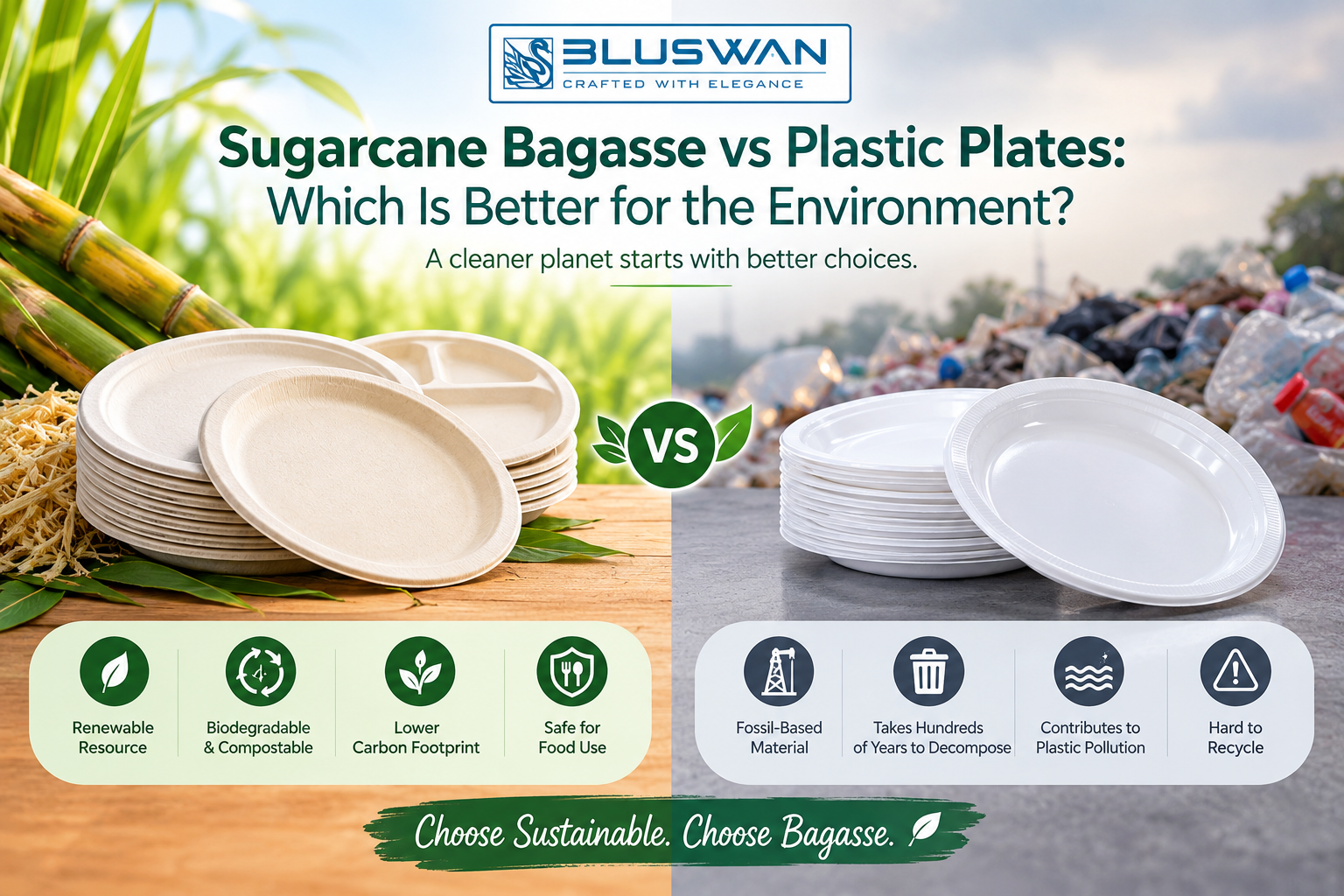
Sugarcane Bagasse vs Plastic Plates: Which Is Better for the Environment? When restaurants, cafés, caterers, and food-service businesses choose disposable plates, convenience is only one part of the decision. The material used for those plates can also affect how waste is managed after the food has been served. For years, plastic plates have been a common choice because they are lightweight, inexpensive, and convenient. However, the environmental concerns associated with single-use plastic have encouraged businesses to explore alternatives made from renewable or plant-based materials. One increasingly popular option is sugarcane bagasse plates. Sugarcane bagasse is the fibrous material left after sugarcane is processed for juice or sugar. It can be converted into food-service products such as plates, bowls, trays, and containers. This gives businesses an alternative to conventional fossil-fuel-based plastic tableware. But does that automatically make bagasse better for the environment? The answer depends on several factors, including how the product is manufactured, how it is used, and what happens to it after disposal. Life-cycle research shows that the environmental performance of disposable tableware depends heavily on production and end-of-life systems. Let's compare sugarcane bagasse plates vs plastic plates in more detail. What Are Sugarcane Bagasse Plates? Sugarcane bagasse is the fibrous residue left after extracting juice from sugarcane. Instead of treating this material simply as waste, manufacturers can use it as a raw material for molded food-service products. Bagasse can be processed into plates with different shapes, sizes, and compartment designs. Common uses include: Restaurants Catering services Food delivery Cloud kitchens Weddings and events Corporate functions Outdoor food service Parties and celebrations The use of agricultural by-products in tableware is one reason bagasse has attracted attention as an alternative to conventional plastic products. What Are Plastic Plates? Plastic plates are generally made from synthetic polymers produced from petrochemical feedstocks. They are widely used because plastic can be lightweight, durable, inexpensive, and resistant to moisture. These characteristics have made plastic popular in food-service applications. However, the same durability that makes plastic useful also creates a waste-management challenge when products are designed for only one use. UNEP identifies the growth of single-use plastic waste as a significant environmental challenge and highlights the importance of reducing unnecessary single-use products and improving waste-management systems. Sugarcane Bagasse vs Plastic Plates: Key Differences Feature Sugarcane Bagasse Plates Plastic Plates Main material Sugarcane fiber Synthetic plastic polymers Material source Agricultural by-product Primarily fossil-based feedstocks Typical use Food service and catering Food service and catering End-of-life options Can be suitable for composting where facilities accept the product Usually managed through conventional waste systems Appearance Natural, fiber-based appearance Smooth plastic appearance Sustainability potential Stronger when suitable composting systems are available Limited by persistence of plastic waste Suitable for food service Yes Yes Disposal requirements Depends on local composting infrastructure Depends on local waste-management infrastructure The table shows why bagasse can be attractive, but it is important not to assume that every product labeled "eco-friendly" automatically has the same environmental performance. 1. Raw Material: Bagasse Uses Agricultural Residue One major difference is where the materials come from. Sugarcane bagasse comes from the fibrous portion of sugarcane left after juice extraction. Turning this material into useful products can create another use for an agricultural by-product. Plastic, on the other hand, is produced from synthetic polymers, with conventional plastics largely linked to fossil-based feedstocks. This difference in material origin is one reason plant-based tableware has become increasingly popular among businesses looking for alternatives to conventional disposable plastics. 2. End-of-Life Is Extremely Important One of the biggest differences between bagasse and plastic is what can happen after the product has been used. A compostable bagasse product may be able to enter an appropriate composting system, depending on the product specifications and local facility requirements. However, compostable does not mean that the product will automatically disappear anywhere it is thrown away. The U.S. Federal Trade Commission states that compostable claims should be supported by reliable evidence and that claims should be qualified when appropriate composting facilities are not available. This is an important point for restaurants. A restaurant choosing bagasse plates should also consider whether suitable organic-waste or composting infrastructure exists in its area. 3. Plastic Can Persist in the Environment Plastic's durability is useful during its intended use, but it becomes a challenge when plastic products are discarded incorrectly. UNEP reports that plastic pollution is a major global environmental issue, with large quantities of plastic waste ending up in landfills or being mismanaged. Single-use plastic products are particularly challenging because they may be used for only a short period before becoming waste. This is why reducing unnecessary single-use products and improving waste-management systems are important parts of addressing plastic pollution. 4. Bagasse Can Fit Into Composting Systems One of the biggest potential advantages of sugarcane bagasse plates is their compatibility with appropriate organic-waste management systems. Research examining compostable food-service tableware has found that compostable tableware combined with organic recycling can have environmental advantages compared with certain fossil-based disposable tableware scenarios. But the disposal system matters. If a compostable product is sent to a waste stream that cannot process it appropriately, its environmental benefits may not be fully realized. Therefore, businesses should look beyond the label and understand how the product should actually be disposed of. Are Sugarcane Bagasse Plates Better Than Plastic Plates? There isn't one universal answer for every situation. Environmental performance depends on the entire life cycle of a product, including raw materials, manufacturing, transportation, use, and disposal. Research comparing disposable tableware systems has found that compostable systems can perform better than fossil-based plastic systems under certain assumptions, particularly when composting or organic recycling is available. At the same time, UNEP's life-cycle work emphasizes that single-use itself is an important part of the environmental equation. In some situations, reusable products can avoid the need to manufacture and dispose of a new item for every meal. So the practical comparison is not simply: Bagasse = good Plastic = bad Instead, businesses should consider the complete product life cycle and the waste system available to them. Benefits of Sugarcane Bagasse Plates for Restaurants For restaurants and catering businesses, bagasse plates can provide several practical advantages. Plant-Based Material Bagasse uses sugarcane fiber, giving businesses an alternative to conventional plastic tableware. Suitable for Different Food-Service Applications Bagasse plates are available in various sizes and formats, making them suitable for meals, snacks, catering, events, and takeaway service. Natural Appearance The light, natural appearance of bagasse can complement restaurants and events that want a more sustainable or minimal presentation. Useful for Catering Large events often require hundreds or thousands of disposable plates. Bagasse can be considered for weddings, parties, corporate events, festivals, and outdoor catering. Supports Alternative Waste Strategies Where suitable composting infrastructure exists and the specific product is certified or accepted by that system, bagasse products may be directed toward organic waste processing rather than conventional plastic waste streams. What Are the Limitations of Sugarcane Bagasse Plates? Choosing a plant-based plate does not remove every environmental concern. Composting Infrastructure Matters A compostable product needs an appropriate composting environment to achieve its intended end-of-life outcome. Transportation Has an Impact Like every manufactured product, bagasse plates require raw materials, manufacturing, packaging, and transportation. These stages all contribute to the product's overall environmental footprint. Not Every "Eco-Friendly" Product Is the Same Products can differ in materials, coatings, manufacturing processes, certifications, and disposal requirements. Businesses should check the manufacturer's specifications instead of relying only on general terms such as "green" or "eco-friendly." Disposal Instructions Are Important Restaurants should understand whether their local waste-management provider accepts the specific product. How Restaurants Can Make a More Sustainable Choice Restaurants looking to reduce their environmental impact can take several practical steps. Choose the Right Plate for the Food A restaurant serving curries and complete meals may need a sturdy compartment plate, while a café serving desserts may need a smaller plate. Choosing the correct product can prevent unnecessary material use. Check Product Certifications If a supplier describes a product as compostable or biodegradable, ask for supporting certifications or documentation. The FTC recommends that environmental claims be supported by competent and reliable evidence. Understand Local Disposal Options Before purchasing large quantities, check whether local waste-management or composting facilities accept the product. Buy From a Reliable Supplier Restaurants should consider product quality, material specifications, packaging, delivery, consistency, and supply capacity when selecting a supplier. Consider Reusable Options Where Practical Disposable alternatives can reduce certain waste-management challenges, but reusable tableware can also be appropriate in settings where washing, storage, and repeated use are practical. UNEP's life-cycle analysis emphasizes that replacing unnecessary single-use products with reusable systems can be an important part of moving toward a more circular economy. Why Sugarcane Bagasse Plates Are Becoming Popular Restaurants are under increasing pressure to balance convenience, customer expectations, operating costs, and sustainability. Sugarcane bagasse offers a plant-based alternative that can fit many food-service applications. Its biggest appeal is that it combines the convenience of disposable tableware with a material derived from sugarcane processing rather than conventional plastic. For businesses that already use disposable plates, moving toward appropriate bagasse products can be one option to explore as part of a broader waste-reduction strategy. Sugarcane Bagasse Plates for Restaurants, Catering and Events Bagasse plates can be used across a wide range of food-service settings. Restaurants Restaurants can use different sizes of bagasse plates for starters, meals, desserts, and takeaway service. Catering Catering companies can use disposable plates for weddings, parties, corporate events, and large gatherings. Cloud Kitchens Food businesses focused on delivery can consider plant-based tableware alongside other sustainable packaging options. Outdoor Events For outdoor functions where washing and storing reusable plates may be difficult, disposable alternatives can offer convenience. Corporate Events Businesses organizing conferences, meetings, workshops, and employee events can consider sustainable food-service products as part of their event planning. How Bluswan Indus Supports Sustainable Tableware Choices Bluswan Indus offers sustainable tableware options designed for food-service applications. Its range includes products made from materials such as Sugarcane Bagasse, Areca Leaf, Rice Bran, and Wheat Bran. For restaurants, catering companies, event organizers, and food businesses exploring alternatives to conventional plastic tableware, choosing the right material and format is an important first step. Businesses should consider their menu, serving requirements, order quantities, disposal system, and product specifications before making a purchase. Final Thoughts The comparison between sugarcane bagasse plates and plastic plates is not simply about choosing one material and declaring it universally better. Plastic remains useful in many applications, but the environmental problems associated with poorly managed single-use plastic waste are well documented. Sugarcane bagasse provides a plant-based alternative that can offer environmental advantages in the right production and waste-management conditions. Research indicates that compostable food-service systems can perform favorably in certain life-cycle scenarios, particularly when organic recycling is available. For restaurants considering a switch, the best approach is to look at the complete picture: material, product quality, food requirements, manufacturing, transportation, disposal, and local composting infrastructure. If your business is looking for an alternative to conventional plastic disposable plates, sugarcane bagasse plates are worth considering as part of a broader sustainable food-service strategy. Frequently Asked Questions Are sugarcane bagasse plates better than plastic plates? Sugarcane bagasse plates can have environmental advantages over fossil-based plastic tableware in certain life-cycle and disposal scenarios, particularly when suitable composting or organic recycling is available. The exact comparison depends on the products and waste systems being compared. What are sugarcane bagasse plates made from? They are made from the fibrous residue left after sugarcane juice is extracted. This material can be processed into disposable food-service products. Are bagasse plates compostable? Some bagasse plates are designed and certified as compostable, but businesses should check the specific manufacturer's certification and disposal instructions. Compostability depends on the product and appropriate composting conditions. Can bagasse plates be used for restaurants? Yes. Bagasse plates are used for a range of food-service applications, including restaurants, catering, events, takeaway, and food delivery. Are bagasse plates suitable for hot food? Many food-service bagasse products are designed for serving meals, but restaurants should always check the manufacturer's specifications for temperature, moisture, oil, and food compatibility. What should restaurants check before buying bagasse plates? Restaurants should check the plate size, strength, food compatibility, certifications, packaging, pricing, supplier reliability, and local disposal or composting options. Are bagasse plates completely impact-free? No. Every manufactured product has an environmental footprint. Raw-material processing, manufacturing, transportation, and disposal all matter. The goal is to compare the complete life cycle rather than assuming that any single material has zero environmental impact.
Areca Leaf Plates: Benefits, Uses & Why They Are Trending in 2026 When restaurants, caterers, event organizers, and food businesses look for alternatives to conventional disposable tableware, areca leaf plates are becoming an increasingly popular option. Made from naturally shed areca palm leaf sheaths, these plates offer a simple way to serve food while using a plant-based material. Their natural appearance, lightweight design, and suitability for different food-service applications have made them popular for weddings, catering, restaurants, parties, outdoor events, and traditional functions. The growing interest in alternatives to single-use plastic is also creating more attention around plant-based tableware. In India, single-use plastic plates, cups, glasses, cutlery, trays and several other listed items have been prohibited since July 1, 2022, under the Plastic Waste Management Rules and amendments. In this article, we will explore areca leaf plates, their benefits, common uses, how they are made, and why businesses are considering them in 2026. What Are Areca Leaf Plates? Areca leaf plates are made from the naturally fallen leaf sheaths of the areca palm, commonly known as the areca nut palm. Instead of cutting down trees or using conventional plastic materials, manufacturers can collect naturally shed leaf sheaths, clean them, dry them, and press them into different shapes using heated moulds. A UNEP resource describing areca-leaf tableware notes that areca palms naturally shed leaf sheaths each year, which can be collected and processed into plates and bowls. It also describes production using cleaning, drying and heated moulding processes. The result is a naturally textured plate with a distinctive brown or light-tan appearance. These plates are available in different shapes and sizes, including: Round plates Square plates Sectioned plates Snack plates Serving trays Bowls Compartment plates This variety makes them suitable for both everyday food service and special events. How Are Areca Leaf Plates Made? The manufacturing process is relatively straightforward compared with many synthetic materials. Step 1: Collection of Fallen Leaf Sheaths Naturally shed areca palm leaf sheaths are collected from the ground. This is an important part of the material's appeal because the raw material can come from naturally shed parts of the plant rather than requiring the palm to be cut down. Step 2: Cleaning The collected leaf sheaths are cleaned to remove dirt and other unwanted material. Step 3: Washing The leaves can be washed with water to prepare them for processing. Step 4: Drying After cleaning, the leaf material is dried properly. Step 5: Heat Pressing The dried leaf sheaths are placed into moulds and pressed using heat. The pressure and mould shape transform the material into plates, bowls, trays, or other tableware products. Step 6: Quality Inspection Finished products can then be checked for shape, strength, cleanliness, and overall quality before packaging. This process allows naturally available plant material to be converted into useful food-service products. 10 Benefits of Areca Leaf Plates 1. Made From Naturally Shed Leaves One of the most attractive features of areca leaf tableware is its raw material. The leaves used for these products can come from naturally shed areca palm leaf sheaths. UNEP documents this as one of the characteristics of areca-leaf tableware production. This gives manufacturers an opportunity to use an agricultural or plant-based material for disposable food-service products. 2. Plant-Based Alternative to Conventional Plastic Areca leaf plates provide a plant-based alternative to conventional plastic disposable plates. This is particularly relevant for businesses looking to reduce their reliance on conventional single-use plastic products. India's Plastic Waste Management Rules prohibit several specified single-use plastic items, including plastic plates, cups, glasses and cutlery. As a result, businesses have greater reason to explore suitable alternatives for food service. 3. Natural Appearance Areca leaf plates have a distinctive natural texture and colour. Unlike conventional plastic plates, which often have a uniform manufactured appearance, each areca leaf product can have slight natural variations. This can work particularly well for: Weddings Traditional functions Organic food businesses Outdoor events Eco-themed events Premium catering 4. Suitable for Different Foods Areca leaf tableware can be used for a variety of food-service applications. UNEP's resource on alternatives to single-use plastics describes areca leaf plates and bowls as suitable for wet and oily foods. Businesses should still check the specifications of their chosen product and test it with their particular menu. 5. Useful for Catering Catering companies often need large quantities of disposable tableware for weddings, parties, corporate events, festivals, and other gatherings. Areca leaf plates can provide a natural-looking option for these occasions. They can be used for serving meals, snacks, starters, desserts, and other food items. 6. Convenient for Outdoor Events Outdoor food service can make reusable tableware difficult to manage because businesses may need additional washing facilities, storage, transportation, and staff. Areca leaf plates offer a disposable format that can be convenient for: Picnics Festivals Food stalls Outdoor parties Community events Corporate gatherings 7. Different Sizes and Designs Areca leaf products are not limited to one type of plate. Businesses can choose from different shapes, sizes, and designs depending on their requirements. For example, a catering company serving complete meals may choose larger plates, while a café or event organizer may prefer smaller plates for snacks and desserts. 8. Composting Potential Plant-based tableware can be suitable for composting under appropriate conditions. However, businesses should check the exact product specifications and local waste-management facilities before making compostability claims. The availability of suitable composting infrastructure is important because the environmental benefit of a compostable or biodegradable product depends partly on what happens after use. 9. Natural Texture Adds Presentation Value Food presentation matters to restaurants and event organizers. The natural appearance of areca leaf plates can add an earthy look to food presentation. They can work particularly well with: Indian cuisine Traditional meals Organic foods Vegetarian dishes Snacks Desserts Festival food 10. Can Support a Sustainable Brand Image Restaurants increasingly communicate sustainability through packaging, ingredients, sourcing, and tableware. Using plant-based tableware can be one part of a broader sustainability strategy. However, businesses should communicate specific product attributes accurately rather than making broad environmental claims without supporting information. Are Areca Leaf Plates Safe for Food Service? Food-contact safety should always be considered when selecting disposable tableware. Businesses should purchase products from reliable suppliers and ask about manufacturing processes, product specifications, applicable food-contact requirements, and quality testing. It is also important to follow the manufacturer's instructions regarding temperature, food type, storage, and intended use. The Food Safety and Standards Authority of India has published guidance concerning food-contact materials and packaging, including materials used as alternatives to single-use plastics. For commercial food businesses, selecting a supplier that can provide appropriate product documentation is an important part of procurement. Areca Leaf Plates vs Plastic Plates The biggest difference is the material. Feature Areca Leaf Plates Conventional Plastic Plates Main material Areca palm leaf sheaths Plastic polymers Appearance Natural Manufactured and uniform Raw material Naturally shed plant material Primarily synthetic material Single-use application Yes Yes Food-service uses Restaurants, catering, events Restaurants, catering, events Waste considerations Depends on disposal system Recycling or waste management may be required Design Natural variations Consistent shapes and colours Sustainability potential Plant-based option Environmental concerns associated with plastic waste The comparison does not mean that every areca product has the same environmental performance. Manufacturing, transportation, packaging, and disposal all matter. Why Are Areca Leaf Plates Trending in 2026? There are several reasons why interest in plant-based tableware continues to grow. Growing Awareness of Plastic Waste Plastic pollution remains an important environmental issue globally. Governments, businesses, and consumers are increasingly looking at ways to reduce unnecessary single-use plastic. India's regulations have already prohibited several specified single-use plastic products, including disposable plastic plates and cutlery. Demand for Natural-Looking Tableware Consumers and businesses often associate natural materials with sustainability. The earthy appearance of areca leaf plates makes them attractive for restaurants, events, weddings, and catering businesses. Growth of Outdoor Food Service Events, food festivals, catering businesses, and outdoor dining often require convenient disposable tableware. Plant-based options provide another category for businesses to consider. Sustainability-Focused Branding Businesses are increasingly communicating sustainability as part of their brand identity. Tableware is visible to customers, making it one of the easier areas where a restaurant or event organizer can demonstrate that it is exploring alternatives to conventional plastic. Where Can Areca Leaf Plates Be Used? Areca leaf plates are versatile enough for many food-service situations. Restaurants Restaurants can use them for special menus, outdoor dining, events, or takeaway food where appropriate. Weddings The natural appearance makes areca plates particularly suitable for traditional weddings and large functions. Catering Caterers can use different plate sizes depending on the menu and serving style. Corporate Events They can be considered for office events, workshops, conferences, and employee gatherings. Festivals Food stalls and community celebrations can use disposable tableware where appropriate waste-management arrangements are available. Parties Birthday parties, family gatherings, and other private events can use smaller plates and bowls for snacks and meals. Food Trucks Food trucks can consider disposable plant-based tableware for customers who want convenient food service. How to Choose the Right Areca Leaf Plates Before buying in bulk, businesses should consider several factors. 1. Choose the Correct Size Select the size based on the type of food being served. Large plates are suitable for full meals, while smaller plates work well for snacks and desserts. 2. Check Strength The plate should be strong enough for the food being served. Restaurants should test plates with their actual menu before ordering large quantities. 3. Consider Food Type If the business serves oily, wet, or heavy foods, test the plate with those foods to ensure it performs as expected. 4. Check Supplier Quality Look for a supplier that can provide consistent quality and reliable supply. 5. Ask About Packaging Good packaging helps protect the plates during transportation and storage. 6. Understand Disposal Requirements Ask the supplier about recommended disposal methods and check what waste-management facilities are available locally. Areca Leaf Plates for Restaurants and Catering Businesses For restaurants and caterers, choosing tableware is not just about price. Businesses need to consider: Food compatibility Plate size Strength Appearance Storage Quantity Supply consistency Packaging Disposal Customer expectations Areca leaf plates can be particularly attractive for businesses that want a natural presentation while exploring plant-based disposable tableware. Why Choose Bluswan Indus for Areca Leaf Tableware? Bluswan Indus offers sustainable tableware products made from plant-based and agricultural materials. Its product range includes Areca Leaf, Sugarcane Bagasse, Rice Bran, and Wheat Bran tableware. For restaurants, catering companies, event organizers, and food-service businesses, having multiple material options makes it easier to select products based on specific serving requirements. When choosing areca leaf plates, businesses should consider the product size, design, strength, quality, quantity, and disposal requirements. Are Areca Leaf Plates Really Eco-Friendly? The term "eco-friendly" should be considered carefully. Areca leaf plates have a plant-based raw material and can be made from naturally shed leaf sheaths. These characteristics can make them an attractive alternative to conventional plastic tableware. However, no disposable product has zero environmental impact. The complete life cycle matters, including: Raw material collection Manufacturing Energy use Water use Packaging Transportation Product use Waste management The best approach is to select products with clear material information and appropriate disposal guidance. Final Thoughts Areca leaf plates offer restaurants, caterers, event organizers, and food businesses a natural alternative to conventional disposable plastic tableware. Their use of naturally shed areca palm leaf sheaths, distinctive appearance, variety of sizes, and suitability for different food-service applications make them an option worth considering in 2026. The growing focus on reducing single-use plastic is also creating greater interest in plant-based alternatives. India's rules already prohibit several specified single-use plastic food-service items, including plastic plates, cups, glasses and cutlery. For businesses considering a switch, the decision should be based on more than appearance. Product quality, food compatibility, supplier reliability, certifications or testing where relevant, and local disposal options should all be considered. If you're looking for natural tableware for restaurants, catering, weddings, parties, or events, areca leaf plates can be a practical plant-based option to explore. Frequently Asked Questions 1. What are areca leaf plates made from? Areca leaf plates are made from naturally shed leaf sheaths of the areca palm. The leaves are cleaned, dried, and pressed into different shapes and sizes. 2. Are areca leaf plates biodegradable? Areca leaf tableware is plant-based and can break down under suitable biological conditions. However, the exact disposal and decomposition process depends on the product and local waste-management conditions. 3. Can areca leaf plates be used for hot food? Many areca leaf products are designed for food service, but businesses should check the manufacturer's specifications and test the product with their specific foods. 4. Are areca leaf plates suitable for catering? Yes. Their different sizes and natural appearance make them suitable for many catering applications, including weddings, parties, festivals, and corporate events. 5. Are areca leaf plates better than plastic plates? Areca leaf plates provide a plant-based alternative to conventional plastic tableware. Their environmental benefits depend on factors including manufacturing, transportation, use, and disposal. 6. Where can areca leaf plates be used? They can be used in restaurants, catering, weddings, parties, outdoor events, festivals, food stalls, corporate events, and other food-service settings. 7. How should businesses dispose of areca leaf plates? Businesses should follow the supplier's disposal guidance and check whether local composting or organic-waste facilities accept the product. Avoid assuming that every plant-based product belongs in the same waste stream. 8. Why are areca leaf plates popular in 2026? Interest in areca leaf plates is linked to the wider search for alternatives to conventional single-use plastic, along with demand for natural-looking tableware and sustainability-focused food-service practices. India has prohibited several specified single-use plastic items, including plastic plates and cutlery, since July 2022.
Why Restaurants Are Switching to Biodegradable Food Packaging in 2026 The food-service industry is changing rapidly. Restaurants, cafés, cloud kitchens, caterers, food trucks, takeaway counters, and delivery businesses are paying more attention to the packaging they use every day. For years, plastic containers, plates, cups, trays, and other disposable products were convenient and inexpensive. But increasing concerns about plastic waste, changing regulations, customer expectations, and the demand for more responsible business practices are encouraging food businesses to explore alternatives. One option gaining attention is biodegradable food packaging. Biodegradable packaging can be made from plant-based or other materials designed to have a lower environmental impact than conventional single-use plastics. Depending on the material and disposal system, options can include sugarcane bagasse, areca leaf, rice bran and other plant-based materials. For restaurants, the goal is not simply to replace one disposable product with another. The right packaging should also be practical, food-safe, durable, affordable, and suitable for the restaurant's actual waste-management system. So, why are restaurants increasingly considering biodegradable food packaging in 2026? Let's explore. What Is Biodegradable Food Packaging? Biodegradable food packaging refers to food containers, plates, bowls, trays, and related products made from materials that can break down through natural biological processes under appropriate conditions. Traditional plastic can persist in the environment for a very long time. This has made plastic pollution a major environmental concern. The United Nations Environment Programme has noted that the persistence of plastics in the environment creates long-term impacts and that alternatives to single-use packaging need to be assessed carefully across their life cycle. Biodegradable and compostable packaging can be made using materials such as: Sugarcane bagasse Areca palm leaves Rice bran or agricultural by-products Wheat bran Paper and fibre-based materials Other certified compostable materials The exact environmental benefit depends on the material, manufacturing process, certification, and what happens after the product is used. Why Is Biodegradable Food Packaging Becoming Important in 2026? There are several reasons restaurants are looking more closely at sustainable packaging. 1. Plastic Waste Is a Major Concern Restaurants can use hundreds or even thousands of disposable packaging items every month. Consider a typical takeaway order: One food container One lid One spoon One fork One sauce container One carry bag Additional wrapping Multiply this by hundreds of orders and the amount of disposable material can become significant. Reducing dependence on conventional single-use plastics can therefore become an important part of a restaurant's waste-reduction strategy. In India, several identified single-use plastic items have been prohibited since July 1, 2022, including plastic plates, cups, glasses, cutlery, straws and trays. The Central Pollution Control Board continues to publish compliance guidance relating to the single-use plastic restrictions. This regulatory environment has made material selection an important consideration for food businesses. 2. Customers Are Paying More Attention to Packaging Food quality is no longer the only part of the customer experience. When customers order food online or take food home, they also see the packaging. A restaurant may offer excellent food, but excessive plastic packaging can create a different impression for customers who are trying to reduce waste. On the other hand, using natural-looking plates, bowls, boxes, or containers can communicate that the business is thinking about responsible consumption. This does not mean customers automatically prefer every biodegradable product. Packaging still needs to be convenient, strong, hygienic, and appropriate for the food being served. The important point is that packaging has become part of the overall food-service experience. 3. Biodegradable Packaging Can Offer Plant-Based Alternatives One of the biggest attractions of biodegradable food packaging is the availability of plant-based materials. Sugarcane Bagasse Sugarcane bagasse is the fibrous material left after sugarcane juice extraction. It can be processed into disposable plates, bowls, trays, and food containers. For example, Bluswan Indus offers sugarcane bagasse plates in different sizes and designs for food-service applications. Bagasse products can be useful for: Restaurants Cloud kitchens Catering companies Food delivery Weddings Corporate events Parties Food stalls Areca Leaf Areca leaf products are made from naturally shed areca palm leaf sheaths. They are commonly used to make plates and bowls. Bluswan Indus offers areca leaf plates and bowls in different sizes for restaurants, events, catering, and other food-service uses. The natural texture of areca leaf products can also provide a distinctive presentation for food. Rice Bran and Agricultural By-Products Agricultural by-products can also be used to create disposable food-service products. Bluswan Indus, for example, lists rice bran plates made from agricultural by-products and positions them as an alternative to conventional disposable plates. Using agricultural residues in products can support a more circular approach to material use, although the actual environmental performance depends on the complete production and disposal system. 4. Restaurants Need Packaging That Can Handle Different Foods Sustainability is important, but restaurants cannot compromise on functionality. Indian food, for example, can include: Rice Dal Sambar Curries Gravies Chutneys Fried foods Snacks Desserts Packaging therefore needs to handle different temperatures, moisture levels, oils, and serving conditions. A packaging product that looks environmentally friendly but becomes weak when exposed to hot or oily food may not be suitable for a restaurant. This is why restaurants should evaluate: Strength Leak resistance Heat resistance Food-contact suitability Size Stackability Storage requirements Transportation Disposal options The Food Safety and Standards Authority of India maintains regulations covering food packaging and food-contact materials. Its Packaging Regulations have also been amended over time, including amendments published in 2025 and 2026. 5. Packaging Can Improve Food Presentation Packaging is not only about protection. Presentation matters, particularly for restaurants selling premium meals, catering services, desserts, salads, snacks, and event food. Natural materials such as areca leaf can create a rustic appearance, while well-designed bagasse products can provide a clean and modern presentation. For restaurants, packaging can therefore support the visual identity of the food. A well-presented meal can look more appealing in: Restaurant takeaway Catering Weddings Corporate events Outdoor events Food festivals Parties Food delivery The packaging becomes part of the customer's experience from the moment the order arrives. 6. Biodegradable Packaging Can Support a Restaurant's Sustainability Goals Many restaurants are working toward reducing waste and improving their sustainability practices. Changing packaging is one area where a restaurant can make a visible operational change. Instead of relying entirely on conventional plastic disposables, businesses can evaluate plant-based and certified compostable alternatives where appropriate. However, sustainability should not stop at purchasing the product. Restaurants should also think about: Material → Use → Collection → Disposal For example, a compostable product does not automatically become compost simply because it is labelled "compostable." The required composting conditions and local waste-management infrastructure matter. This is why businesses should check product certifications, disposal instructions, and local waste-processing capabilities before making environmental claims. 7. Biodegradable Food Packaging Works for Different Food Businesses One reason biodegradable packaging is attracting attention is its flexibility. It is not limited to traditional restaurants. Restaurants Restaurants can use biodegradable plates, bowls, and takeaway packaging for dine-in events, takeaway orders, and special occasions. Cloud Kitchens Cloud kitchens depend heavily on takeaway and delivery packaging. Choosing appropriate sustainable alternatives can become part of their packaging strategy. Catering Businesses Catering companies can use disposable plates and bowls for large gatherings where washing and transporting reusable tableware may be difficult. Food Trucks Food trucks need lightweight and convenient serving products. Plant-based disposable tableware can be considered for suitable menu items. Events and Weddings Large events can generate significant quantities of disposable waste. Sustainable tableware can be incorporated into an event's procurement plan. 8. It Can Help Businesses Prepare for Changing Regulations Environmental regulations can change over time. India's Plastic Waste Management framework has already introduced restrictions on identified single-use plastic products. The government maintains the relevant rules and amendments through the Ministry of Environment, Forest and Climate Change, while CPCB provides implementation and compliance information. For restaurant owners, this creates an important lesson: Do not wait until a packaging material becomes restricted before exploring alternatives. Businesses can review their packaging inventory periodically and identify which products have suitable alternatives. This can make future packaging changes easier to manage. 9. Choosing the Right Biodegradable Packaging Not every biodegradable product is suitable for every restaurant. Before purchasing, businesses should consider the following factors. Check the Material Understand what the product is made from. Is it: Bagasse? Areca leaf? Rice bran? Wheat bran? Paper? Certified compostable material? Check Food-Contact Suitability Packaging that comes into direct contact with food should meet applicable food-safety requirements. Check Product Strength Test the product with the actual food served by the restaurant. A product designed for dry snacks may not be suitable for heavy gravy-based meals. Check Size Choose packaging according to portion size and menu requirements. Check Certifications If a supplier claims that a product is compostable or certified, ask for relevant documentation. Check Disposal Find out how the packaging should be disposed of after use and whether appropriate waste-management facilities are available in the restaurant's area. 10. Why Businesses Are Looking Beyond Plastic Plastic became popular because it is lightweight, inexpensive, durable, and convenient. Replacing it is therefore not as simple as choosing any material labelled "eco-friendly." Restaurants need packaging that balances: Performance + Food Safety + Cost + Convenience + Environmental Considerations Biodegradable food packaging can provide one pathway for businesses looking to reduce reliance on conventional single-use plastics. But responsible packaging decisions should be based on the complete life cycle of the product rather than marketing claims alone. UNEP's work on alternatives to single-use packaging emphasizes life-cycle assessment as a way to compare environmental impacts across the value chain. Why Bluswan Indus Is Relevant to Sustainable Food Packaging Bluswan Indus focuses on biodegradable and eco-friendly products for businesses looking for alternatives to conventional disposable products. Its current product range includes: Sugarcane bagasse plates Sugarcane bagasse bowls Areca leaf plates Areca leaf bowls Rice bran plates Wheat bran products Disposable dinnerware sets The company describes its offering as biodegradable packaging, compostable tableware, and eco-friendly products for businesses and other applications. Its product catalogue includes different plate sizes and formats, allowing businesses to select products according to serving requirements. For restaurants and catering businesses, having multiple material and size options can make it easier to test different packaging solutions based on their menu and operational needs. The Future of Restaurant Packaging The restaurant industry is unlikely to stop needing disposable packaging completely. Takeaway, food delivery, outdoor catering, events, and quick-service restaurants all depend on convenient packaging. The bigger change is likely to be what those products are made from and how they are managed after use. In 2026, restaurant owners can look beyond simply asking: "Is this packaging cheap?" They can also ask: What is this product made from? Is it suitable for my food? Does it meet applicable food-safety requirements? Is it certified where necessary? Can it handle hot and oily foods? How should it be disposed of? Does my local waste system support its disposal? Can I reduce unnecessary packaging? These questions can help businesses make more informed packaging decisions. Final Thoughts The move toward biodegradable food packaging is connected to several factors: concerns about plastic waste, regulatory changes, customer expectations, product innovation, and the search for practical alternatives. Materials such as sugarcane bagasse, areca leaf, and agricultural by-products provide restaurants with different options to explore. However, the most sustainable choice is not simply the product with the greenest label. Restaurants should consider the material, manufacturing process, food safety, durability, certifications, transportation, usage, and end-of-life disposal. For restaurants, caterers, cloud kitchens, food trucks, and event businesses, 2026 is a useful time to review packaging choices and identify where biodegradable or compostable alternatives can fit into their operations. Choose packaging based on performance, safety, verified environmental claims, and practical disposal — and build a food-service system that works for both your customers and your business. Frequently Asked Questions 1. What is biodegradable food packaging? Biodegradable food packaging is packaging made from materials designed to break down through biological processes under suitable environmental conditions. 2. Is bagasse suitable for restaurants? Sugarcane bagasse can be used for plates, bowls, trays, and other food-service products. Specific suitability depends on the product design and the food being served. 3. Are areca leaf plates biodegradable? Areca leaf plates are made from naturally shed areca palm leaf sheaths and are commonly used as biodegradable tableware. Product specifications and disposal conditions should still be checked with the supplier. 4. Is biodegradable packaging always compostable? No. "Biodegradable" and "compostable" are not interchangeable terms. Businesses should check the specific product's certifications and disposal requirements. 5. Where can restaurants use biodegradable packaging? Restaurants can consider it for takeaway, catering, events, food delivery, parties, food trucks, and other suitable food-service applications. 6. What should restaurants check before buying biodegradable packaging? Restaurants should check material, food-contact suitability, strength, size, certifications, temperature performance, cost, storage, and available disposal infrastructure.
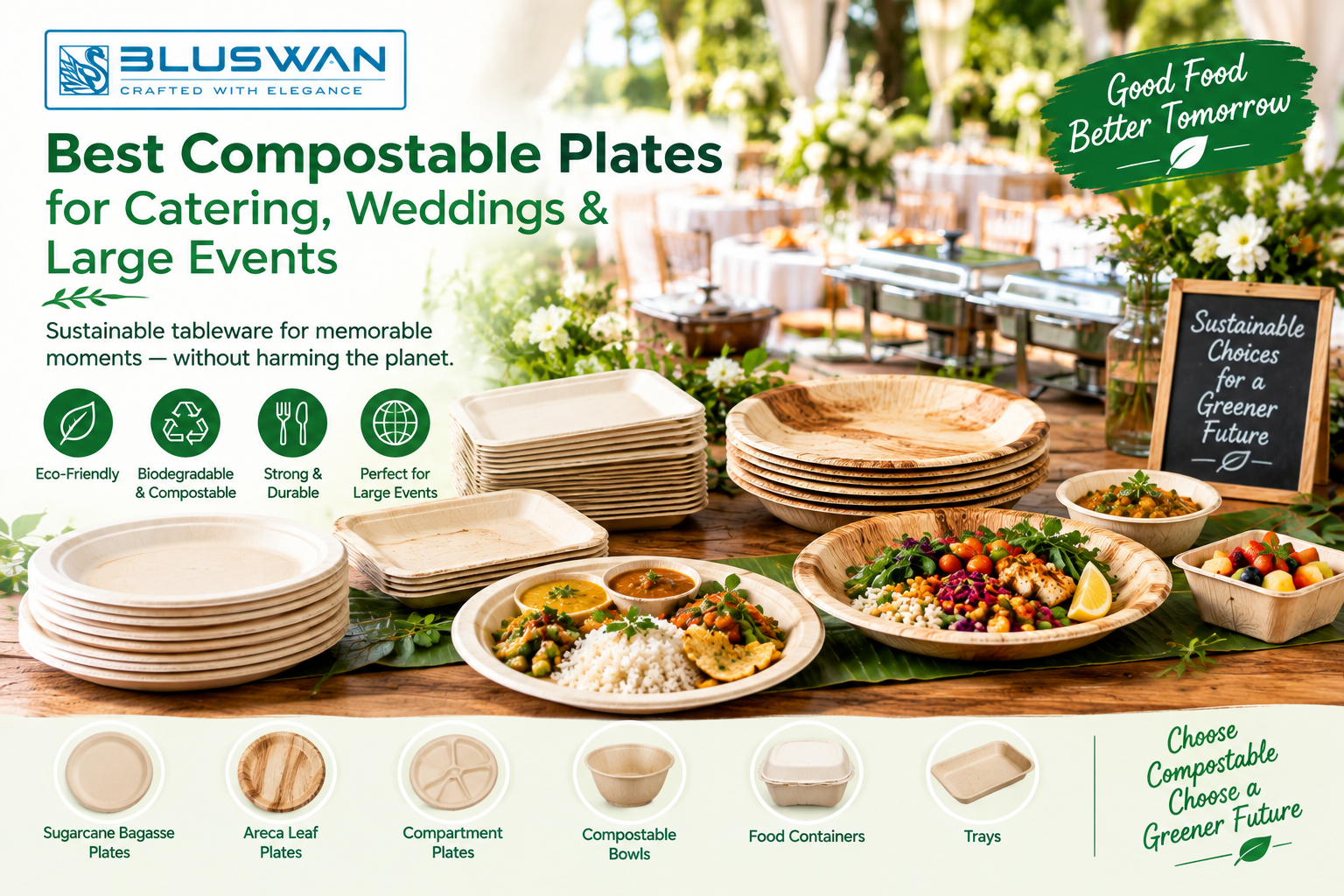
Best Compostable Plates for Catering, Weddings & Large Events Large events create large amounts of food-service waste. Weddings, catering functions, corporate events, festivals, parties, exhibitions, and outdoor gatherings can serve hundreds or even thousands of guests in a single day. Choosing the right tableware is therefore an important part of event planning. Traditional disposable plastic plates have been widely used because they are lightweight, affordable, and convenient. However, growing concerns about plastic waste have encouraged event organizers and catering businesses to explore alternatives. Compostable plates are one option gaining attention among caterers, restaurants, event planners, and businesses looking for more sustainable disposable tableware. Compostable plates can be made from materials such as sugarcane bagasse, areca leaf, and other plant-based or fibre-based materials. Depending on the material and applicable certification, compostable products are designed to break down under specific composting conditions. For large events, the ideal plate needs to offer more than environmental benefits. It should be strong, suitable for the food being served, easy to transport, convenient for guests, and practical to dispose of after the event. In this guide, we explore different types of compostable plates for catering, weddings, and large events, their benefits, applications, and what event organizers should consider before purchasing. What Are Compostable Plates? Compostable plates are disposable plates designed to break down into compostable material under specified composting conditions. They are commonly made from renewable or plant-based materials, including: Sugarcane bagasse Areca palm leaves Paper and natural fibres Agricultural by-products Other certified compostable materials It is important to understand that compostable does not simply mean that a product will disappear anywhere in nature. Many compostable products require particular temperature, moisture, microbial activity, and processing conditions to break down properly. Therefore, event organizers should check the product's certification and disposal instructions before making compostability claims. Why Compostable Plates Are Suitable for Large Events Large events have unique tableware requirements. A small family gathering may need 20 or 30 plates, while a wedding or corporate event may require hundreds or thousands. Reusable plates can create additional requirements for: Washing Water Labour Transportation Storage Collection after the event Disposable compostable plates can provide an alternative where reusable tableware is not practical. They can be particularly useful for: Wedding receptions Outdoor weddings Catering functions Corporate events Birthday parties Festivals Food festivals Community gatherings Religious and cultural events Food stalls Buffets Conferences The right choice depends on the event's food menu, guest count, budget, venue facilities, and waste-management system. 1. Sugarcane Bagasse Plates Sugarcane bagasse is one of the most popular plant-fibre materials used for disposable food-service products. Bagasse is the fibrous residue left after extracting juice from sugarcane. This material can be processed into plates, bowls, trays, and other food-service products. Why Bagasse Plates Work Well for Catering Bagasse plates are available in different shapes and sizes, making them suitable for various menus. They can be used for: Rice meals Curries Snacks Starters Desserts Vegetarian meals Non-vegetarian meals Buffet food Their natural fibre appearance can also give catering setups a clean and modern look. For large events, stackable plate designs can make transportation and storage easier. 2. Areca Leaf Plates Areca leaf plates are made from naturally shed areca palm leaf sheaths. The fallen leaf sheaths can be collected, cleaned, dried, and processed into plates and bowls. Their natural appearance makes them especially popular for events where organizers want a rustic or nature-inspired presentation. Areca Leaf Plates for Weddings Areca leaf plates can be suitable for: Traditional weddings Outdoor weddings Garden parties Eco-conscious events Festivals Catering functions Corporate gatherings They can also complement traditional Indian food presentation because of their earthy appearance. For weddings, event planners should choose the appropriate plate size based on the menu and serving style. 3. Compartment Compostable Plates Large events often serve several dishes together. A compartment plate can separate different food items without requiring multiple plates. For example, one plate can include separate sections for: Rice Curry Vegetables Snacks Salad Dessert This can be especially useful for: Wedding meals Corporate lunches School events Community functions Catering services Compartment plates can also help simplify distribution because guests can receive one plate instead of several separate dishes. 4. Round Compostable Plates Round plates remain a practical choice for many catering applications. They are suitable for both formal and casual events and can be used for a wide range of food items. Round compostable plates can be selected in different sizes according to portion requirements. Smaller plates Suitable for: Snacks Starters Desserts Cakes Fruits Medium plates Suitable for: Light meals Lunch Breakfast Snacks Large plates Suitable for: Full meals Wedding meals Buffet servings Multiple food portions Selecting the correct size helps avoid unnecessary waste and provides guests with enough space for their food. 5. Compostable Bowls for Catering Although plates are the main focus of event tableware, bowls can also be important. Many catering menus include foods that are better served in deeper containers. Compostable bowls can be used for: Soups Desserts Ice cream Curries Rice dishes Salads Snacks Chutneys Using plates and bowls from compatible materials can also create a consistent table setting. Compostable Plates for Indian Weddings Indian weddings often involve large-scale food service. A single wedding can include several food counters, buffet stations, snacks, desserts, beverages, and multiple meals. This means tableware planning needs to be done carefully. For a wedding, organizers should estimate: Number of guests × meals/serving occasions × additional plates required It is also sensible to keep a reasonable additional quantity for unexpected guests, damaged products, or changes in the serving plan. Example If an event has 500 guests and requires one main meal plate per guest, purchasing exactly 500 plates may not provide enough flexibility. The caterer can plan additional stock based on the event's serving arrangements and expected usage. Compostable Plates for Outdoor Events Outdoor events can present different challenges compared with indoor functions. There may be limited access to: Washing facilities Water Storage Waste collection Kitchen infrastructure Disposable compostable tableware can be convenient in such situations. Examples include: Outdoor weddings Food festivals Company picnics Sports events Cultural festivals Community gatherings Open-air parties However, organizers should plan waste collection in advance. Simply using compostable products does not automatically guarantee that they will be composted after the event. What Makes a Good Compostable Plate for Catering? When purchasing compostable plates, environmental claims should not be the only consideration. Here are several important factors. 1. Strength The plate should be strong enough to hold the food being served. For a heavy meal containing rice, curry, vegetables, and meat, a lightweight plate that bends easily may not be appropriate. 2. Size Choose plate sizes according to the menu. Large meals require more space, while desserts and snacks may require smaller plates. 3. Food Compatibility Consider whether the plate is suitable for: Hot food Cold food Oily food Moist food Saucy food Always follow the supplier's product specifications. 4. Certification If a product is marketed as compostable, ask the supplier for relevant certifications and documentation. This helps businesses distinguish verified product claims from general marketing language. 5. Storage Large events may require hundreds or thousands of plates. Choose products that can be stacked and stored efficiently without damage or contamination. 6. Transportation Catering companies often move tableware from warehouses to venues. Lightweight, stackable products can make transportation and handling easier. Compostable Plates vs Traditional Plastic Plates The choice between conventional plastic and compostable tableware involves several factors. Feature Compostable Plates Conventional Plastic Plates Material options Plant fibres and other compostable materials Conventional plastics Appearance Natural/fibre-based options available Plastic appearance Event use Catering, weddings, parties, events General disposable use End-of-life Depends on material and composting facilities Often requires conventional waste management Storage Usually stackable Usually stackable Food suitability Depends on product specification Depends on product specification Environmental claims Should be verified Depends on material and recycling system There is no single product that is perfect for every event. The most appropriate choice depends on the food, venue, budget, local waste system, and product specifications. How Many Compostable Plates Should You Buy? Quantity planning is one of the most important parts of event preparation. Start with: Step 1: Count the guests Determine the expected number of attendees. Step 2: Count serving occasions Will guests eat: Breakfast? Lunch? Dinner? Snacks? Dessert? Step 3: Identify the plate type A main meal may require a large plate, while snacks may require a smaller plate. Step 4: Consider additional requirements Allow for: Extra guests Additional servings Damaged products Staff requirements Separate food counters A catering supplier can also help estimate quantities based on the event menu. How Compostable Plates Can Improve Event Presentation Tableware contributes to the overall appearance of a catering setup. Natural-fibre plates can complement: Wooden tables Outdoor décor Green-themed events Rustic wedding themes Traditional food presentations Eco-conscious corporate events For wedding planners and event organizers, this can create a consistent visual theme from food presentation to décor. Natural tableware can be particularly suitable for events where sustainability is part of the overall theme. Sustainability Does Not End After the Event One of the biggest mistakes businesses can make is assuming that a compostable plate automatically becomes compost after disposal. The actual end-of-life outcome depends on: The product material Certification Collection system Composting facility Local waste-management infrastructure For a large event, organizers should create a simple waste-management plan. For example: Food Waste → Compostable Tableware → Other Waste → Separate Collection Clearly labelled waste bins can help guests and staff dispose of materials correctly. If composting facilities are available, collected compostable products can potentially be directed to the appropriate system according to local requirements. Why Catering Businesses Are Exploring Compostable Tableware Catering companies operate at scale. They regularly manage large quantities of food, packaging, and disposable tableware. For them, compostable products can become part of a broader sustainability strategy. Potential applications include: Wedding catering Corporate catering Hotel events Outdoor catering Festival catering Institutional food service Party catering The key is selecting products that work operationally rather than choosing a product based only on its environmental label. Why Choose Bluswan Indus for Sustainable Tableware? Bluswan Indus offers a range of eco-friendly disposable tableware products designed for food-service and event applications. Its product range includes options such as: Sugarcane bagasse plates Areca leaf plates Bagasse bowls Rice bran plates Wheat bran products Disposable tableware sets These options can be considered by restaurants, caterers, event planners, wedding organizers, and businesses looking for alternatives to conventional disposable tableware. For large events, selecting the right combination of plate sizes, bowls, and serving products can help caterers organize food service according to the menu and guest requirements. Tips for Choosing Compostable Plates for Your Event Before placing a bulk order, consider these practical tips: ✔ Understand your menu Choose tableware according to the type of food being served. ✔ Calculate your guest count Estimate the number of plates required for each meal and serving occasion. ✔ Order samples Test the plate with actual food before making a large purchase. ✔ Check specifications Review size, strength, temperature suitability, and food-contact information. ✔ Ask about certification Verify compostability claims with appropriate documentation. ✔ Plan waste collection Know where used plates will go after the event. ✔ Consider storage Make sure your venue has sufficient clean and dry storage space. ✔ Buy from a reliable supplier A dependable supplier can help with product selection, bulk quantities, and event-specific requirements. The Future of Sustainable Event Tableware The demand for convenient food-service products is unlikely to disappear. Catering, weddings, festivals, corporate events, and outdoor gatherings will continue to need practical tableware. The opportunity is to make better-informed choices about the materials used. Compostable plates can be one part of a broader approach to responsible event planning. The future of event tableware is not only about replacing plastic. It is about choosing products that balance: Functionality + Food Safety + Convenience + Cost + Responsible Disposal When these factors are considered together, event organizers can create a more practical and responsible food-service system. Final Thoughts Choosing tableware for a large event requires careful planning. From sugarcane bagasse plates and areca leaf plates to compartment plates, round plates, and compostable bowls, there are several options available for catering businesses and event organizers. The right choice depends on the menu, guest count, event type, budget, storage requirements, food-contact suitability, certifications, and local disposal facilities. For weddings, catering functions, corporate events, festivals, and large gatherings, compostable plates can provide a convenient alternative to conventional disposable tableware when the products and end-of-life system are appropriate. The most important step is to look beyond the word "compostable" and understand the complete product journey—from material and manufacturing to use and disposal. Plan your event. Choose the right tableware. Serve your guests responsibly. Frequently Asked Questions Are compostable plates good for weddings? They can be suitable for weddings, particularly large or outdoor events where disposable tableware is needed. The plate should be selected according to the food menu and serving requirements. What are compostable plates made from? They can be made from materials such as sugarcane bagasse, areca leaf, paper fibres, agricultural by-products, and other certified compostable materials. Are bagasse plates suitable for catering? Bagasse plates are commonly used for catering and food-service applications. The appropriate product should be selected based on food type, size, strength, and supplier specifications. Are areca leaf plates suitable for weddings? Areca leaf plates can be used for weddings, catering, outdoor events, and traditional food-service applications. Their natural appearance can also complement rustic and nature-inspired event themes. How should compostable plates be disposed of? Disposal depends on the specific product and local waste-management infrastructure. Check the manufacturer's instructions and applicable composting requirements. How do I choose the right plate size for a large event? Consider the menu and portion size. Smaller plates can work for snacks and desserts, while larger plates are generally more appropriate for full meals and buffet servings.
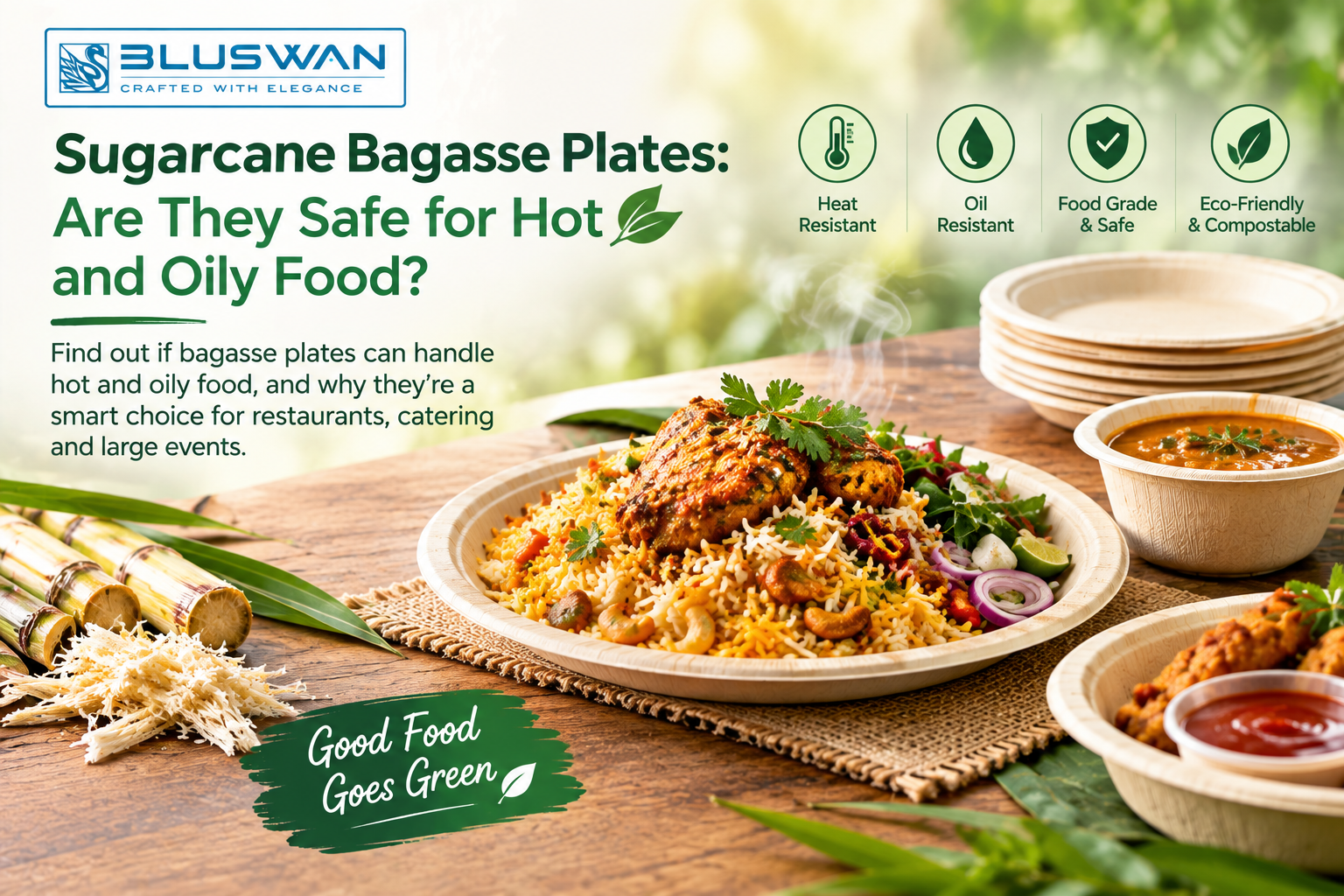
Sugarcane Bagasse Plates: Are They Safe for Hot and Oily Food? Focus Keyword: bagasse plates As restaurants, caterers, food-delivery businesses, and event organizers look for alternatives to conventional plastic tableware, bagasse plates have become a popular option. Made from sugarcane fibre, these plates offer a natural-looking and convenient way to serve food while making use of a by-product of the sugar industry. But one question comes up often: Are sugarcane bagasse plates safe for hot and oily food? The short answer is: many food-grade bagasse plates are designed for hot and oily foods, but safety and performance depend on the specific product, manufacturing process, food-contact compliance, and intended-use instructions. This distinction is important. A plate should not be considered safe simply because it is labelled "bagasse" or "biodegradable." Restaurants and businesses should choose products made specifically for food contact and obtain appropriate compliance documentation from the supplier. India's Food Safety and Standards Authority of India (FSSAI) requires food-contact packaging materials to meet applicable requirements and states that packaging materials should be compatible with their intended use without affecting food quality or safety. FSSAI's regulations also require food-contact packaging materials to meet relevant conformity requirements. Let's look at what bagasse plates are, how they perform with hot and oily foods, and what businesses should check before purchasing them. What Are Sugarcane Bagasse Plates? Sugarcane bagasse is the fibrous material left after sugarcane is crushed to extract its juice. Instead of treating this fibre simply as waste, manufacturers can process it into pulp and mold it into useful products such as: Plates Bowls Food trays Takeaway containers Compartment plates Food-service packaging This makes bagasse an interesting material for disposable food-service products. Research published in Matter described tableware made from sugarcane bagasse and bamboo fibres as biodegradable and suitable for food-packaging applications, with testing showing properties such as oil stability and water resistance in the developed products. The important point is that not every bagasse product is identical. Thickness, fibre composition, molding process, additives, coatings, and manufacturing quality can all affect performance. Are Bagasse Plates Safe for Hot Food? Generally, food-grade bagasse plates that are manufactured and tested for hot-food applications can be suitable for serving hot food. This is one reason bagasse tableware is widely considered for restaurants, catering services, cafeterias, events, and takeaway applications. Hot foods can include: Rice Biryani Pasta Noodles Curries Vegetables Fried foods Grilled foods Snacks However, "hot-food safe" should be treated as a product-specific claim, not a blanket statement about every bagasse plate. Before using a particular plate for very hot food, businesses should check the manufacturer's recommended temperature range and food-contact documentation. The Principal Scientific Adviser's Office of the Government of India describes one biodegradable tableware technology using agricultural waste including sugarcane bagasse as suitable for hot and cold foods and microwave-friendly. This illustrates that appropriately engineered plant-fibre tableware can be designed for hot-food applications. What Happens When Hot Food Is Served on Bagasse Plates? When hot food is placed on a good-quality bagasse plate, the plate is expected to retain its basic shape and provide sufficient strength for normal serving. However, performance depends on several factors: Temperature Extremely hot food may place more stress on disposable tableware than moderately warm food. Moisture Foods containing a lot of water or liquid can affect fibre-based products over time. Contact Time A plate may perform differently when food is served and consumed quickly compared with food that remains on the plate for several hours. Product Thickness A thicker, well-formed plate generally provides different structural performance from a lightweight product. Manufacturing Quality The quality of the raw material, pulping, molding, drying, and finishing processes can affect the final product. This is why restaurants should test samples with the actual foods they serve before placing large orders. Are Bagasse Plates Safe for Oily Food? Oily food is another important consideration. Indian and international cuisines include many dishes containing oils, sauces, butter, and fats. Examples include: Fried chicken Biryani Butter chicken Paneer butter masala Fried rice Samosas French fries Curries Pizza Grilled foods Some bagasse products are engineered to provide good resistance to oils and moisture. A peer-reviewed study on bagasse-based tableware reported that its developed tableware had strong oil stability and hydrophobicity, demonstrating that bagasse fibre products can be engineered for food-service requirements. However, this research does not mean every bagasse plate on the market has identical performance. Businesses should therefore ask suppliers for product-specific specifications and testing information. Why Oil Resistance Matters When oily food remains on a fibre-based plate, the oil can interact with the material. A suitable food-service plate should maintain its structure long enough for normal eating or serving. Poor-quality tableware may: Become soft Lose rigidity Bend under weight Absorb liquids Allow leakage Become difficult to handle For catering businesses, this can create a poor customer experience. For this reason, oil resistance should be considered alongside strength, moisture resistance, temperature performance, and food-contact compliance. Can Bagasse Plates Handle Curry and Gravy? This is one of the most common questions for Indian restaurants and caterers. Many food-grade bagasse plates are designed for foods containing moisture, sauces, and oils. But performance varies between products. For dishes such as: Sambar Dal Chicken curry Paneer curry Gravy Saucy pasta Rice with curry the plate should be tested under realistic serving conditions. For particularly liquid-heavy dishes, a bagasse bowl or deeper compartment plate may be more appropriate than a shallow plate. The best product depends on: Food type + temperature + quantity + contact time + plate design What Does Food-Grade Mean? "Food-grade" generally means that a material or product is intended and suitable for contact with food when used under the specified conditions. For food businesses, this is a particularly important distinction. FSSAI's packaging regulations state that packaging materials intended to come into contact with food must meet applicable requirements, and materials should be compatible with their intended use so that they do not compromise the quality or safety of food. Therefore, restaurants should not select disposable plates solely because they look natural or are advertised as eco-friendly. Instead, ask: Is the product intended for food contact? Does the supplier provide compliance documentation? What temperature range is recommended? Is it suitable for oily foods? Is it suitable for liquid foods? Are there any restrictions on microwave use? What certifications or laboratory reports are available? Are Bagasse Plates Free From Harmful Chemicals? It is not accurate to say that every bagasse plate is automatically free from all potentially concerning substances. The final product depends on manufacturing practices and any substances used during processing or finishing. A recent study examining 22 commercial sugarcane pulp tableware products found varying levels of total fluorine and detected occasional PFOA residues in some samples, while measured migration of the targeted PFAS compounds under the study's simulated conditions was low. The researchers concluded that manufacturing quality control remains important. Another study of sugarcane pulp takeaway containers reported migration and microparticle concerns under certain acidic-food test conditions, highlighting why food-contact materials should be assessed according to their intended use rather than assumed to be universally safe. This is an important lesson for buyers: Choose verified food-contact products rather than relying only on the word "natural" or "biodegradable." Are Bagasse Plates Better Than Plastic Plates? The answer depends on what you mean by "better." From a material perspective, bagasse uses a plant-derived fibre stream from sugarcane processing, while conventional plastic tableware is made from petrochemical-derived polymers. Bagasse can therefore offer an alternative for businesses seeking plant-fibre tableware. However, environmental performance should be evaluated across the full life cycle, including: Raw materials Manufacturing Transportation Product use Waste collection Composting or disposal A biodegradable product does not automatically have the same environmental outcome in every location. The disposal infrastructure available to the business also matters. Benefits of Bagasse Plates for Restaurants For food-service businesses, bagasse plates can offer several practical advantages. 1. Plant-Fibre Material Bagasse comes from sugarcane fibre, making it different from conventional plastic tableware. 2. Suitable for Many Food Applications Depending on the product specification, bagasse plates can be used for hot, cold, moist, and oily foods. 3. Lightweight Disposable fibre plates can be easier to transport and handle than heavier reusable tableware. 4. Stackable Many bagasse plates are designed to stack efficiently, which can simplify storage. 5. Different Sizes Businesses can select different sizes according to their menu and portion requirements. 6. Natural Appearance The fibre texture can provide a clean, natural appearance for catering and events. 7. Suitable for Large Events Bagasse plates can be considered for: Weddings Catering Corporate events Festivals Parties Food stalls Outdoor events Bagasse Plates for Restaurants and Catering Restaurants have different requirements from household users. A restaurant may serve hundreds of meals every day, making reliability extremely important. Before choosing bagasse plates, businesses should test them with their actual menu. For example: Dry Foods Rice, bread, snacks, and dry meals are generally easier to serve. Oily Foods Test the plate with fried food, oily curries, and sauces. Liquid Foods Consider deeper bowls or containers for soups and heavily liquid dishes. Heavy Meals Test whether the plate remains rigid when loaded with the restaurant's normal serving size. This simple testing process can prevent problems after a bulk purchase. How to Choose the Right Bagasse Plate Here are some practical points to check. 1. Check the Product Specification Look for information about intended food applications and temperature limitations. 2. Ask for Food-Contact Documentation Request relevant certificates, conformity reports, or laboratory documentation from the supplier. 3. Test Hot Food Place the actual hot food served by your restaurant on a sample plate. 4. Test Oily Food Use oily curries, fried food, or sauces to evaluate the product. 5. Test Holding Time Don't only test the plate for five minutes. If customers normally take 30–60 minutes to eat, test under realistic conditions. 6. Check Strength Load the plate with a normal serving and see whether it bends or becomes difficult to carry. 7. Check Storage Make sure the plates can be stored in a clean, dry area. What About Microwaving Bagasse Plates? Microwave suitability is product-specific. Some plant-fibre tableware products are designed and tested for microwave use, while others may not be. Therefore, never assume that every bagasse plate is microwave-safe. The Government of India's Principal Scientific Adviser's Office lists a particular biodegradable tableware technology made using agricultural waste as microwave- and food-safe, but this should not be generalized to every bagasse product available on the market. Always follow the manufacturer's instructions. Are Bagasse Plates Compostable? Many bagasse products are marketed as compostable or biodegradable, but the exact claim depends on the product and certification. Compostability can also depend on the composting environment. Some products are designed for industrial or commercial composting rather than ordinary household composting. Therefore, businesses should check: Compostability certification Required composting conditions Disposal instructions Local composting facilities Whether coatings or additives are present A clear disposal plan is particularly important for restaurants and large events. Why Bluswan Indus Uses Bagasse Tableware Bluswan Indus offers sugarcane bagasse plates and other sustainable tableware products for food-service applications. Its product range includes different plate formats and sizes designed for restaurants, catering businesses, events, and other food-service requirements. For businesses looking to move away from conventional disposable tableware, bagasse can be considered alongside other plant-based options such as areca leaf and rice-bran products. The important step is selecting the correct product according to the food, temperature, serving method, and disposal requirements. Final Verdict: Are Bagasse Plates Safe for Hot and Oily Food? Food-grade bagasse plates can be suitable for hot and oily foods when they are specifically manufactured, tested, and labelled for those applications. However, the phrase "bagasse plate" alone is not enough to guarantee safety or performance. Restaurants and catering businesses should verify: Food-contact suitability Temperature limits Oil and moisture resistance Product strength Applicable certifications Laboratory or conformity documentation Manufacturer instructions Scientific research shows that bagasse can be engineered into food-contact tableware with useful strength, water resistance, and oil resistance. At the same time, research on commercial sugarcane-pulp products has identified cases where chemical residues or migration issues warrant stronger manufacturing controls. So, the smartest approach is not simply to ask "Are bagasse plates safe?" Instead, ask: "Is this particular bagasse plate tested and suitable for the food I want to serve?" That question helps restaurants make a much more informed purchasing decision. Frequently Asked Questions 1. Can bagasse plates hold hot food? Yes, many food-grade bagasse plates are designed for hot-food service. Always check the specific manufacturer's temperature and usage specifications. 2. Can I serve oily food on bagasse plates? Many bagasse plates are designed to handle oily foods, but oil resistance varies between products. Test the specific plate with your food before bulk purchasing. 3. Can bagasse plates hold curry? Suitable bagasse plates can be used for many curry-based foods. For foods with a lot of liquid, a deeper plate, compartment plate, or bagasse bowl may be more appropriate. 4. Are bagasse plates food-safe? Food-grade bagasse tableware can be suitable for food contact when manufactured and tested according to applicable requirements. Buyers should request relevant compliance documentation. 5. Are bagasse plates microwave-safe? Some products are specifically designed and tested for microwave use, but this cannot be assumed for every bagasse plate. Follow the manufacturer's instructions. 6. Are bagasse plates biodegradable? Many bagasse products are designed to be biodegradable or compostable, but the exact claim depends on the product, certification, and disposal conditions. 7. Are bagasse plates suitable for restaurants? Yes. Depending on their specifications, bagasse plates can be used in restaurants, catering, food delivery, weddings, corporate events, and other food-service applications. 8. What should I check before buying bagasse plates? Check food-contact compliance, temperature suitability, oil resistance, strength, size, certifications, storage requirements, and disposal instructions.
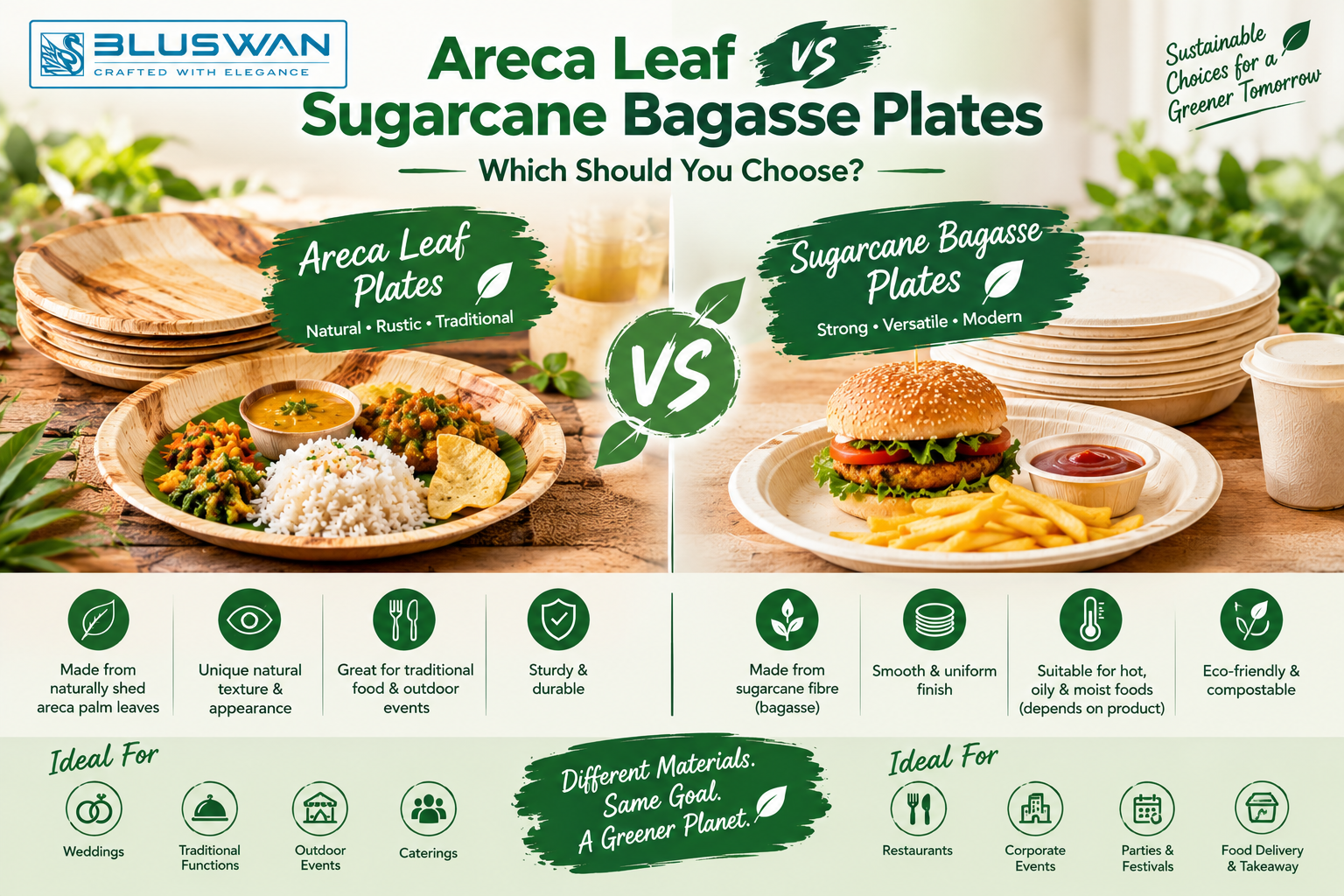
Areca Leaf vs Sugarcane Bagasse Plates: Which Should You Choose? When restaurants, caterers, event organizers, and businesses look for alternatives to conventional disposable plastic plates, two popular options often come up: areca leaf plates and sugarcane bagasse plates. Both are plant-based tableware options with different materials, manufacturing processes, appearances, and practical characteristics. Choosing between them is not simply about deciding which one is "better." The right option depends on the type of food, event, presentation, quantity, budget, storage, and disposal system. So, areca leaf vs. bagasse — which should you choose? In this guide, we compare both options in detail to help restaurants, caterers, wedding planners, event organizers, and food-service businesses make a more informed choice. What Are Areca Leaf Plates? Areca leaf plates are made from the naturally shed leaf sheaths of areca palm trees. The fallen leaf sheaths can be collected, cleaned, dried, and processed into different shapes and sizes of plates, bowls, and serving products. One of the most recognizable features of areca leaf tableware is its natural appearance. The plates often retain variations in colour and texture because they are made from natural leaf material. Areca leaf plates are commonly considered for: Weddings Traditional functions Outdoor events Catering Restaurants Parties Festivals Corporate events Eco-conscious gatherings Their natural texture can work particularly well with traditional Indian food and rustic or nature-inspired event themes. What Are Sugarcane Bagasse Plates? Sugarcane bagasse is the fibrous material that remains after sugarcane is processed for juice extraction. This fibre can be processed into pulp and molded into food-service products such as: Plates Bowls Trays Food containers Compartment plates Takeaway packaging Bagasse plates usually have a clean, uniform appearance and can be manufactured in different shapes and sizes. They are widely considered for restaurants, catering businesses, food delivery, cafeterias, events, and takeaway applications. Areca Leaf vs Bagasse: Quick Comparison Feature Areca Leaf Plates Sugarcane Bagasse Plates Main material Naturally shed areca palm leaf sheaths Sugarcane fibre Appearance Natural, rustic, textured Smooth, molded, uniform Product options Plates and bowls Plates, bowls, trays, containers Food applications Dry, moist and suitable food applications depending on product Hot, moist and oily foods depending on product specifications Design options Natural shapes and textures Many molded shapes and compartments Events Weddings, traditional functions, outdoor events Weddings, catering, restaurants, corporate events Storage Stackable depending on design Generally stackable Presentation Rustic and natural Clean and modern Sustainability Plant-based material Plant-based fibre material Best choice Natural event presentation Versatile food-service applications The comparison above is a general guide. Actual performance depends on the individual product, manufacturing process, specifications, and intended use. 1. Material Difference The biggest difference between the two products is their raw material. Areca Leaf Areca plates use naturally shed areca palm leaf sheaths. The material is collected after naturally falling from the palm and then processed into tableware. Bagasse Bagasse comes from sugarcane processing. The fibrous residue left after juice extraction can be converted into pulp and molded into disposable tableware. Both approaches make use of plant-based materials, but they involve different manufacturing processes. 2. Appearance and Presentation Appearance can be an important consideration for weddings, restaurants, and events. Areca Leaf Plates Areca leaf plates have a distinctive natural appearance. They can feature: Natural grain patterns Brown or beige tones Unique textures Slight variations between individual products This makes them particularly attractive for rustic, traditional, outdoor, and nature-themed events. Bagasse Plates Bagasse plates generally have a more consistent appearance. They can be produced with: Smooth surfaces Uniform shapes Raised edges Compartments Different sizes This makes bagasse suitable for modern catering and restaurant environments where consistency is important. 3. Which Is Better for Hot Food? Both areca leaf and bagasse products can be designed for food-service use, but the exact performance depends on the product. Restaurants serving hot food should always check the supplier's specifications. Foods may include: Rice Biryani Curries Vegetables Fried foods Pasta Noodles Snacks A high-quality food-service plate should maintain sufficient structural integrity under its intended conditions. However, it is important not to assume that every areca leaf or bagasse plate has the same heat resistance. Always check the manufacturer's recommended temperature range and intended use. 4. Which Is Better for Oily Food? Oil resistance is another important consideration for restaurants and caterers. Many Indian foods contain significant amounts of oil, sauces, or gravy. Examples include: Butter chicken Paneer curry Biryani Fried chicken Samosas French fries Curries Fried rice Bagasse tableware can be manufactured to provide resistance to moisture and oils, making suitable products useful for many food-service applications. Areca leaf plates can also be used for various moist and oily foods when the specific product is designed for those applications. The best approach is to test the actual plate with the actual food before purchasing large quantities. 5. Which Is Better for Weddings? For weddings, the choice often depends on the style of the event. Choose Areca Leaf When: You want a natural look The wedding has a traditional theme You are hosting an outdoor event Rustic decoration is part of the theme You want visible natural textures Areca leaf plates can complement traditional Indian meals and natural event décor. Choose Bagasse When: You need uniform plate designs You want different plate sizes You need compartment plates The caterer serves multiple food varieties You prefer a clean, modern presentation For large weddings, both can be useful depending on the food and event design. 6. Which Is Better for Restaurants? Restaurants usually focus heavily on practicality. They may need tableware that is: Easy to store Easy to transport Strong Suitable for their menu Consistent in size Available in bulk Easy to dispose of Bagasse can offer a broad range of molded products, including plates, bowls, trays, and takeaway containers. This makes it useful for restaurants with diverse menus. Areca leaf products can be particularly attractive for restaurants that want a natural or traditional presentation. The choice should therefore be based on the restaurant's actual menu and serving style. 7. Which Is Better for Catering? Catering businesses often need to serve large numbers of people quickly. A catering company may need: Hundreds or thousands of plates Multiple plate sizes Bowls Trays Compartment plates Food containers Bagasse products can be useful because they are available in many molded formats. Areca leaf plates can also work well for catering, particularly where natural presentation is important. For a large catering order, the supplier should be able to provide consistent product quality and sufficient quantities. 8. Areca Leaf vs Bagasse for Food Delivery Food delivery creates different packaging requirements. A delivery container may need to deal with: Heat Moisture Oil Sauces Transportation Handling Storage Bagasse is commonly available in food-container and takeaway formats, which can make it suitable for certain delivery applications. Areca leaf products are more commonly associated with plates and bowls, although the exact product range varies by supplier. For food delivery, businesses should choose products specifically designed for takeaway use rather than assuming a disposable plate will work as a delivery container. 9. Strength and Durability Strength is important for both products. Imagine a customer carrying a plate filled with: Rice Curry Vegetables Dal Fried food The plate needs to remain stable during normal use. Bagasse plates can be molded into different thicknesses and structural designs. Areca leaf plates have their own natural fibre structure and can provide a sturdy serving surface when properly manufactured. However, strength can vary significantly between products. Before placing a bulk order, test: The empty plate A normal food serving Hot food Moist food Oily food Longer holding time This is more reliable than choosing based only on the material name. 10. Which Looks More Premium? This depends on the type of event. Areca Leaf Areca leaf products often have a natural and handcrafted appearance. They can work well for: Premium outdoor events Traditional weddings Farm-to-table restaurants Eco-themed events Rustic celebrations Bagasse Bagasse products can provide a clean and professional appearance. They are often suitable for: Restaurants Corporate events Catering Food festivals Cafeterias Takeaway businesses Neither material automatically makes an event look more premium. The overall presentation, food, décor, and table setting all contribute. 11. Which Is More Environmentally Friendly? This question requires some care. Both are made from plant-based materials, but you can't determine environmental performance simply by looking at the raw material. A proper comparison can consider: Source of raw material Manufacturing process Energy consumption Water use Transportation Product lifespan Waste collection Composting or disposal For compostable products, the availability of appropriate composting infrastructure is also important. A product labelled biodegradable or compostable should therefore be evaluated according to its certification and disposal requirements. For businesses, it is better to make specific, verified environmental claims rather than assuming that every plant-based product has the same environmental impact. 12. Which Is Easier to Store? Storage is particularly important for caterers. Both areca leaf and bagasse plates can be supplied in stackable formats. However, storage efficiency depends on: Plate shape Plate thickness Packaging Quantity Box dimensions Warehouse space Bagasse products with standardized shapes can be convenient for businesses that need large quantities of uniform tableware. Areca leaf plates may have more natural variation in appearance and shape. For large orders, always check carton dimensions and stacking requirements before delivery. 13. Which Is More Cost-Effective? Price can vary depending on: Product size Material Thickness Shape Quantity Manufacturing quality Supplier Transportation Packaging Therefore, there is no universal answer that one material is always cheaper. Restaurants and caterers should compare the total cost per usable serving, rather than simply comparing the price of one plate. For example, a cheaper plate may not be economical if it is too small, too weak, or unsuitable for the food being served. How to Choose Between Areca Leaf and Bagasse Here is a simple decision guide. Choose Areca Leaf If You Want: ✔ Natural appearance ✔ Rustic presentation ✔ Traditional event styling ✔ Outdoor wedding tableware ✔ Natural leaf texture ✔ Plates and bowls with a distinctive look Choose Bagasse If You Want: ✔ Consistent shapes ✔ Multiple sizes ✔ Compartment plates ✔ Plates, bowls and trays ✔ Food-service versatility ✔ Restaurant and catering applications ✔ Modern presentation Why Bluswan Indus Offers Both Options Bluswan Indus provides sustainable tableware options including areca leaf plates and sugarcane bagasse products. Offering different materials gives restaurants, caterers, and event organizers the flexibility to select products according to their specific requirements. For example: Wedding → Areca leaf plates for natural presentation Restaurant → Bagasse plates for consistent food service Outdoor event → Either option depending on menu and event theme Catering → Bagasse plates, compartment plates, bowls, or areca leaf products depending on the food The most important factor is matching the product to the actual application. Areca Leaf vs Bagasse: What Should You Choose? There is no single answer for every business. If your priority is natural appearance and traditional presentation, areca leaf plates may be a suitable option. If your priority is product variety, uniformity, and versatile food-service formats, bagasse may be more suitable. For many businesses, the decision can be as simple as matching the material to the event: Natural & Traditional → Areca Leaf Modern & Versatile → Bagasse However, businesses should still check product specifications, food-contact suitability, certifications, temperature limits, and disposal requirements before purchasing. Final Thoughts The areca leaf vs bagasse comparison is not about finding one material that works for everyone. Both materials have different characteristics and can serve different food-service needs. Areca leaf plates offer a natural, distinctive appearance that can work particularly well for weddings, traditional functions, outdoor events, and nature-inspired celebrations. Sugarcane bagasse plates provide a molded plant-fibre option available in various shapes and formats, making them useful for restaurants, catering companies, food-service businesses, and large events. Before making your choice, consider: Type of food Hot or cold serving Moisture and oil content Event type Plate size Strength Presentation Storage Quantity Budget Food-contact requirements Disposal facilities The best tableware is ultimately the one that matches your food, event, operational needs, and responsible disposal plan. Whether you choose the natural character of areca leaf or the versatility of sugarcane bagasse, selecting the right product can help create a practical and attractive food-service experience. Frequently Asked Questions 1. Are areca leaf plates better than bagasse plates? Neither is universally better. Areca leaf can be attractive for natural and traditional events, while bagasse offers a wide range of molded food-service products. 2. Are bagasse plates suitable for hot food? Many food-grade bagasse plates are designed for hot-food applications, but temperature suitability should always be confirmed with the supplier. 3. Can areca leaf plates be used for oily food? Suitable areca leaf plates can be used for many food-service applications, but businesses should verify the product specifications and test it with their actual menu. 4. Which is better for weddings? Areca leaf works well for natural or traditional wedding themes, while bagasse is useful when you need consistent sizes and different plate formats. 5. Which is better for catering? Both can be used for catering. The choice depends on the food, presentation, quantity, and product specifications. 6. Are both areca leaf and bagasse biodegradable? Both are plant-based materials, but businesses should verify the specific product's biodegradability or compostability claims and disposal requirements. 7. Can I use bagasse and areca leaf products at the same event? Yes. Businesses can select different tableware products for different food items or serving areas based on their requirements.
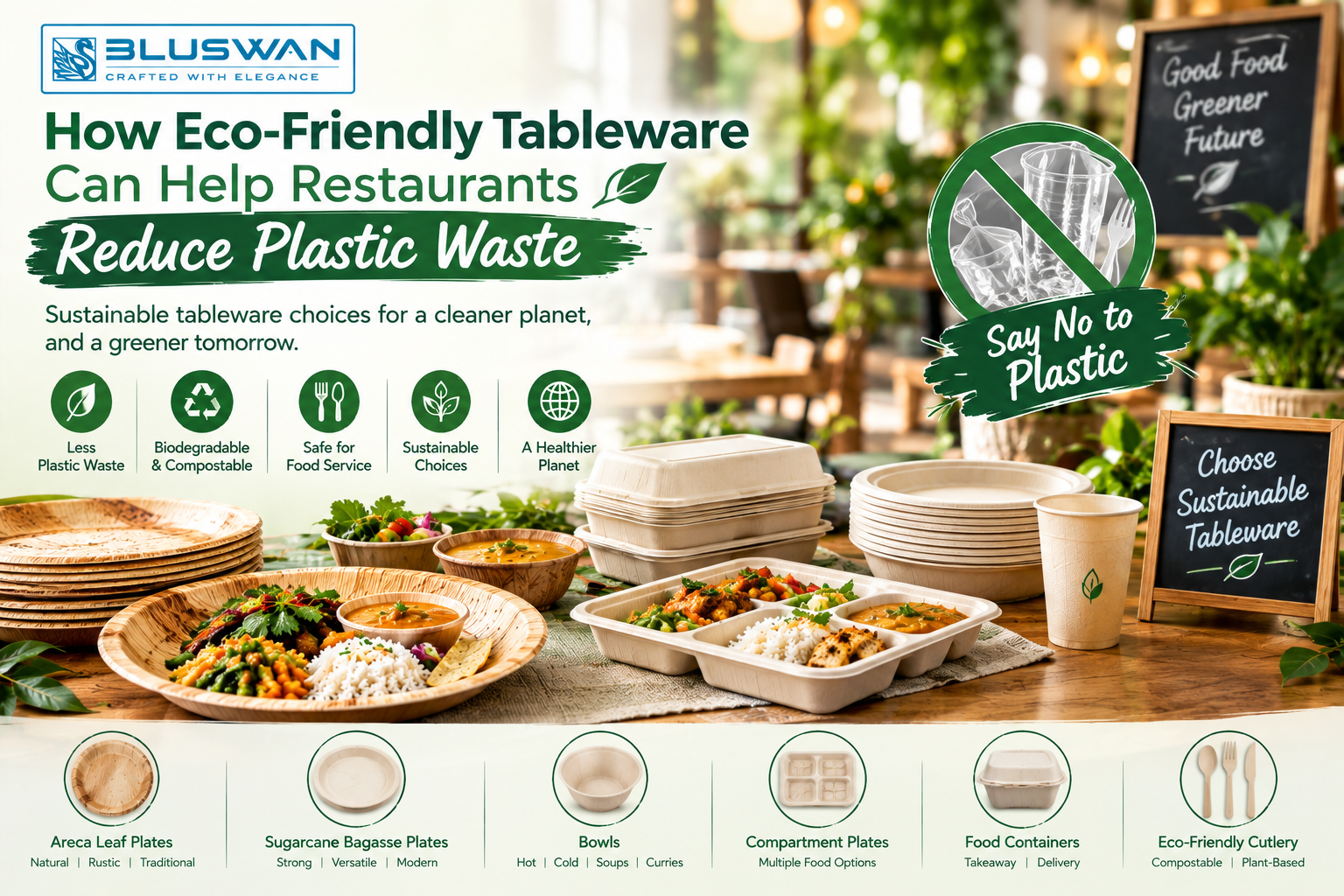
How Eco-Friendly Tableware Can Help Restaurants Reduce Plastic Waste Restaurants serve food every day, and with every meal comes a packaging and tableware decision. From plates and bowls to takeaway containers, spoons, cups, and trays, food-service businesses can generate a large amount of disposable waste. For many years, conventional plastic products were widely used because they were lightweight, convenient, and inexpensive. However, growing concerns about plastic pollution and changing regulations have encouraged restaurants to explore different materials. One option is eco-friendly tableware. Eco-friendly tableware can include products made from plant-based fibres and other materials, such as sugarcane bagasse, areca leaf, rice bran, wheat bran, paper, and certified compostable materials. Depending on the product, these alternatives can help restaurants reduce their dependence on conventional single-use plastics. In India, several identified single-use plastic items—including plastic plates, cups, glasses, cutlery, and trays—have been prohibited since July 1, 2022. The Central Pollution Control Board publishes guidance and information on the implementation of these restrictions. But switching tableware is not simply about replacing plastic with another disposable product. Restaurants also need to consider food safety, durability, cost, customer experience, waste collection, and the actual end-of-life options available in their location. Let's explore how eco-friendly tableware can help restaurants reduce plastic waste and how businesses can choose suitable products. What Is Eco-Friendly Tableware? Eco-friendly tableware generally refers to plates, bowls, trays, containers, cups, and other food-service products designed with environmental considerations in mind. Depending on the product, materials can include: Sugarcane bagasse Areca palm leaves Rice bran Wheat bran Paper Wood or bamboo Other plant-based fibres Certified compostable materials These materials are not identical. Their environmental performance depends on how they are sourced, manufactured, transported, used, collected, and disposed of. For restaurants, the most useful approach is to choose products based on their actual application and verified product specifications, rather than relying only on terms such as "green," "natural," or "eco-friendly." Why Should Restaurants Reduce Plastic Waste? Plastic has played an important role in modern food service because it is lightweight, durable, and convenient. However, single-use plastic products can become a waste-management challenge when they are used in large quantities. Think about a busy restaurant. A single takeaway order might use: One food container One lid One spoon One fork One sauce container One carry bag Additional wrapping Now multiply that by hundreds of orders every day. The amount of disposable material can quickly become significant. Reducing unnecessary plastic use can therefore be part of a restaurant's broader waste-reduction strategy. 1. Eco-Friendly Tableware Can Reduce Reliance on Conventional Plastic One of the simplest ways a restaurant can change its waste profile is to review the disposable products it uses. Instead of automatically purchasing conventional plastic plates and containers, businesses can investigate suitable alternatives. For example: Sugarcane Bagasse Bagasse is the fibrous residue left after sugarcane juice extraction. It can be processed into plates, bowls, trays, and food containers. Areca Leaf Areca leaf tableware is made from naturally shed areca palm leaf sheaths and can be shaped into plates and bowls. Agricultural Fibre Products Materials such as rice bran and wheat bran can also be used in certain disposable food-service products. The right choice depends on the restaurant's menu and operational requirements. 2. Restaurants Can Choose Tableware Based on Their Menu Not every restaurant needs the same type of tableware. A restaurant serving biryani may have different requirements from a café serving sandwiches. Similarly, a dessert shop may need different products from a catering business. For Rice and Meals Larger plates or compartment plates can be useful. For Curries Deeper bowls or suitable food containers may be more practical. For Snacks Smaller plates can reduce unnecessary material use. For Takeaway Food containers with appropriate lids are generally more suitable. Choosing the right size and format can help businesses avoid using oversized packaging for smaller portions. 3. Bagasse Tableware Offers a Plant-Fibre Alternative Sugarcane bagasse is one of the commonly used materials in sustainable food-service tableware. The material comes from sugarcane fibre left after juice extraction. It can be molded into: Round plates Compartment plates Bowls Trays Food containers For restaurants, bagasse can be useful because different product formats can accommodate different foods. For example, a restaurant could use a larger plate for a complete meal and a smaller plate for snacks or desserts. The important point is to select food-contact products that meet applicable requirements and are appropriate for their intended use. 4. Areca Leaf Tableware Provides Another Option Areca leaf plates offer a different approach. The plates are made from naturally shed areca palm leaf sheaths. Their natural texture and appearance can make them suitable for restaurants and events that want a distinctive presentation. They can be considered for: Traditional restaurants Outdoor dining Weddings Catering Events Parties Food festivals For businesses that want natural-looking tableware, areca leaf can provide an alternative to conventional plastic plates. 5. Eco-Friendly Tableware Can Improve the Customer Experience Customers don't only experience the food. They also experience: The plate The packaging The presentation The cleanliness The convenience The disposal process Natural-fibre tableware can provide a different visual experience compared with conventional plastic. For example, an areca leaf plate can complement a traditional Indian meal, while a clean molded bagasse plate can work well in a modern café or catering setup. Packaging and tableware can therefore become part of a restaurant's overall presentation. 6. It Can Support a Restaurant's Sustainability Goals Many businesses now include waste reduction as part of their sustainability planning. Changing disposable tableware can be one practical step. However, restaurants should avoid treating one product switch as a complete sustainability strategy. A broader approach could include: Reduce → Reuse → Replace → Recycle/Compost Where Appropriate For example, a restaurant can first identify unnecessary packaging, then consider reusable options where practical, and use suitable alternative materials for products that genuinely need to be disposable. This approach can be more effective than simply replacing every plastic product with another disposable product. 7. Food Safety Should Always Come First Environmental considerations should never replace food safety. Any tableware that comes directly into contact with food should be appropriate for that intended use. FSSAI's Packaging Regulations define food-grade material as material that is safe and suitable for its intended use and should not endanger human health or cause unacceptable changes to food. The regulations also address packaging materials that come directly into contact with food. The regulations further state that food-contact packaging materials should be compatible with their intended use, and they include conformity requirements for packaging materials that come into contact with food. Therefore, restaurants should ask suppliers for appropriate product documentation before making bulk purchases. 8. Choose the Right Tableware for Hot and Oily Foods Indian and international restaurant menus often include hot and oily foods. Examples include: Biryani Curries Fried chicken Noodles Pasta Samosas French fries Rice dishes Gravies Not every eco-friendly product performs identically. Restaurants should check: Temperature suitability Oil resistance Moisture resistance Strength Recommended holding time Food-contact compliance The best practice is to test samples with the actual food served by the restaurant. A plate that performs well with dry snacks may not be appropriate for a heavy curry. 9. Eco-Friendly Tableware Can Be Useful for Takeaway and Delivery Food delivery has increased the importance of packaging decisions. A takeaway package needs to protect food during: Kitchen → Packing → Transportation → Delivery → Customer During this process, packaging may experience: Heat Moisture Oil Pressure Movement Handling Restaurants should therefore choose containers based on the food they deliver. For example, a curry-based meal may require a leak-resistant container, while sandwiches may require a different format. Bagasse containers and other fibre-based products can be considered where they meet the restaurant's specific performance requirements. 10. Proper Disposal Is Just as Important One common misunderstanding is that a product labelled biodegradable or compostable will automatically disappear after it is thrown away. That is not necessarily the case. The end-of-life outcome depends on: Material Product certification Composting conditions Collection system Local waste infrastructure For example, some compostable products require specific commercial or industrial composting conditions. Restaurants should therefore understand the disposal instructions for the products they purchase. Create Separate Waste Collection Areas Restaurants can also improve waste management by creating clearly identified collection points. For example: Food Waste Leftover food and organic waste. Compostable Tableware Where suitable collection and composting facilities exist. Recyclable Materials Materials that can enter an appropriate recycling stream. Other Waste Materials that cannot be reused, recycled, or composted through the available system. Clear signage can help employees and customers understand where different materials should go. 11. Reduce Unnecessary Packaging Switching to eco-friendly tableware is only one part of reducing plastic waste. Restaurants should also examine whether they are using more packaging than necessary. Ask questions such as: Does every takeaway order need plastic cutlery? Does every sauce need a separate container? Can customers choose whether they need cutlery? Can multiple items be packed together? Is unnecessary wrapping being used? Can reusable systems work for dine-in customers? Reducing packaging at the source can be more effective than simply changing the material. 12. Train Restaurant Employees Even good packaging systems can fail if employees don't understand them. Restaurant staff should know: Which products are disposable Which products are reusable Which products are compostable Where different waste goes Which containers are suitable for specific foods How to store tableware safely Short training sessions can help reduce mistakes and improve consistency. 13. Buy From Reliable Suppliers The supplier is an important part of the decision. Before purchasing large quantities, restaurants should ask for: Product specifications Food-contact documentation Relevant certifications Material information Temperature guidelines Storage instructions Disposal information Sample products This is particularly important when a product is advertised as biodegradable, compostable, food-safe, or chemical-free. A reliable supplier should be able to explain what the product is made from and how it is intended to be used. 14. Compare Total Cost, Not Just Product Price Eco-friendly tableware may sometimes have a different purchase price from conventional disposable products. Restaurants should therefore evaluate the total cost of use. Consider: Price per unit Quantity required Product strength Storage Transportation Customer experience Waste-management costs Packaging requirements A cheaper plate may not be economical if it breaks easily or is unsuitable for the restaurant's menu. Similarly, a slightly more expensive product may make operational sense if it performs better for the intended application. 15. Start With One Part of the Restaurant Restaurants do not necessarily need to change every product immediately. A practical approach is to start with one category. For example: Step 1: Replace conventional disposable plates. Step 2: Test the new plates with the restaurant's menu. Step 3: Collect staff and customer feedback. Step 4: Review waste and operational performance. Step 5: Consider changing additional products. This gradual approach allows businesses to identify what works before committing to a large-scale change. How Bluswan Indus Supports Eco-Friendly Tableware Needs Bluswan Indus offers a range of eco-friendly disposable tableware products, including options made from materials such as sugarcane bagasse, areca leaf, rice bran, and wheat bran. Its product range can be considered by: Restaurants Catering businesses Cloud kitchens Food-service companies Event organizers Wedding planners Corporate event teams Different materials and product formats can help businesses choose tableware according to their food-service requirements. For restaurants considering a switch, the best starting point is to identify the products currently generating the most plastic waste and evaluate suitable alternatives. A Simple Plan for Restaurants to Reduce Plastic Waste Restaurants can follow a simple five-step approach. Step 1: Audit List all disposable plastic products used every week. Step 2: Identify Find products that can realistically be replaced or eliminated. Step 3: Test Order samples of suitable alternatives and test them with actual food. Step 4: Implement Introduce the selected products gradually. Step 5: Measure Track product usage, waste, cost, customer feedback, and operational issues. This turns sustainability into a measurable business process rather than simply a marketing message. Common Mistakes to Avoid Choosing Products Only Because They Look Green Natural appearance does not automatically prove environmental performance. Ignoring Food Safety Every food-contact product should be suitable for its intended use. Assuming Biodegradable Means Compostable These terms are not interchangeable. Buying in Bulk Without Testing Always test products with the actual menu first. Ignoring Disposal A compostable product needs an appropriate end-of-life pathway to deliver its intended composting benefit. Using Larger Products Than Necessary Choosing the correct size can help reduce material use. The Future of Restaurant Tableware Restaurants will continue to need convenient, hygienic, and practical tableware. The question is increasingly about how businesses can meet those needs while reducing unnecessary plastic and improving waste management. Eco-friendly tableware can be one part of that transition. Plant-based materials such as sugarcane bagasse and areca leaf offer alternatives for certain applications, while reusable systems, waste reduction, recycling, and responsible procurement can complement the change. The strongest approach is not simply to replace one disposable product with another. It is to examine the entire food-service system and identify where material use can be reduced. Final Thoughts Eco-friendly tableware can help restaurants reduce their reliance on conventional single-use plastics, particularly when businesses choose appropriate products, reduce unnecessary packaging, and plan for responsible disposal. Sugarcane bagasse, areca leaf, and other plant-based materials can provide useful options for plates, bowls, trays, and food-service products. But sustainability requires more than choosing a product labelled "eco-friendly." Restaurants should consider: Material Food safety Product performance Temperature and oil resistance Certifications Cost Storage Transportation Waste collection End-of-life disposal For restaurants, the goal should be simple: Use less unnecessary material, choose suitable alternatives where needed, and manage waste responsibly. With the right approach, eco-friendly tableware can become part of a practical restaurant strategy that combines food quality, customer experience, operational efficiency, and responsible resource use. Frequently Asked Questions 1. What is eco-friendly tableware? Eco-friendly tableware includes plates, bowls, containers, trays, and other food-service products designed with environmental considerations, often using plant-based fibres or other alternative materials. 2. Can eco-friendly tableware replace plastic plates? For many food-service applications, suitable plant-based or certified compostable products can replace certain conventional disposable plastic products. The choice depends on the food and product specifications. 3. Is bagasse tableware suitable for restaurants? Food-grade bagasse products can be used for many restaurant and catering applications. Restaurants should verify the specific product's food-contact and performance specifications. 4. Are areca leaf plates eco-friendly? Areca leaf plates are made from naturally shed areca palm leaf sheaths. Their suitability and environmental benefits should still be considered together with manufacturing and disposal practices. 5. Is compostable tableware automatically better for the environment? Not necessarily. Environmental performance depends on the product's material, production, transportation, use, collection, and end-of-life treatment. 6. How can restaurants reduce plastic waste besides changing tableware? Restaurants can reduce unnecessary packaging, offer cutlery only when needed, use reusable products where practical, improve waste segregation, and train employees on proper waste management. 7. What should restaurants check before buying eco-friendly tableware? Check the material, food-contact suitability, certifications, temperature limits, strength, moisture and oil resistance, storage requirements, and disposal instructions.
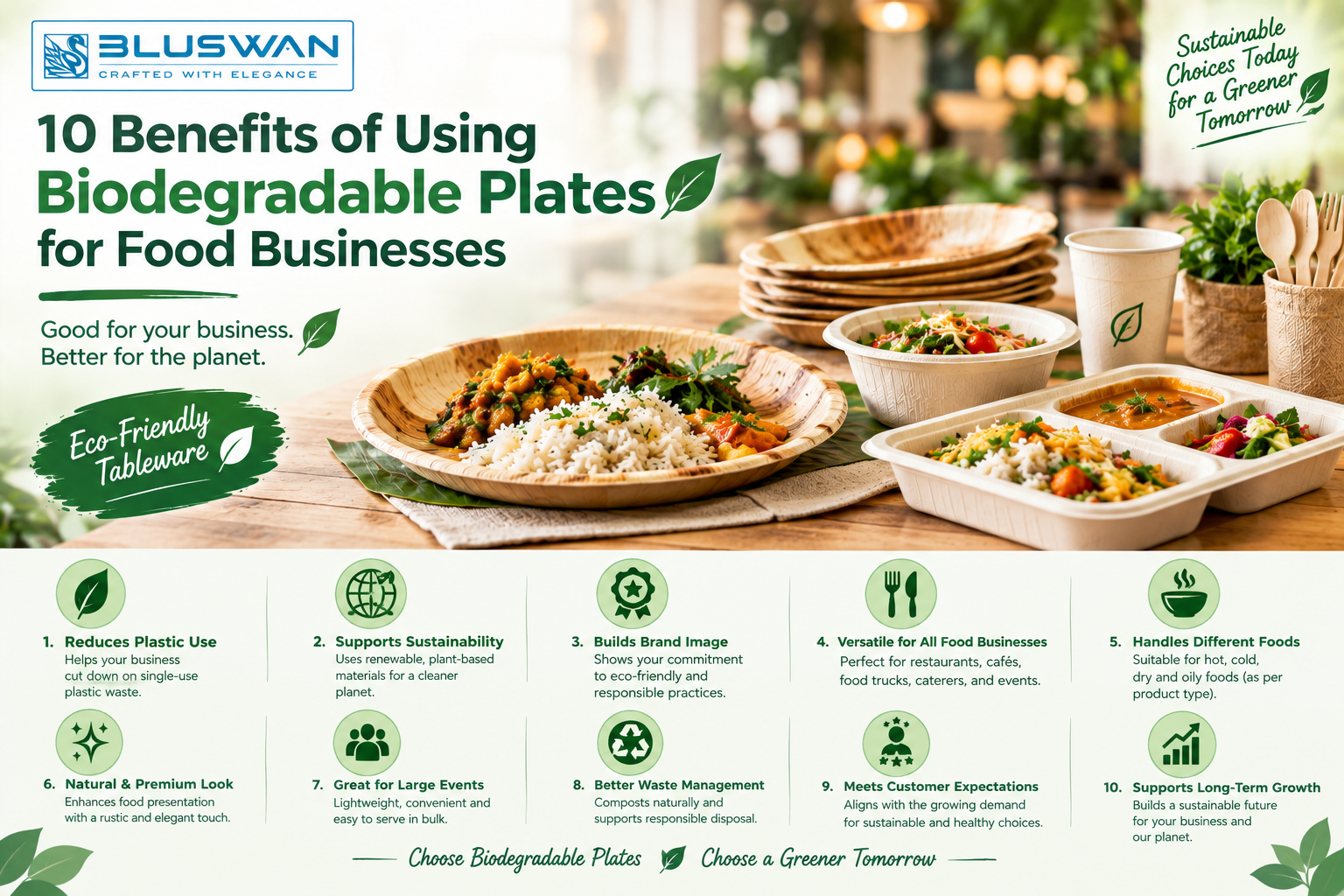
10 Benefits of Using Biodegradable Plates for Food Businesses The food industry is changing rapidly as restaurants, cafés, caterers, cloud kitchens, food trucks, and event organizers look for better alternatives to conventional plastic tableware. One of the simplest changes a food business can make is switching from traditional disposable plastic plates to biodegradable plates. Biodegradable plates are made from materials that can break down naturally under suitable conditions. Depending on the product, common materials include sugarcane bagasse, areca palm leaves, rice bran, wheat bran, and other plant-based fibres. For food businesses, the decision is not only about environmental responsibility. The right biodegradable plates can also improve customer experience, support a sustainable brand image, simplify food service, and provide practical solutions for dine-in, takeaway, catering, and events. In this blog, let's explore 10 important benefits of using biodegradable plates for food businesses and why they are becoming an increasingly popular tableware option. 1. Helps Reduce Dependence on Plastic One of the biggest benefits of biodegradable plates is that they can help food businesses reduce their dependence on conventional plastic disposable plates. Restaurants and catering businesses can use hundreds or even thousands of disposable plates every month. When conventional plastic products are used for short periods and discarded, they contribute to the growing volume of waste. Switching some disposable tableware categories to plant-based alternatives can be a practical step toward reducing plastic use. For example, a restaurant can choose: Sugarcane bagasse plates Areca leaf plates Bagasse bowls Compostable food containers Plant-based takeaway packaging Businesses don't necessarily need to change everything at once. They can start with one product category and gradually expand their sustainable tableware range. 2. Supports a More Sustainable Food-Service Model Modern customers increasingly pay attention to how businesses operate and what happens to the products they use. When a restaurant chooses biodegradable plates made from plant-based materials, it demonstrates an effort to move toward more responsible food-service practices. Materials such as sugarcane bagasse are produced from agricultural fibre, while areca leaf plates are made from naturally shed areca palm leaf sheaths. This makes plant-based tableware an attractive option for businesses that want to reduce their reliance on petroleum-based disposable products. A sustainable food-service model can include several small changes: Using biodegradable plates Reducing unnecessary packaging Choosing recyclable or compostable packaging where appropriate Educating employees about waste separation Avoiding unnecessary single-use plastic Working with responsible suppliers Together, these changes can create a more environmentally conscious business operation. 3. Improves Your Brand Image Today, customers don't only evaluate restaurants based on taste and price. They may also notice presentation, packaging, service, and the overall values of a business. Using biodegradable plates can become part of a restaurant's sustainability story. For example, a café using plant-based takeaway packaging can communicate its commitment through social media, packaging labels, menus, or in-store displays. A simple message such as: "We choose plant-based tableware to reduce unnecessary plastic use." can help customers understand why the business selected a particular product. For eco-conscious customers, these visible choices can make a restaurant feel more aligned with their values. 4. Suitable for Restaurants, Catering and Events Biodegradable plates are not limited to one type of food business. They can be useful across many food-service applications, including: Restaurants Restaurants can use biodegradable plates for special events, outdoor dining, buffets, or takeaway orders. Catering Caterers can use disposable plant-based plates for weddings, parties, corporate functions, and large gatherings. Food Trucks Food trucks can benefit from lightweight disposable tableware that makes serving and cleanup easier. Cafés Cafés can use suitable biodegradable bowls and plates for snacks, desserts, breakfast items, and other menu products. Cloud Kitchens Cloud kitchens can combine biodegradable plates or containers with sustainable takeaway packaging. Weddings and Events Large events can generate significant quantities of disposable tableware waste. Plant-based alternatives can provide a more sustainability-focused option. Because these products are available in different sizes and shapes, businesses can select tableware according to their menu and serving requirements. 5. Good Options for Different Types of Food A common concern among food businesses is whether biodegradable plates can handle different types of food. The answer depends on the material, product design, thickness, and manufacturer's specifications. Good-quality products are available for a variety of applications, including: Rice dishes Curries Snacks Salads Desserts Fried foods Biryani Breakfast items Bakery products Catering meals Sugarcane bagasse plates, for example, are commonly used for food-service applications because they are made from moulded plant fibre and are available in different shapes and sizes. Areca leaf plates can provide a natural, premium appearance that works particularly well for traditional meals, weddings, outdoor events, and catering. Food businesses should always check the supplier's specifications for heat, moisture, oil resistance, and intended food-contact use before selecting a product. 6. Creates a Natural and Premium Look Not all disposable tableware has to look basic. Areca leaf plates, in particular, have a natural texture and appearance that can create a distinctive presentation. The natural colour and visible leaf pattern can work well with: Traditional Indian meals Organic food businesses Farm-to-table restaurants Outdoor catering Weddings Festivals Eco-friendly cafés Corporate events Bagasse products, on the other hand, generally have a clean and modern appearance. This gives food businesses different options depending on their brand identity. A premium presentation can make even disposable food service feel more thoughtful and professional. 7. Convenient for Large Events and Catering Large events require careful planning. Organizers need to think about serving speed, storage, transportation, cleaning, and waste management. Reusable crockery can require significant washing and handling, while disposable tableware can simplify certain event operations. Biodegradable plates can be useful for: Weddings Birthday parties Corporate events Food festivals Religious gatherings School events College events Outdoor functions Community celebrations For caterers, lightweight disposable tableware can also make transportation and distribution easier. However, businesses should plan the required quantity carefully to avoid unnecessary product waste. A simple calculation can help: Number of guests × plates per guest + extra stock = required quantity For example, for 500 guests, a caterer might plan for more than 500 plates depending on the menu and serving style. 8. Can Support Better Waste-Management Practices Choosing biodegradable plates is only one part of responsible waste management. How the products are disposed of also matters. Food businesses should understand the disposal requirements of the specific tableware they purchase. Products marketed as biodegradable or compostable may require particular environmental conditions to break down effectively. Businesses can improve waste management by: Keeping food waste separate where practical. Following local waste-collection requirements. Providing clearly marked waste bins. Training employees to separate different waste streams. Working with appropriate waste-management or composting facilities where available. Checking supplier claims about compostability and disposal. It is important not to assume that every product labelled "biodegradable" can break down quickly in any environment. Responsible disposal should always be considered when selecting sustainable tableware. 9. Helps Meet Changing Customer Expectations Customers are becoming more aware of packaging and disposable products. Someone ordering food online may notice whether the restaurant uses plastic containers, paper packaging, bagasse containers, or other alternatives. Similarly, guests at weddings and corporate events may appreciate businesses that make more environmentally responsible choices. This doesn't mean customers will choose a restaurant only because it uses biodegradable plates. Food quality, service, pricing, hygiene, and convenience remain important. However, sustainable packaging can become an additional positive factor. Restaurants can use this opportunity to communicate their efforts honestly rather than making exaggerated environmental claims. For example: "Our takeaway packaging uses plant-based materials where suitable." is more useful than making broad claims without explaining the product or disposal method. 10. Supports Long-Term Business Sustainability The final benefit is broader than simply replacing plastic plates. Choosing biodegradable plates can encourage food businesses to review their entire approach to packaging and disposable products. Once a restaurant starts looking at its tableware, it may also review: Takeaway containers Food delivery packaging Cups Bowls Cutlery Packaging materials Waste segregation Supplier practices Unnecessary packaging This can lead to a more organized and sustainability-focused purchasing strategy. Businesses can also compare products based on more than just price. Important factors include: Product quality Strength Food-contact suitability Heat resistance Oil resistance Size Storage requirements Supplier reliability Packaging Disposal options Overall cost per serving The cheapest disposable plate is not always the most cost-effective choice. A stronger product that performs well with the restaurant's menu may provide better value. Popular Types of Biodegradable Plates Food businesses have several plant-based tableware options to consider. Sugarcane Bagasse Plates Bagasse plates are made from sugarcane fibre left after juice extraction. They are commonly available in round, square, compartment, and other designs. They are suitable for many food-service applications when the product is properly manufactured and intended for food contact. Areca Leaf Plates Areca leaf plates are made from naturally shed areca palm leaf sheaths. They have a distinctive natural appearance and are popular for traditional meals, catering, weddings, and events. Rice Bran Tableware Rice bran can also be used as a plant-based material for certain tableware products. These products can be considered by businesses looking for alternatives made from agricultural materials. Wheat Bran Products Wheat bran is another agricultural material that can be used in some disposable food-service products. The right choice depends on the business's menu, budget, presentation requirements, and disposal arrangements. How to Choose the Right Biodegradable Plates Before purchasing biodegradable plates in bulk, food businesses should consider several factors. 1. Understand Your Menu A plate designed for dry snacks may not be the best choice for curry, gravy, or oily food. 2. Choose the Correct Size Select sizes according to the portions you normally serve. 3. Check Product Strength The plate should comfortably support the intended food without bending or leaking. 4. Check Food-Contact Suitability Always purchase products intended for food contact and follow the manufacturer's usage instructions. 5. Ask About Disposal Understand whether the product is biodegradable, compostable, or recyclable and what conditions are required for its end-of-life treatment. 6. Buy From a Reliable Supplier A reliable supplier can provide consistent quality, product specifications, and suitable packaging for bulk orders. Why Bluswan Indus Can Be a Sustainable Tableware Choice For restaurants, caterers, event organizers, and other food businesses looking for plant-based disposable tableware, Bluswan Indus offers a range of sustainable food-service options. Businesses can explore products such as areca leaf and sugarcane bagasse tableware based on their specific serving requirements. Instead of choosing tableware only by appearance or price, businesses should consider the complete application—from food compatibility and product strength to storage and responsible disposal. The right product can help create a better customer experience while supporting a more thoughtful approach to disposable food service. Final Thoughts The shift toward biodegradable plates is more than a trend. For food businesses, it can be a practical way to rethink disposable tableware and reduce reliance on conventional plastic products. From restaurants and cafés to caterers, cloud kitchens, food trucks, weddings, and large events, plant-based plates can offer a combination of convenience, presentation, and sustainability when the right products are selected and disposed of appropriately. The 10 key benefits include: Reduced dependence on conventional plastic Support for sustainable food service Improved brand image Versatility across food businesses and events Options for different types of food Natural and premium presentation Convenience for catering and large events Better opportunities for responsible waste management Alignment with changing customer expectations Support for long-term sustainable business practices For food businesses planning to make their operations more environmentally responsible, switching selected disposable products to suitable biodegradable alternatives can be a simple place to start. Choose the right material, verify the product's food-service suitability, and plan for responsible disposal. Sustainable tableware works best when the entire process—from purchase to disposal—is considered.
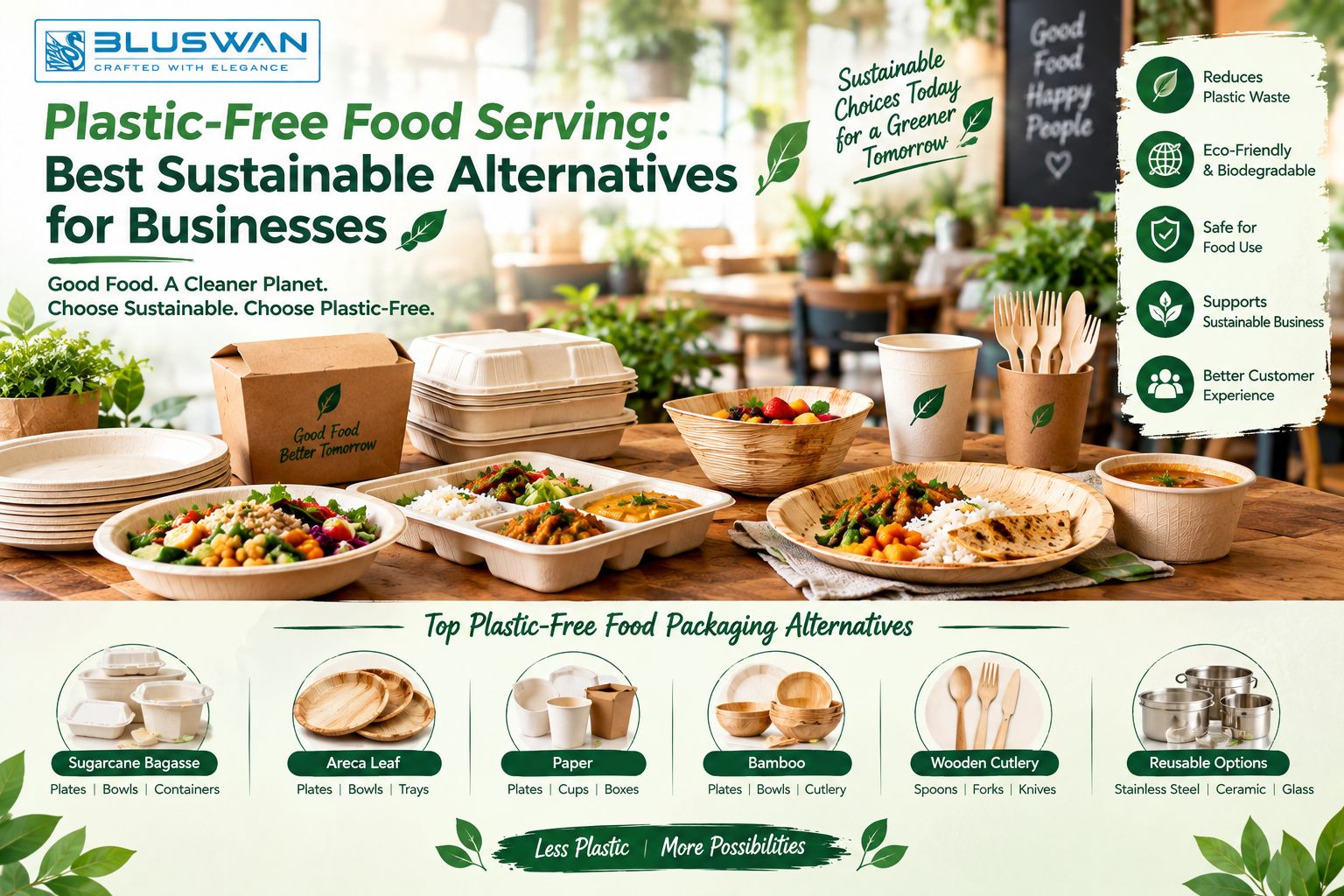
Plastic-Free Food Serving: Best Sustainable Alternatives for Businesses The food-service industry is changing quickly. Restaurants, cafés, caterers, cloud kitchens, food trucks, hotels, and event organizers are looking for practical ways to reduce their dependence on conventional plastic products. One of the most visible changes is the move toward plastic-free food packaging and sustainable food-serving products. From plates and bowls to takeaway containers and cutlery, businesses now have several alternatives made from plant-based and renewable materials. Sugarcane bagasse, areca leaf, paper, bamboo, wood, and other fibre-based materials can provide useful options for different food-service requirements. Going plastic-free does not mean that every business has to completely change its operations overnight. A better approach is to identify where plastic is being used most and replace suitable products step by step. In this blog, we explore the best sustainable alternatives for plastic-free food serving, their benefits, applications, and important factors businesses should consider before making the switch. What Is Plastic-Free Food Packaging? Plastic-free food packaging refers to food-serving and packaging products designed without conventional plastic as the primary material. Depending on the product, alternatives may be made from: Sugarcane bagasse Areca palm leaves Paper and cardboard Bamboo Wood Other plant-based fibres Agricultural by-products These materials can be used to manufacture plates, bowls, trays, takeaway boxes, cups, containers, and cutlery. However, businesses should look beyond the term "eco-friendly" when choosing products. Different materials have different properties, disposal requirements, food-contact specifications, and environmental impacts. The best solution is the one that matches the food, serving method, budget, and local waste-management system. Why Are Businesses Moving Away From Plastic? Plastic has traditionally been popular because it is lightweight, inexpensive, durable, and convenient. The problem is that many disposable plastic food-service products are designed for very short periods of use. A plate or container may be used for only a few minutes before becoming waste. This has encouraged restaurants and other food businesses to explore alternatives. Customers are also becoming more interested in sustainable packaging. A restaurant that uses plant-based plates or responsible takeaway packaging can communicate its sustainability efforts as part of its brand identity. For businesses, the transition can provide several advantages: Reduced reliance on conventional plastic More sustainable product choices Better brand positioning Attractive food presentation Options for events and catering Support for responsible waste management Alignment with changing customer expectations 1. Sugarcane Bagasse Plates and Containers Sugarcane bagasse is one of the most popular alternatives for disposable food-service products. Bagasse is the fibrous material left after sugarcane is processed for juice or sugar. This fibre can be processed and moulded into plates, bowls, trays, and takeaway containers. Why businesses choose bagasse Bagasse products can offer a clean, modern appearance while providing practical food-serving solutions. They are available in various designs, including: Round plates Square plates Compartment plates Bowls Meal trays Clamshell containers Takeaway boxes Bagasse products are commonly considered for restaurants, catering companies, food delivery businesses, corporate events, and large gatherings. For businesses serving rice, curries, snacks, salads, or takeaway meals, selecting the appropriate bagasse product can provide a convenient alternative to conventional plastic tableware. 2. Areca Leaf Plates Areca leaf plates are another popular sustainable food-serving option. They are made from naturally shed areca palm leaf sheaths that are collected, cleaned, dried, and formed into tableware. One of their biggest advantages is their natural appearance. The visible texture of the leaf gives the plates a distinctive look that works particularly well for: Indian meals Weddings Traditional functions Outdoor catering Festivals Eco-conscious restaurants Corporate events Parties Areca leaf plates can make food presentation feel more natural and premium. They are especially useful for businesses that want their tableware itself to communicate a connection with nature. 3. Paper Plates and Food Containers Paper remains one of the most familiar alternatives to plastic. Paper-based products are available as: Plates Cups Food boxes Burger boxes Sandwich boxes Wrapping materials Bakery packaging However, businesses should pay attention to how paper products are manufactured and coated. Not every paper product is automatically plastic-free or compostable. Some food-service paper products may contain coatings or linings designed to provide moisture or grease resistance. Therefore, businesses should ask suppliers about the material composition and disposal requirements before purchasing in bulk. 4. Bamboo Tableware Bamboo is a rapidly renewable plant material and is used for several food-service products. Bamboo can be used to produce items such as: Serving trays Plates Bowls Skewers Serving utensils Decorative food-service products Bamboo products can be particularly attractive for restaurants that want a natural or premium presentation. They can work well in cafés, resorts, restaurants, outdoor events, and specialty food businesses. The exact environmental performance depends on how the product is manufactured, transported, used, and disposed of, so businesses should consider the complete product lifecycle. 5. Wooden Cutlery Plastic spoons, forks, and knives are common in takeaway and catering operations. Wooden alternatives can provide a simple way to reduce conventional plastic cutlery. Wooden cutlery can include: Spoons Forks Knives Stirring sticks Serving utensils These products can pair well with bagasse plates and areca leaf tableware. For restaurants offering takeaway meals, replacing plastic cutlery with suitable wood-based alternatives can also improve the overall appearance of the packaging. 6. Paper and Fibre-Based Takeaway Boxes Takeaway packaging is another major area where restaurants can reduce their dependence on conventional plastic. Businesses can explore fibre-based containers for: Rice meals Burgers Sandwiches Snacks Desserts Salads Bakery products Combo meals Different foods require different packaging properties. For example, oily foods and gravies need containers designed to handle moisture and grease. Hot foods require packaging suitable for the expected temperature. Therefore, businesses should test packaging with their actual menu before switching completely. A container that works perfectly for a sandwich may not necessarily be suitable for a hot curry. 7. Compostable Food Containers Compostable food containers are another option businesses may consider. These products are designed to break down under specified composting conditions. However, businesses should understand the difference between biodegradable and compostable products. "Compostable" generally refers to products designed to break down under defined composting conditions, while "biodegradable" is a broader term. A product's disposal route matters. If a restaurant uses compostable containers but sends them to a waste stream where suitable composting is unavailable, the intended environmental benefit may not be fully achieved. Therefore, businesses should consider both product selection and local waste infrastructure. 8. Plant-Based Bowls and Trays Bowls and trays are essential for many food businesses. Restaurants serving soups, curries, rice bowls, salads, desserts, and combination meals can explore plant-fibre alternatives to conventional plastic bowls and trays. Bagasse bowls and trays can provide a practical solution for many applications. Compartment trays are particularly useful for meals containing several components. For example, an Indian meal may include: Rice Curry Dal Vegetables Salad Pickle A compartment tray can keep different foods separated while making serving easier. 9. Reusable Tableware for Dine-In Businesses Going plastic-free does not always mean replacing plastic with another disposable product. For dine-in restaurants, reusable tableware can sometimes be the better solution. Businesses can use: Stainless steel plates Ceramic plates Glassware Reusable bowls Reusable cutlery Reusable products can reduce the need for single-use tableware when the business has suitable washing, storage, and sanitation facilities. A restaurant should compare the operational requirements of reusable products with disposable alternatives. For takeaway and large outdoor events, disposable plant-based products may be more practical. For regular dine-in service, reusable tableware may make more sense. 10. Eco-Friendly Packaging for Food Delivery Food delivery has created a major demand for convenient packaging. Cloud kitchens and restaurants need containers that are: Strong Leak-resistant Easy to transport Suitable for hot food Easy to stack Practical for customers Suitable for the restaurant's menu Businesses can consider fibre-based containers and other suitable alternatives instead of conventional plastic containers. However, food delivery packaging should always be tested under real conditions. A restaurant should test the packaging for: Heat Moisture Oil Sauces Transportation Stacking Storage time A sustainable package that fails during delivery can result in food spills, customer complaints, and unnecessary waste. How to Choose the Right Plastic-Free Food Packaging Switching to sustainable packaging should be a planned business decision. Here are some important factors to consider. 1. Understand Your Food Start with your menu. Ask: Is the food hot? Is it oily? Does it contain gravy? Is it dry? Does it require separation? How long will it remain inside the container? This will help determine the right packaging material. 2. Consider Strength A plate or container should be strong enough for the food it is intended to carry. Test products before ordering large quantities. 3. Check Food-Contact Suitability Food packaging should be intended for food contact and should meet applicable food-safety requirements. Businesses should request relevant product information and compliance documentation from suppliers where appropriate. 4. Understand Disposal Don't select a product simply because it says "eco-friendly." Ask: Is it recyclable? Is it compostable? Is it biodegradable? What conditions are required? Is appropriate waste collection available locally? Understanding the end-of-life process is an important part of sustainable packaging. 5. Compare Total Cost The cheapest product may not always be the most economical. Consider: Product price Transportation Storage Breakage Leakage Customer complaints Waste Product performance A reliable product that performs consistently can provide better overall value. Benefits of Going Plastic-Free Switching suitable food-service products away from conventional plastic can offer several benefits. Better Sustainability Positioning Businesses can demonstrate practical efforts toward reducing conventional plastic use. Improved Customer Perception Sustainable packaging can appeal to customers who value environmentally responsible choices. Better Presentation Natural materials such as areca leaf and bagasse can create an attractive food presentation. Flexible Applications Plant-based tableware is available for restaurants, catering, events, takeaway, and delivery. Stronger Brand Story Businesses can communicate their sustainability efforts through social media, packaging, menus, and marketing campaigns. Avoid Greenwashing Businesses should be careful when promoting sustainable packaging. Simply calling a product "100ìo-friendly" does not explain its complete environmental impact. Instead, communicate specific information. For example: "We use sugarcane bagasse containers for selected takeaway meals." This is more informative than making a broad environmental claim. Businesses should also avoid claiming that every biodegradable product will disappear quickly in normal surroundings. Disposal conditions can vary significantly between materials and products. Honest communication builds more trust with customers. Why Bluswan Indus Can Help Businesses Choose Sustainable Tableware For restaurants, caterers, event organizers, food-service businesses, and other organizations looking for alternatives to conventional disposable plastic, Bluswan Indus offers sustainable tableware solutions. Its product range can help businesses explore options such as: Areca leaf plates Sugarcane bagasse plates Bowls Compartment plates Food containers Other sustainable food-service products The right choice depends on the type of food, serving method, expected usage, budget, and disposal system. Businesses should select products based on actual operational requirements rather than choosing a product simply because it is marketed as sustainable. Final Thoughts Moving toward plastic-free food packaging is becoming an important consideration for modern food businesses. Restaurants, cafés, caterers, cloud kitchens, food trucks, hotels, and event organizers have several alternatives available, from sugarcane bagasse and areca leaf to paper, bamboo, wood, and reusable tableware. The most effective approach is not simply to replace one disposable product with another. Businesses should look at the entire process—from sourcing and food service to transportation, customer use, and final disposal. Start with the products where plastic use is highest. Test sustainable alternatives with your actual menu, train employees, communicate your choices honestly, and build a waste-management system that supports those products. With the right planning, businesses can reduce their reliance on conventional plastic while maintaining food quality, convenience, presentation, and customer satisfaction. Choose smarter packaging. Serve responsibly. Build a more sustainable food business.
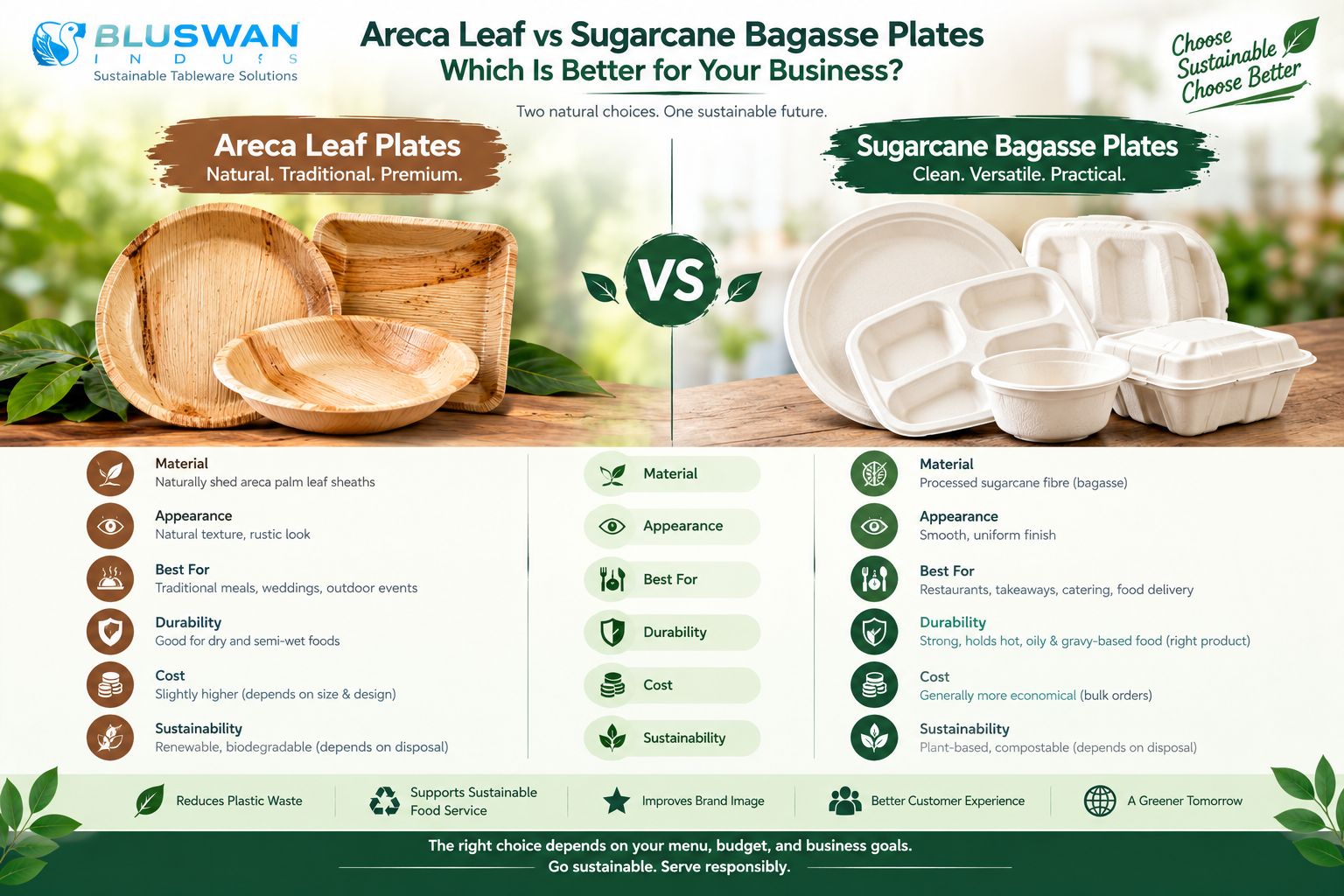
Areca Leaf vs Sugarcane Bagasse Plates: Which Is Better for Your Business? Choosing the right disposable plates is an important decision for restaurants, cafés, catering companies, cloud kitchens, hotels, and event organizers. Businesses need tableware that looks good, handles food properly, fits their budget, and supports their sustainability goals. Two popular plant-based alternatives to conventional plastic tableware are areca leaf plates and sugarcane bagasse plates. Both are used in food service, but they differ in appearance, manufacturing materials, product designs, storage requirements, and typical applications. Areca leaf plates offer a natural, rustic appearance, while sugarcane bagasse plates provide a clean, uniform design with a wide range of shapes and compartment options. So, which one is better for your business? The answer depends on your menu, customer expectations, serving style, purchasing budget, and local waste-management facilities. In this guide, we compare areca leaf and sugarcane bagasse plates to help you make the right choice. What Are Areca Leaf Plates? Areca leaf plates are made from the naturally shed leaf sheaths of the areca palm. The collected sheaths are cleaned, dried, and pressed into different shapes to create plates, bowls, and serving trays. Because the original leaf texture remains visible, every plate can have a slightly different natural pattern and colour. Key features of areca leaf plates Made from naturally shed areca palm leaf sheaths. Have a distinctive natural appearance. Available in different sizes, shapes, and designs. Popular for weddings, traditional meals, catering, and outdoor events. Can provide an attractive alternative to conventional disposable tableware. Areca leaf plates are particularly suitable for businesses that want their food presentation to have a natural or premium look. What Are Sugarcane Bagasse Plates? 8 Sugarcane bagasse plates are made from bagasse, the fibrous residue left after sugarcane juice extraction. The fibre is processed and moulded into food-service products such as plates, bowls, trays, and takeaway containers. Bagasse tableware usually has a smooth, consistent appearance and is available in several practical designs. Key features of bagasse plates Made from processed sugarcane fibre. Available in round, square, and compartment designs. Commonly used for takeaway meals and catering. Offered in a variety of sizes and product formats. Can be suitable for many hot and cold food applications when the product is designed and tested for that use. Bagasse plates are often a practical choice for businesses that need consistent products for regular, high-volume food service. Areca Leaf vs Bagasse Plates: Quick Comparison Feature Areca leaf plates Sugarcane bagasse plates Material Naturally shed areca palm leaf sheaths Processed sugarcane fibre Appearance Natural, textured, rustic Smooth, clean, uniform Design options Vary by manufacturer and leaf shape Often available in many standard shapes and compartments Food presentation Premium, traditional, natural Modern, practical, professional Common uses Weddings, outdoor dining, traditional meals Restaurants, takeaways, catering, food delivery Product consistency Natural variations may occur More uniform moulded shapes Storage Needs clean, dry storage Needs clean, dry storage Sustainability Depends on sourcing, production, and disposal Depends on processing, production, and disposal Best fit Businesses prioritising natural presentation Businesses needing consistent, versatile tableware Neither material is automatically better in every situation. The best option depends on the product specification and how your business operates. 1. Which Plates Look Better for Food Presentation? Appearance can influence the customer experience, especially at weddings, restaurants, resorts, and premium events. Areca leaf plates have natural patterns and earthy colours. Their appearance works well with traditional Indian meals, organic food concepts, outdoor dining, and rustic event decorations. Sugarcane bagasse plates generally have a neat and consistent finish. Their clean design works well in modern restaurants, food courts, cafeterias, and takeaway businesses. For example, a caterer serving a traditional meal at a wedding may prefer areca leaf plates because they complement the setting. A cloud kitchen serving daily lunch combos may prefer bagasse compartment plates for their uniform shape. Best choice: Areca leaf for a natural, distinctive look; bagasse for a clean, consistent presentation. 2. Which Is Better for Hot, Oily and Gravy-Based Food? Food compatibility is one of the most important considerations when purchasing disposable plates. Both areca leaf and bagasse plates are available for different food-service applications. However, performance varies according to the plate's thickness, construction, and manufacturer specifications. For hot rice, curries, biryani, fried snacks, and oily dishes, check whether the specific product is designed to handle the expected temperature, moisture, and food weight. Before placing a bulk order, test the plates with your actual menu. Check whether they: Remain firm while holding food. Handle oil and moisture without leaking. Maintain their shape during serving. Can be carried comfortably by staff or customers. Remain suitable throughout the normal serving period. Bagasse plates are available in moulded designs suitable for many meal-service applications, including compartment meals. Areca leaf plates can also work well for traditional food service when the chosen product is appropriate for the food. Best choice: Select based on tested product performance, not just the material name. 3. Which Is Better for Restaurants? Restaurants need tableware that matches their menu, service style, and customer expectations. For restaurants with regular takeaway orders, bagasse plates and containers can be useful because they are available in standardised designs and different sizes. Compartment products can help keep separate meal components apart. Areca leaf plates can be suitable for restaurants serving traditional food, hosting outdoor dining events, or creating a distinctive natural presentation. A restaurant can also use different products for different purposes. For example, bagasse containers may be used for takeaway orders while areca leaf plates are reserved for special dining events. Best choice: Bagasse for consistent everyday service; areca leaf for distinctive presentation. Both may suit restaurants with different service requirements. 4. Which Is Better for Catering and Weddings? Catering businesses need to serve large numbers of guests efficiently. The tableware must be easy to distribute, comfortable to use, and appropriate for the menu. Areca leaf plates are popular for traditional celebrations and events where natural-looking tableware complements the setting. Bagasse plates are useful for buffets, corporate events, food festivals, and catering operations that require standardised designs. Compartment plates can be especially practical when meals contain several dishes. Before selecting either option, consider: The number of guests. The type of food being served. Whether meals are plated or buffet-style. The required plate sizes. Storage and transportation arrangements. Waste collection after the event. Best choice: Areca leaf for a natural event presentation; bagasse for versatile, standardised serving requirements. 5. Which Is More Convenient for Food Delivery? Food delivery businesses need packaging that protects meals during transport. A plate alone may not be enough; the business may need a matching lid, tray, or takeaway container. Bagasse products are available in clamshell containers, bowls, trays, and compartment designs. This makes it easier to create a consistent packaging system for different menu items. Areca leaf plates are more commonly chosen for serving and presentation, although suitable products can also be used for takeaway applications. For delivery, test the complete packaging system rather than only the plate. Check for leaks, movement, stacking stability, heat retention needs, and whether the container stays closed during transport. Best choice: Bagasse often provides more practical format options for takeaway operations, but the actual container's performance should determine the final decision. 6. Which Is More Environmentally Friendly? Both are plant-based alternatives to conventional plastic, but their environmental impact depends on more than their raw materials. Areca leaf plates use naturally shed palm leaf sheaths, while bagasse plates make use of fibrous residue from sugarcane processing. Both approaches can make use of plant materials that might otherwise have limited value. However, the complete environmental picture also depends on: How the raw materials are collected and processed. Energy and water used during manufacturing. Transportation distances. Whether the products contain additional coatings or additives. The availability of appropriate disposal facilities. Whether the product is actually compostable under the available conditions. It is important not to assume that every plant-based plate will decompose quickly in every environment. Businesses should request accurate product information and follow the recommended disposal route. Best choice: Neither material wins in every environmental category. Compare verified product information and local disposal options before making sustainability claims. 7. Which Is More Cost-Effective? Price matters, especially for businesses purchasing thousands of plates each month. The cost of areca leaf and bagasse plates can vary according to size, thickness, shape, order quantity, supplier, transportation, and product quality. Rather than comparing only the price per plate, calculate the total cost of using the product. Consider: Price per unit. Shipping and delivery charges. Storage requirements. Breakage or damaged stock. Product performance with your menu. Waste and customer complaints. Minimum order quantities. For example, a catering business may prefer a plate that costs slightly more if it performs reliably with heavy meals and reduces serving problems. Ask suppliers for bulk pricing and samples before committing to a large order. Best choice: The option that meets your requirements at a sustainable overall operating cost. 8. Which Is Easier to Store and Handle? Both types of plates require suitable storage conditions. Keep them in a clean, dry, protected area away from moisture, pests, and contamination. Follow the supplier's instructions for stacking and storage. Bagasse plates often have uniform moulded shapes, which can make them convenient for standardised stacking and portioning. Areca leaf plates may vary slightly in shape and thickness because they are made from natural leaf sheaths. If your business has limited storage space, request product dimensions and packaging details before ordering. For high-volume businesses, test how easily staff can stack, carry, and distribute the plates during busy service periods. Best choice: Bagasse may be convenient for standardised stacking, while areca leaf can work well when the natural product's dimensions fit your storage system. 9. Which Is Better for Your Business Type? Use this quick guide to narrow down your options. Business type Option to consider Why Traditional restaurant Areca leaf or bagasse Depends on presentation and menu Cloud kitchen Bagasse Variety of takeaway formats Wedding caterer Areca leaf or bagasse Natural appearance or standardised serving Corporate cafeteria Bagasse Practical shapes and portion options Outdoor food festival Either Depends on food, handling, and disposal Premium event venue Areca leaf Distinctive natural appearance Bulk food distributor Both Broader product selection for customers These are starting points rather than strict rules. Always check product specifications and test the plate with the food you intend to serve. 10. How to Choose the Right Supplier A reliable supplier helps ensure consistent product quality and dependable availability. Before purchasing areca leaf or sugarcane bagasse plates, ask the supplier about: Available sizes, shapes, and designs. Minimum order quantity and bulk pricing. Product specifications and food-contact suitability. Performance with hot, oily, or moist food. Packaging, transportation, and storage requirements. Compostability claims and disposal instructions. Samples for testing before a large order. For businesses buying regularly, consistency matters. A product that performs differently from one delivery to another can create operational problems. Why Choose Bluswan Indus for Sustainable Tableware? Bluswan Indus serves the sustainable tableware market with products such as areca leaf and sugarcane bagasse tableware. For restaurants, caterers, distributors, and event organisers exploring alternatives to conventional disposable plastic, comparing these product categories can help identify suitable options for their operations. When selecting products, consider the food being served, required appearance, plate strength, order quantity, and disposal arrangements. Explore the available products at Bluswan Indus and contact the business to confirm current product availability, specifications, and bulk-order requirements. Frequently Asked Questions 1. Are areca leaf plates better than bagasse plates? Not in every situation. Areca leaf plates offer a distinctive natural appearance, while bagasse plates offer a variety of uniform shapes and compartment designs. The better option depends on your business needs. 2. Can bagasse plates hold hot food? Many bagasse plates are designed for hot-food applications. Check the manufacturer's temperature guidance and test the specific product before using it for hot meals. 3. Are areca leaf plates suitable for weddings? Yes. Their natural appearance makes them an option for weddings, traditional functions, outdoor catering, and other events. 4. Are both types of plates biodegradable? Both materials are plant-based, but the breakdown rate and disposal requirements depend on the product and environmental conditions. Verify the supplier's claims and local disposal options. 5. Which plates are better for bulk food businesses? Bagasse may suit businesses that need standardised plates, compartments, and takeaway formats. Areca leaf may suit businesses that prioritise natural presentation. Some businesses may benefit from stocking both. Final Verdict: Areca Leaf vs Bagasse Plates Choosing between areca leaf and sugarcane bagasse plates comes down to your menu, budget, customer experience, and service requirements. Choose areca leaf plates when a natural appearance and distinctive presentation are priorities. Choose sugarcane bagasse plates when you need consistent shapes, compartment options, and a variety of takeaway formats. Both can be useful alternatives to conventional plastic tableware when selected appropriately and managed responsibly. For the best result, test samples with your actual food, compare total costs, and confirm product specifications before ordering in bulk. Make the right tableware choice for your business—and build a more responsible food-service experience.
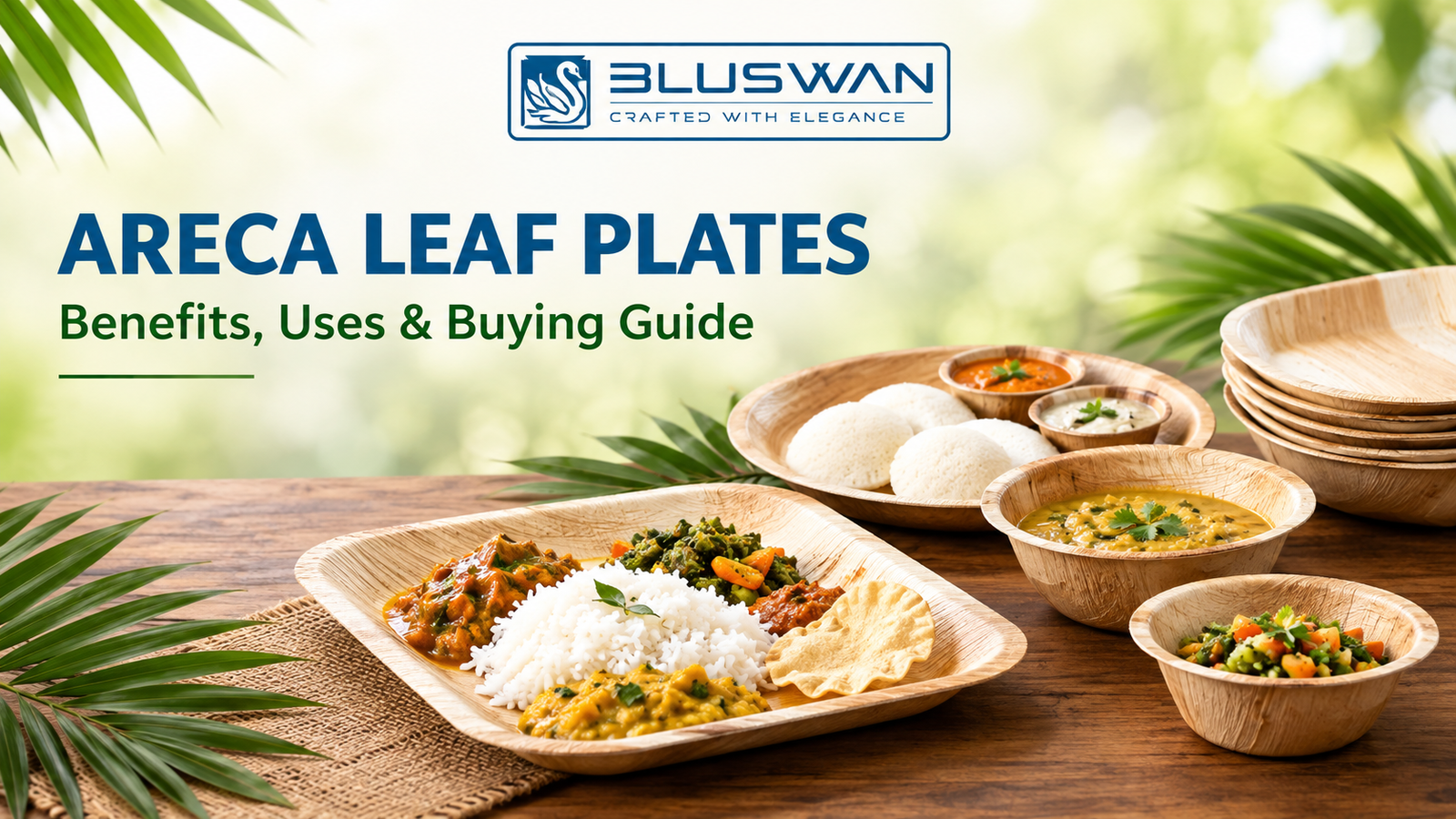
Areca Leaf Plates: Benefits, Uses, and Buying Guide Are you looking for a practical alternative to plastic disposable plates? Areca leaf plates are becoming a popular choice for households, restaurants, catering companies, event organizers, and businesses that want to reduce their dependence on conventional disposable tableware. Made from naturally fallen areca palm leaf sheaths, these plates offer a simple combination of functionality, natural appearance, and reduced reliance on plastic-based materials. They are available in different shapes and sizes, making them suitable for everything from everyday meals to weddings, festivals, outdoor events, and commercial food service. In this guide, we will explore what areca leaf plates are, their key benefits, common uses, manufacturing process, and the factors to consider before buying them for personal or business use. What Are Areca Leaf Plates? Areca leaf plates, also known as areca palm leaf plates or palm leaf plates, are disposable food-serving products made from the naturally shed leaf sheaths of the areca palm tree (Areca catechu). Unlike conventional plastic plates, these products use plant-based material rather than petroleum-based plastic. The collected leaf sheaths are cleaned, shaped using heated moulds, trimmed, and inspected before packaging. The natural grain and colour of the leaf give every plate a slightly different appearance. Depending on the manufacturer, they may be available as round plates, square plates, compartment plates, bowls, and serving trays. Areca leaf plates are particularly useful for people and businesses looking for alternatives to plastic or foam tableware without sacrificing convenience. 7 Key Benefits of Areca Leaf Plates 1. Made from Naturally Fallen Leaf Sheaths One of the main advantages of areca leaf plates is their raw material. Manufacturers collect naturally fallen leaf sheaths instead of cutting down trees specifically to produce disposable plates. Using this agricultural by-product creates an additional use for material that might otherwise be discarded or used for other low-value purposes. For buyers interested in more responsible purchasing decisions, this makes areca leaf tableware worth considering. 2. A Plant-Based Alternative to Plastic Plates Traditional disposable plates may contain plastic or foam materials that persist in the environment after disposal. Areca leaf plates provide a plant-based option for many food-serving situations. Choosing suitable alternatives can help businesses reduce their use of conventional plastic tableware. However, the environmental impact of any disposable product also depends on manufacturing, transportation, waste collection, and disposal practices. For the best results, choose products with clear material information and follow local waste-management guidelines. 3. Suitable for Different Types of Food Quality areca leaf plates can be used to serve a wide range of foods, including rice dishes, snacks, vegetables, bread, desserts, and many cooked meals. Their rigid structure makes them useful for serving food at parties, buffets, catering functions, and outdoor gatherings. Performance can vary depending on the plate's thickness, shape, and manufacturing quality. For very liquid-heavy dishes or prolonged contact with liquids, check the supplier's product specifications before ordering in bulk. 4. Natural Appearance for Special Occasions Areca leaf plates have a distinctive natural texture and warm, earthy colour. This makes them suitable for occasions where presentation matters as much as convenience. They can complement traditional meals, rustic themes, outdoor celebrations, and eco-conscious event styling. Wedding planners, caterers, and event organizers may find them useful when they want serving products that look different from standard white plastic or paper plates. 5. Available in Different Shapes and Sizes Areca leaf tableware is available in a variety of formats to meet different serving requirements. Common options include: Small plates for snacks and desserts Medium plates for breakfast and light meals Large dinner plates for full meals Compartment plates for serving multiple food items Bowls for suitable side dishes and snacks Trays for catering and buffet presentations Product dimensions and availability vary by manufacturer. Before ordering, confirm the exact diameter, depth, compartment layout, and quantity per carton. 6. Can Reduce Washing and Cleanup Work Disposable areca leaf plates can be convenient for events where washing and storing large quantities of reusable crockery would require additional time and labour. They can help simplify post-event cleanup at outdoor functions, community gatherings, festivals, and catered occasions. However, reusable plates may be a better environmental choice where efficient washing facilities are available and products can be used repeatedly. The right option depends on the event, available infrastructure, and waste-management arrangements. 7. Can Be Compostable Under Suitable Conditions Because areca leaf plates are made primarily from plant material, they can break down under suitable composting conditions. Their decomposition time depends on factors such as moisture, temperature, microbial activity, plate thickness, and the composting environment. There is no single guaranteed timeframe for every product or disposal location. For businesses that prioritize compostability, ask suppliers for supporting documentation and confirm whether the products are accepted by the composting facilities available to you. How Areca Leaf Plates Are Made Understanding the manufacturing process can help buyers assess product quality and choose a reliable supplier. Step 1: Collection of Fallen Leaves Naturally fallen areca palm leaf sheaths are collected from farms and plantations. Suitable raw materials are selected based on their condition and size. Step 2: Cleaning and Preparation The collected sheaths are cleaned to remove dust, dirt, and other unwanted material. They may be soaked or otherwise prepared to make shaping easier. Step 3: Heat Pressing and Moulding The prepared leaf sheaths are placed in specially designed moulds. Heat and pressure shape the material into plates, bowls, or trays. The natural leaf structure provides the finished product's form. Manufacturers may use different machines and production methods depending on their equipment and product specifications. Step 4: Trimming and Quality Inspection After moulding, the products are trimmed and checked for defects. Quality checks may include shape, finish, cracks, cleanliness, dimensions, and structural strength. Step 5: Packing and Dispatch Approved products are packed into suitable cartons for storage, transportation, and delivery. For commercial orders, buyers should ask about packaging quantity, carton dimensions, storage requirements, production capacity, and delivery schedules. Common Uses of Areca Leaf Plates Weddings and Family Functions Areca leaf plates can be used for serving meals at weddings, engagements, birthdays, anniversaries, and family celebrations. Their natural appearance works well with traditional and outdoor event settings. Restaurants and Catering Businesses Restaurants, caterers, food stalls, and event-service companies may use these plates for selected dine-in events, catered meals, and temporary food-service arrangements. Before choosing them for regular commercial use, test the plates with your actual menu and service duration. Festivals and Religious Gatherings Community meals, festivals, temple events, and other large gatherings often require substantial quantities of serving plates. Areca leaf plates can be a convenient option where suitable collection and disposal arrangements are available. Outdoor Events and Picnics For picnics, outdoor parties, and similar occasions, lightweight disposable plates can make serving and cleanup easier. Cafés, Food Trucks, and Takeaway Services Some cafés, food trucks, and takeaway businesses use natural tableware to support their preferred presentation and packaging approach. Confirm that the selected product is suitable for the food being served and the intended method of transport. Areca Leaf Plates vs Plastic and Paper Plates Different disposable plates have different strengths. Comparing their features helps you select the most appropriate option. Feature Areca leaf plates Plastic plates Paper plates Main material Natural leaf sheath Plastic polymer Paper or paperboard Appearance Natural grain and colour Usually uniform Usually uniform Strength Depends on design and quality Depends on polymer and thickness Depends on paper weight and construction Environmental considerations Plant-based; compostability depends on conditions Conventional plastic can persist in the environment Depends on sourcing, coatings, and recycling or composting options Typical uses Events, meals, catering Various food-service uses Parties, snacks, and food service Cost Varies by size, grade, and quantity Varies by material and design Varies by material and construction There is no single best disposable plate for every situation. Consider durability, price, food type, local disposal options, and the total environmental impact when comparing products. Buying Guide: How to Choose the Right Areca Leaf Plates Whether you are purchasing for a family event or a commercial operation, the following checks can help you make a better decision. 1. Choose the Correct Size Select plate dimensions based on portion size and the type of food being served. Small plates may be suitable for snacks, while larger plates are more practical for complete meals. For bulk purchases, request samples before confirming the final order. 2. Check Material and Product Quality Inspect samples for excessive cracks, weak edges, uneven moulding, unpleasant odours, and visible contamination. Natural variations in colour and grain are normal, but the plates should still meet your functional requirements. 3. Confirm Food-Contact Suitability Ask the supplier for relevant food-contact safety information and test documentation, where applicable. Do not assume that every natural-looking product automatically meets all food-contact requirements. 4. Ask About Liquid and Heat Performance If your menu includes curries, gravies, oily dishes, or hot food, test the plates under actual serving conditions. Check the manufacturer's instructions before using the plates in a microwave, oven, refrigerator, or freezer. Not every product has the same temperature tolerance or approved uses. 5. Compare Wholesale Pricing For larger orders, request a written quotation that includes the price per plate, number of pieces per carton, packaging costs, applicable taxes, shipping charges, minimum order quantity, and delivery timelines. Compare suppliers on total delivered cost rather than unit price alone. 6. Review Packaging and Storage Ask how the products are protected during transport and how they should be stored. Keep plates in a clean, dry environment and protect them from moisture, pests, and contamination. 7. Verify Supplier Reliability Look for clear product specifications, responsive customer service, transparent commercial terms, and consistent quality. If buying regularly, discuss repeat-order availability and how the supplier handles damaged or defective goods. Are Areca Leaf Plates a Good Choice for Businesses? Areca leaf plates may be suitable for caterers, event planners, restaurants, retailers, wholesalers, and businesses that want plant-based disposable tableware. For these buyers, the decision should go beyond appearance. Product consistency, cost per serving, packaging, delivery reliability, food suitability, and end-of-life disposal all matter. Businesses should also avoid making unsupported environmental claims. If a product is described as certified compostable, food-safe, or suitable for microwave use, request the relevant evidence from the supplier. By comparing samples and commercial terms before placing a large order, businesses can select products that match their service requirements and customer expectations. Frequently Asked Questions About Areca Leaf Plates 1. What are areca leaf plates made from? They are made from the naturally shed leaf sheaths of the areca palm tree. The material is cleaned and shaped using heat and pressure to form plates and other tableware. 2. Are areca leaf plates biodegradable? Areca leaf plates made primarily from natural leaf material can biodegrade under suitable conditions. The rate of decomposition depends on the product and the disposal environment. 3. Can areca leaf plates hold hot food? Many areca leaf plates are designed for serving hot food. However, heat performance varies by product, so check the supplier's specifications and test samples with your intended menu. 4. Are areca leaf plates suitable for curries and gravies? Some products can handle moderately wet or oily foods for normal meal service. Performance varies, particularly with very liquid-heavy dishes or prolonged contact, so test the specific product before purchasing in bulk. 5. Can areca leaf plates be used in a microwave? Some areca leaf plates may be suitable for microwave use, but this should not be assumed for every product. Follow the manufacturer's instructions and confirm the product's temperature limits. 6. Where can businesses buy areca leaf plates in bulk? Businesses can contact manufacturers, wholesalers, and established tableware suppliers. Before ordering, compare samples, minimum order quantities, product specifications, pricing, packaging, and delivery terms. 7. Are areca leaf plates better than plastic plates? They can be a useful plant-based alternative to conventional plastic plates, especially where composting or appropriate organic-waste processing is available. The best choice depends on how the products are manufactured, used, collected, and disposed of. Conclusion Areca leaf plates offer a practical way to serve food using material derived from naturally fallen palm leaf sheaths. Their natural appearance, range of shapes and sizes, and potential for composting make them worth considering for events, catering, restaurants, and other food-service applications. Before buying, compare product quality, dimensions, food-contact information, heat and liquid performance, wholesale pricing, and disposal options. These checks will help you choose plates that suit your needs rather than relying on environmental claims alone. If you are exploring natural tableware for personal use or business supply, Bluswan Indus can be your starting point for learning more about its available products and purchasing options. Contact the company to confirm current product availability, specifications, bulk-order quantities, and pricing.
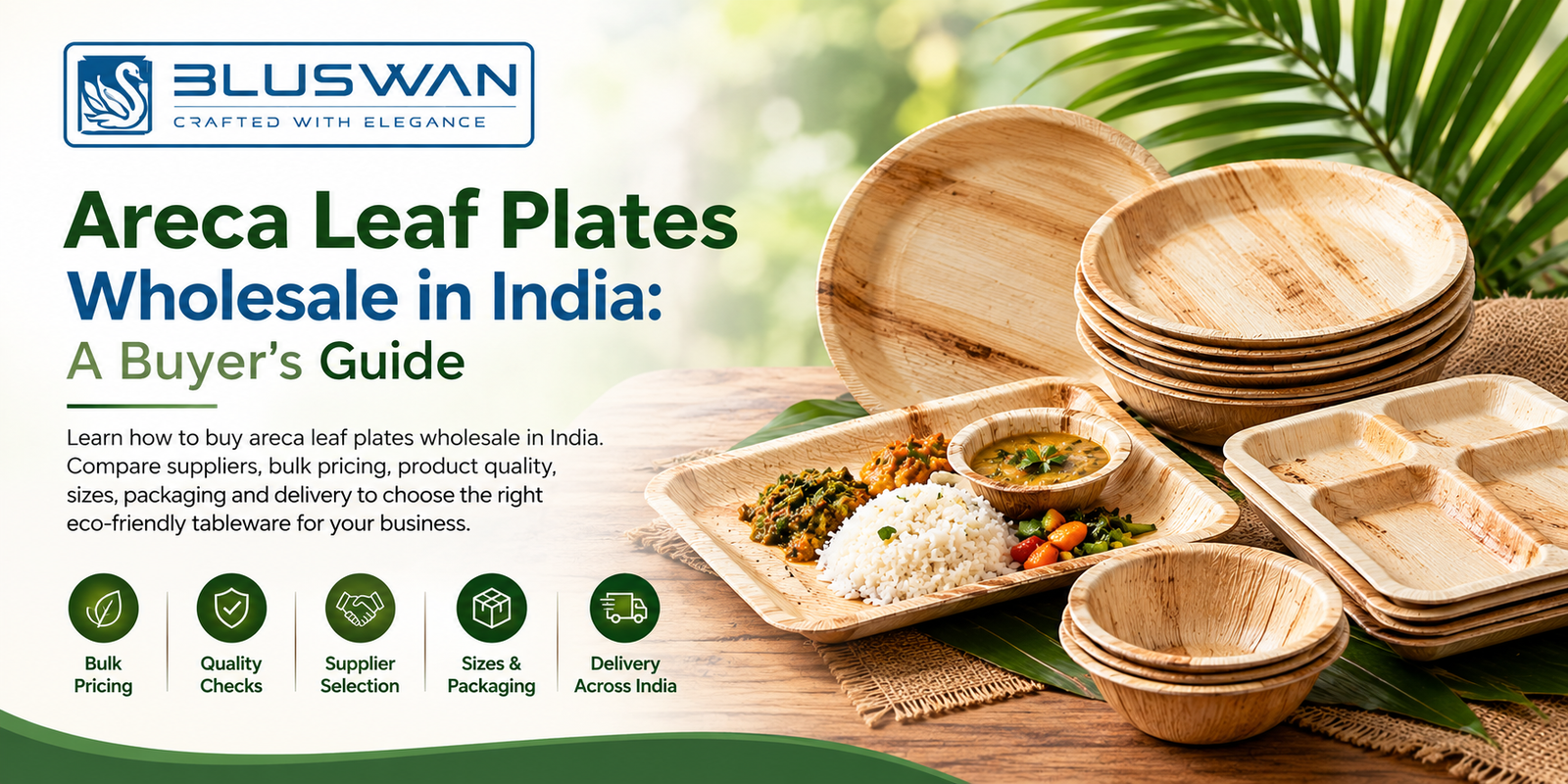
Areca Leaf Plates Wholesale in India: A Buyer's Guide Are you looking for a reliable supplier of areca leaf plates wholesale in India? Whether you run a catering business, restaurant, retail store, distribution company, or event management service, choosing the right disposable tableware supplier is important for maintaining product quality and managing costs. Areca leaf plates are made from naturally fallen areca palm leaf sheaths. Their natural appearance, variety of shapes and sizes, and suitability for many food-serving applications make them an option for businesses looking for alternatives to conventional plastic tableware. However, buying in bulk requires more than comparing prices. Buyers need to evaluate product quality, plate dimensions, packaging, minimum order quantities, supplier reliability, transportation costs, and delivery schedules. In this guide, we explain how to buy areca leaf plates wholesale in India, what to check before placing a bulk order, and how to choose products that suit your business requirements. What Are Areca Leaf Plates? Areca leaf plates, also known as areca palm leaf plates or palm leaf plates, are manufactured from the naturally shed leaf sheaths of the areca palm tree (Areca catechu). The collected leaf sheaths are cleaned, prepared, and shaped using heated moulds. The finished products are then trimmed, inspected, and packed for distribution. Unlike conventional plastic plates, areca leaf plates are made primarily from natural plant material. Their colour, texture, and grain can vary because each leaf sheath has its own natural characteristics. Wholesale buyers can find different product types depending on supplier availability, including: Round areca leaf plates Square and rectangular plates Compartment plates for serving multiple food items Areca leaf bowls Serving trays and other tableware products The available sizes, shapes, packaging formats, and minimum order quantities depend on the manufacturer or wholesaler. Buyers should confirm the exact specifications before ordering. Why Buy Areca Leaf Plates Wholesale in India? 1. Better Purchasing Options for Bulk Buyers Businesses that regularly use disposable tableware may benefit from purchasing larger quantities rather than placing frequent small orders. Wholesale purchasing can simplify stock planning, reduce repeated procurement work, and provide access to volume-based pricing where suppliers offer it. However, wholesale rates vary by product size, quality, order volume, packaging, and delivery location. Always compare quotations for equivalent products. 2. Suitable for Multiple Business Applications Areca leaf plates can be used by a wide range of businesses, including: Restaurants and cafés Catering companies Wedding and event planners Food stalls and outdoor food vendors Retail shops and supermarkets Disposable tableware distributors Hospitality and food-service suppliers Each business has different requirements. A caterer may prioritize strength and cost per serving, while a retailer may focus on packaging, product appearance, and customer demand. 3. A Natural Tableware Alternative Many businesses are exploring plant-based tableware as part of their purchasing and sustainability goals. Areca leaf plates provide an alternative to conventional plastic plates in suitable food-service applications. Because they are made from natural leaf material, they may also be suitable for composting under appropriate conditions. Buyers should check whether the specific product contains coatings or other materials and confirm local disposal requirements. Environmental benefits depend on the complete product lifecycle and how waste is managed. 4. Different Product Options for Different Customers Wholesale suppliers may offer plates in multiple dimensions and designs. This allows distributors and retailers to select products for different customer groups. For example, small plates may be useful for snacks, medium plates for light meals, and larger plates for full meals or catering functions. Offering a suitable product range can help businesses serve different needs without relying on a single plate size. Who Should Buy Areca Leaf Plates in Bulk? Restaurants and Cafés Restaurants and cafés can consider areca leaf plates for selected meals, events, takeaway arrangements, and outdoor food service. Before placing a large order, test samples with the actual menu. Check whether the plates maintain their shape during normal serving and whether their dimensions suit the portions offered. Catering Companies Caterers often need substantial quantities of tableware for weddings, corporate events, parties, and community functions. For these buyers, the most important factors are consistent quality, predictable availability, practical packaging, and timely delivery. Ordering ahead of major events can also help reduce the risk of last-minute shortages. Retailers and Supermarkets Retail businesses may purchase areca leaf plates in bulk and sell them in smaller packs to households, event organizers, and local food businesses. Retailers should compare pack sizes, packaging appearance, storage requirements, and the expected selling price before deciding which products to stock. Wholesalers and Distributors Distributors require dependable suppliers who can support repeat orders and provide consistent product specifications. Before establishing a long-term relationship, confirm production or sourcing capacity, stock availability, order lead times, payment terms, and procedures for handling defective products. How to Choose the Right Areca Leaf Plate Sizes Selecting the correct size is an important part of wholesale purchasing. The ideal dimensions depend on the food being served and the intended customer. Product type Common application Small plates Snacks, desserts, and small servings Medium plates Breakfast, light meals, and snacks Large plates Full meals and catering Compartment plates Meals with separate food portions Bowls Suitable side dishes, snacks, and selected wet foods Serving trays Buffets, events, and food presentation These are general use categories, not guaranteed product specifications. Available dimensions vary by supplier. When requesting a quotation, specify the plate diameter or length and width, shape, compartment arrangement, and quantity required for each product. If you are unsure which size will work best, request samples before committing to a large order. What Determines Areca Leaf Plates Wholesale Prices in India? One of the most common questions from bulk buyers is how much areca leaf plates cost when purchased wholesale. There is no single price that applies to every product. The final quotation depends on several factors. 1. Plate Size and Design Larger plates generally use more raw material than smaller ones. Compartment plates, deeper bowls, and specialised shapes may also involve different production requirements. Compare prices only after confirming that the products have matching dimensions and specifications. 2. Product Quality and Finish Differences in thickness, strength, edge finishing, and consistency can affect product value. A lower-priced product may not be the most economical option if a high proportion of plates are damaged or unsuitable for the intended use. 3. Order Quantity Some suppliers offer different rates for larger orders. Minimum order quantities may vary by product, supplier, packaging type, and customisation requirements. Ask whether the quoted price applies to your exact quantity and whether mixed sizes are permitted within the order. 4. Packaging Requirements Products may be packed in different quantities per bundle or carton. Special packaging, retail-ready packs, and private-label branding can change the total cost. Confirm the number of usable pieces per carton and any additional packaging charges. 5. Shipping and Delivery Transportation costs depend on the supplier's location, shipment size, delivery destination, and chosen transport method. For a fair comparison, calculate the total delivered cost rather than looking only at the quoted price per plate. 6. Taxes and Other Charges Applicable taxes, handling charges, and other commercial costs may affect the final invoice. Request a written quotation that clearly separates the product price from applicable additional charges. How to Calculate the Total Cost of a Wholesale Order Before placing an order, work out the total cost of obtaining the products at your business location. A simple calculation is: Total order cost = Product cost + Packaging charges + Transportation + Applicable taxes and other fees For example, suppose you request a quotation for 10,000 plates. If the supplier quotes a price per plate, multiply that price by the order quantity, then add the confirmed additional charges. You can also calculate the landed cost per plate: Landed cost per plate = Total delivered order cost ÷ Number of usable plates received This second calculation is particularly useful when comparing suppliers. It accounts for delivery expenses and helps you understand the real cost of the products available for sale or use. Use actual supplier quotations rather than relying on general online price estimates. 7 Things to Check Before Buying Areca Leaf Plates Wholesale 1. Request Product Samples Ask shortlisted suppliers whether samples are available. Samples allow you to assess the actual product rather than relying only on website photographs. Check the plate's shape, size, finish, strength, and suitability for your intended food applications. 2. Inspect Quality and Consistency Natural variations in colour and leaf grain are normal. However, products should still meet agreed quality requirements. Inspect samples for cracked edges, weak sections, contamination, unpleasant odours, uneven moulding, and inconsistent dimensions. 3. Confirm Food-Contact Suitability Ask the supplier for relevant food-contact safety information and supporting documentation where applicable. Do not assume that a product is suitable for every food type or temperature simply because it is made from natural material. 4. Understand the Minimum Order Quantity Minimum order quantity, commonly called MOQ, is the smallest order a supplier will accept under specified conditions. Before requesting a quotation, decide how many pieces you need, which sizes you require, and whether you want a mixed order. Confirm whether the MOQ applies to each product size or to the total order. 5. Check Packaging and Storage Ask how the products are packed and protected during transportation. Store areca leaf plates in a clean, dry place, away from excess moisture and contamination. Suitable storage helps preserve product condition until the plates are needed. 6. Confirm Delivery Timelines Discuss order processing, dispatch schedules, transportation arrangements, and expected delivery dates. If you are buying for a wedding, festival, or major catering event, allow sufficient time for sample approval, order confirmation, and delivery. 7. Review the Supplier's Commercial Terms Before making payment, obtain written confirmation of the product specifications, quantity, price, payment terms, delivery arrangements, and process for resolving damaged or non-conforming goods. For repeat purchases, agree on quality expectations and ordering procedures in advance. Manufacturer vs Wholesale Trader: Which Should You Choose? Both manufacturers and wholesale traders can be suitable sourcing options. Buying directly from a manufacturer may provide better visibility into production methods, raw material sourcing, quality checks, and manufacturing capacity. It can be useful for businesses that need regular or customised orders, depending on the manufacturer's capabilities. Buying from a wholesale trader may offer convenience, access to multiple product types, and smaller or more flexible order quantities, depending on the supplier. The right choice depends on your order volume, budget, product range, delivery requirements, and need for production transparency. In either case, verify the supplier's business details, request samples, compare written quotations, and agree on specifications before confirming a large order. Areca Leaf Plates Wholesale for Export Buyers Indian suppliers may also serve international buyers, including importers, distributors, and private-label businesses. However, export purchasing involves additional checks beyond ordinary domestic wholesale orders. Before placing an international order, confirm: Import rules in the destination country Applicable food-contact and product requirements Required testing reports and certificates Export packaging and shipping documentation Minimum order quantities and production schedules Freight, insurance, duties, and other import costs Regulations differ between countries and can change. Confirm the current requirements with the relevant authorities or a qualified import professional before shipping. Do not assume that a product accepted in one market is automatically permitted in another. Frequently Asked Questions 1. Where can I buy areca leaf plates wholesale in India? You can approach manufacturers, wholesalers, distributors, and established tableware suppliers. Compare product samples, specifications, pricing, minimum order quantities, and delivery arrangements before selecting a supplier. 2. What is the minimum order quantity for wholesale areca leaf plates? The MOQ varies by supplier, product size, packaging, and customisation. Ask for the minimum quantity for each size and whether mixed products can be included in one order. 3. How do I get the best wholesale price? Request quotations from multiple suppliers using the same product specifications and order quantities. Compare the total delivered cost, product quality, packaging, and payment terms instead of selecting a supplier based only on the lowest unit price. 4. Are areca leaf plates suitable for catering businesses? They can be suitable for many catering applications. Test the selected product with your menu and confirm its strength, dimensions, and food-contact suitability before purchasing in bulk. 5. Can I order different sizes in one wholesale shipment? Some suppliers allow mixed-size orders, while others set a separate MOQ for each product. Confirm this when requesting a quotation. 6. Are areca leaf plates biodegradable? Products made primarily from natural areca leaf material can biodegrade under suitable conditions. The rate depends on the product composition and disposal environment. Check product documentation and local composting options. 7. What information should I provide when requesting a quotation? Include the plate types, sizes, quantities, delivery location, packaging requirements, and whether you need regular supply or a one-time order. For exports, also mention the destination country and relevant documentation requirements. Conclusion Buying areca leaf plates wholesale in India can be a practical option for retailers, caterers, restaurants, distributors, and other food-service businesses. The key to a successful purchase is choosing products that meet your requirements while balancing quality, cost, and dependable supply. Start by identifying the sizes and quantities you need. Request samples, compare written quotations, calculate the total delivered cost, and confirm packaging and delivery arrangements before placing a bulk order. For long-term purchasing, focus on consistent quality, clear communication, and reliable order fulfilment rather than price alone. Looking for natural tableware for your business? Explore the products available from Bluswan Indus and contact the company to confirm current areca leaf plate availability, product specifications, wholesale quantities, and pricing. A well-planned purchasing process can help your business manage costs, maintain product quality, and serve customers with greater confidence.
2026 © All rights reserved by Bluswan indus Pvt Ltd
Powered by : Innoplus TechnologiesYour item has already added in wishlist successfully