Welcome to our Organic store Bluswan Indus Pvt Ltd! | +91 9346545670 (Main Office) | +91 7794920404 (Machines)
Welcome to our Organic store Bluswan Indus Pvt Ltd! | +91 9346545670 (Main Office) | +91 7794920404 (Machines)
Focus Keyword: bagasse plates
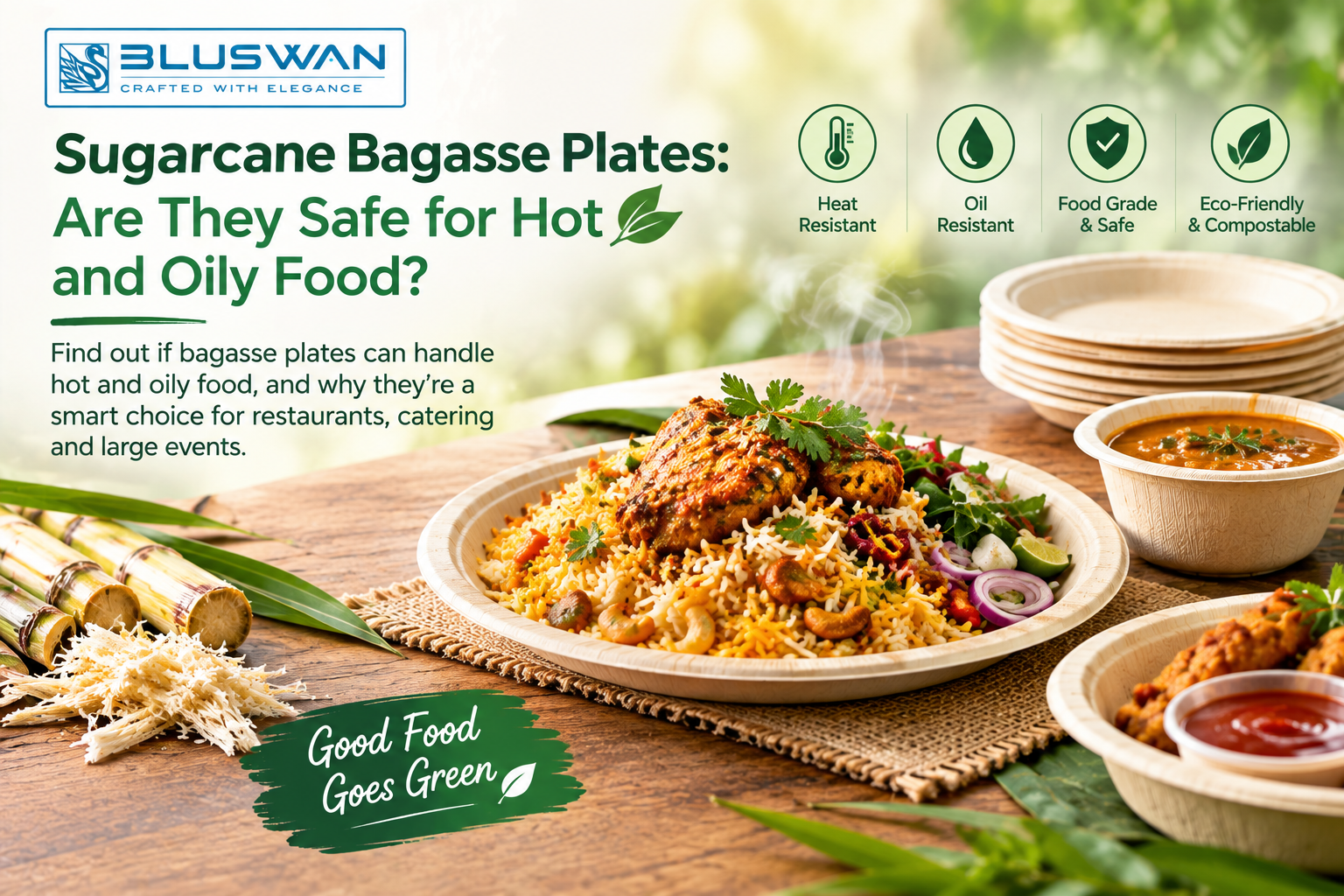
As restaurants, caterers, food-delivery businesses, and event organizers look for alternatives to conventional plastic tableware, bagasse plates have become a popular option. Made from sugarcane fibre, these plates offer a natural-looking and convenient way to serve food while making use of a by-product of the sugar industry.
But one question comes up often:
Are sugarcane bagasse plates safe for hot and oily food?
The short answer is: many food-grade bagasse plates are designed for hot and oily foods, but safety and performance depend on the specific product, manufacturing process, food-contact compliance, and intended-use instructions.
This distinction is important. A plate should not be considered safe simply because it is labelled "bagasse" or "biodegradable." Restaurants and businesses should choose products made specifically for food contact and obtain appropriate compliance documentation from the supplier.
India's Food Safety and Standards Authority of India (FSSAI) requires food-contact packaging materials to meet applicable requirements and states that packaging materials should be compatible with their intended use without affecting food quality or safety. FSSAI's regulations also require food-contact packaging materials to meet relevant conformity requirements.
Let's look at what bagasse plates are, how they perform with hot and oily foods, and what businesses should check before purchasing them.
Sugarcane bagasse is the fibrous material left after sugarcane is crushed to extract its juice.
Instead of treating this fibre simply as waste, manufacturers can process it into pulp and mold it into useful products such as:
This makes bagasse an interesting material for disposable food-service products.
Research published in Matter described tableware made from sugarcane bagasse and bamboo fibres as biodegradable and suitable for food-packaging applications, with testing showing properties such as oil stability and water resistance in the developed products.
The important point is that not every bagasse product is identical. Thickness, fibre composition, molding process, additives, coatings, and manufacturing quality can all affect performance.
Generally, food-grade bagasse plates that are manufactured and tested for hot-food applications can be suitable for serving hot food.
This is one reason bagasse tableware is widely considered for restaurants, catering services, cafeterias, events, and takeaway applications.
Hot foods can include:
However, "hot-food safe" should be treated as a product-specific claim, not a blanket statement about every bagasse plate.
Before using a particular plate for very hot food, businesses should check the manufacturer's recommended temperature range and food-contact documentation.
The Principal Scientific Adviser's Office of the Government of India describes one biodegradable tableware technology using agricultural waste including sugarcane bagasse as suitable for hot and cold foods and microwave-friendly. This illustrates that appropriately engineered plant-fibre tableware can be designed for hot-food applications.
When hot food is placed on a good-quality bagasse plate, the plate is expected to retain its basic shape and provide sufficient strength for normal serving.
However, performance depends on several factors:
Extremely hot food may place more stress on disposable tableware than moderately warm food.
Foods containing a lot of water or liquid can affect fibre-based products over time.
A plate may perform differently when food is served and consumed quickly compared with food that remains on the plate for several hours.
A thicker, well-formed plate generally provides different structural performance from a lightweight product.
The quality of the raw material, pulping, molding, drying, and finishing processes can affect the final product.
This is why restaurants should test samples with the actual foods they serve before placing large orders.
Oily food is another important consideration.
Indian and international cuisines include many dishes containing oils, sauces, butter, and fats.
Examples include:
Some bagasse products are engineered to provide good resistance to oils and moisture.
A peer-reviewed study on bagasse-based tableware reported that its developed tableware had strong oil stability and hydrophobicity, demonstrating that bagasse fibre products can be engineered for food-service requirements.
However, this research does not mean every bagasse plate on the market has identical performance.
Businesses should therefore ask suppliers for product-specific specifications and testing information.
When oily food remains on a fibre-based plate, the oil can interact with the material.
A suitable food-service plate should maintain its structure long enough for normal eating or serving.
Poor-quality tableware may:
For catering businesses, this can create a poor customer experience.
For this reason, oil resistance should be considered alongside strength, moisture resistance, temperature performance, and food-contact compliance.
This is one of the most common questions for Indian restaurants and caterers.
Many food-grade bagasse plates are designed for foods containing moisture, sauces, and oils. But performance varies between products.
For dishes such as:
the plate should be tested under realistic serving conditions.
For particularly liquid-heavy dishes, a bagasse bowl or deeper compartment plate may be more appropriate than a shallow plate.
The best product depends on:
Food type + temperature + quantity + contact time + plate design
"Food-grade" generally means that a material or product is intended and suitable for contact with food when used under the specified conditions.
For food businesses, this is a particularly important distinction.
FSSAI's packaging regulations state that packaging materials intended to come into contact with food must meet applicable requirements, and materials should be compatible with their intended use so that they do not compromise the quality or safety of food.
Therefore, restaurants should not select disposable plates solely because they look natural or are advertised as eco-friendly.
Instead, ask:
It is not accurate to say that every bagasse plate is automatically free from all potentially concerning substances.
The final product depends on manufacturing practices and any substances used during processing or finishing.
A recent study examining 22 commercial sugarcane pulp tableware products found varying levels of total fluorine and detected occasional PFOA residues in some samples, while measured migration of the targeted PFAS compounds under the study's simulated conditions was low. The researchers concluded that manufacturing quality control remains important.
Another study of sugarcane pulp takeaway containers reported migration and microparticle concerns under certain acidic-food test conditions, highlighting why food-contact materials should be assessed according to their intended use rather than assumed to be universally safe.
This is an important lesson for buyers:
Choose verified food-contact products rather than relying only on the word "natural" or "biodegradable."
The answer depends on what you mean by "better."
From a material perspective, bagasse uses a plant-derived fibre stream from sugarcane processing, while conventional plastic tableware is made from petrochemical-derived polymers.
Bagasse can therefore offer an alternative for businesses seeking plant-fibre tableware.
However, environmental performance should be evaluated across the full life cycle, including:
A biodegradable product does not automatically have the same environmental outcome in every location.
The disposal infrastructure available to the business also matters.
For food-service businesses, bagasse plates can offer several practical advantages.
Bagasse comes from sugarcane fibre, making it different from conventional plastic tableware.
Depending on the product specification, bagasse plates can be used for hot, cold, moist, and oily foods.
Disposable fibre plates can be easier to transport and handle than heavier reusable tableware.
Many bagasse plates are designed to stack efficiently, which can simplify storage.
Businesses can select different sizes according to their menu and portion requirements.
The fibre texture can provide a clean, natural appearance for catering and events.
Bagasse plates can be considered for:
Restaurants have different requirements from household users.
A restaurant may serve hundreds of meals every day, making reliability extremely important.
Before choosing bagasse plates, businesses should test them with their actual menu.
For example:
Rice, bread, snacks, and dry meals are generally easier to serve.
Test the plate with fried food, oily curries, and sauces.
Consider deeper bowls or containers for soups and heavily liquid dishes.
Test whether the plate remains rigid when loaded with the restaurant's normal serving size.
This simple testing process can prevent problems after a bulk purchase.
Here are some practical points to check.
Look for information about intended food applications and temperature limitations.
Request relevant certificates, conformity reports, or laboratory documentation from the supplier.
Place the actual hot food served by your restaurant on a sample plate.
Use oily curries, fried food, or sauces to evaluate the product.
Don't only test the plate for five minutes. If customers normally take 30–60 minutes to eat, test under realistic conditions.
Load the plate with a normal serving and see whether it bends or becomes difficult to carry.
Make sure the plates can be stored in a clean, dry area.
Microwave suitability is product-specific.
Some plant-fibre tableware products are designed and tested for microwave use, while others may not be.
Therefore, never assume that every bagasse plate is microwave-safe.
The Government of India's Principal Scientific Adviser's Office lists a particular biodegradable tableware technology made using agricultural waste as microwave- and food-safe, but this should not be generalized to every bagasse product available on the market.
Always follow the manufacturer's instructions.
Many bagasse products are marketed as compostable or biodegradable, but the exact claim depends on the product and certification.
Compostability can also depend on the composting environment.
Some products are designed for industrial or commercial composting rather than ordinary household composting.
Therefore, businesses should check:
A clear disposal plan is particularly important for restaurants and large events.
Bluswan Indus offers sugarcane bagasse plates and other sustainable tableware products for food-service applications.
Its product range includes different plate formats and sizes designed for restaurants, catering businesses, events, and other food-service requirements.
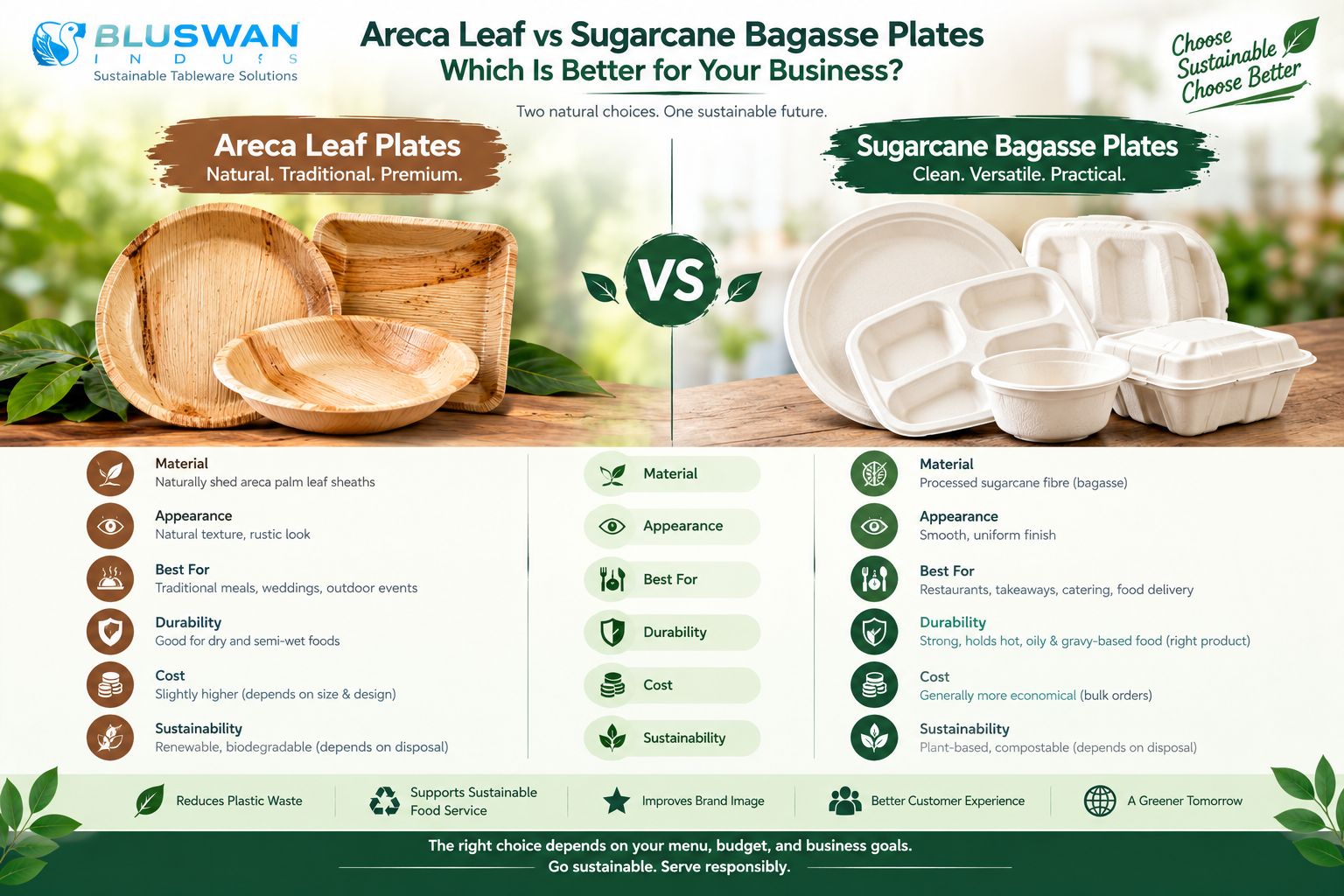
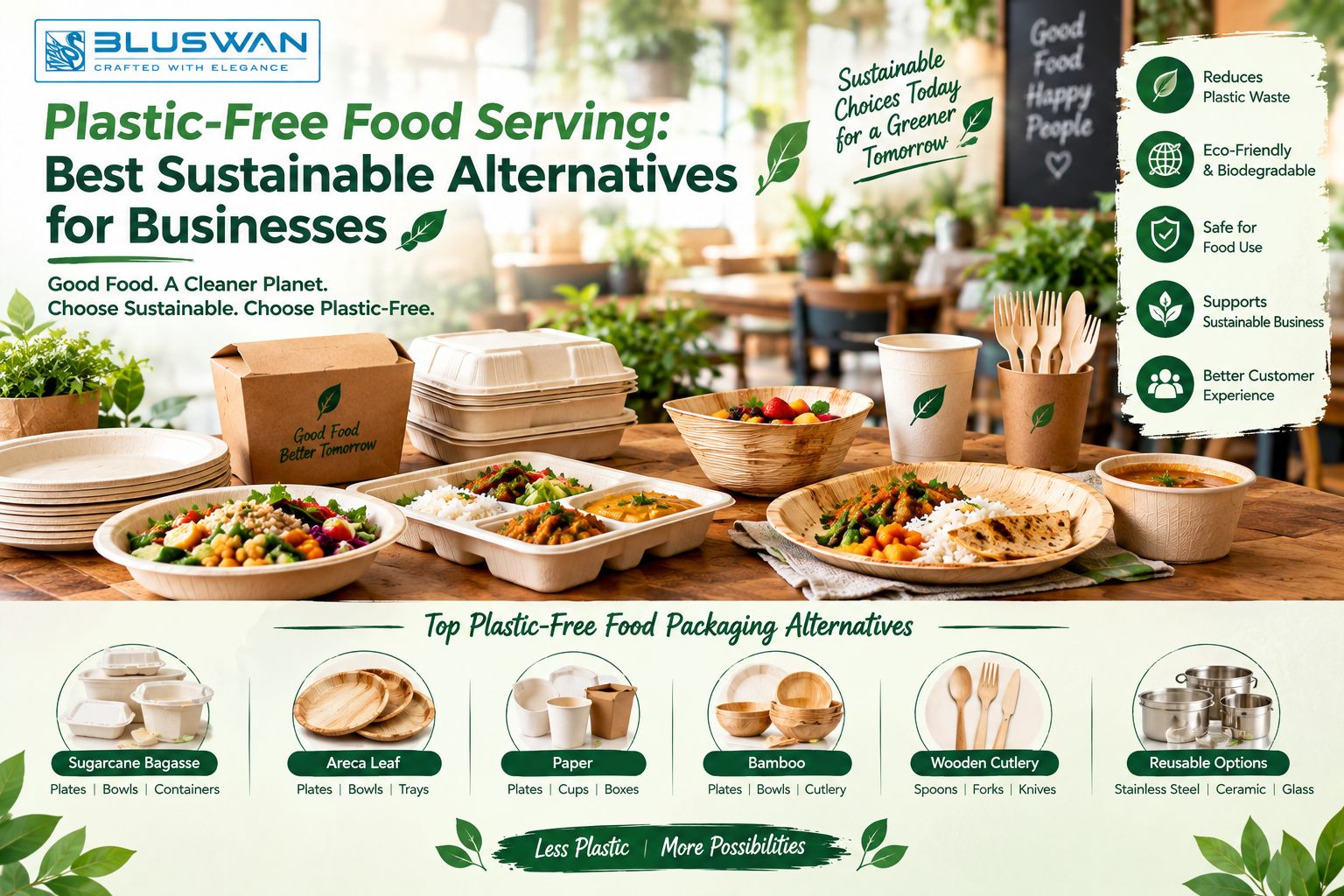
For businesses looking to move away from conventional disposable tableware, bagasse can be considered alongside other plant-based options such as areca leaf and rice-bran products.
The important step is selecting the correct product according to the food, temperature, serving method, and disposal requirements.
Food-grade bagasse plates can be suitable for hot and oily foods when they are specifically manufactured, tested, and labelled for those applications.
However, the phrase "bagasse plate" alone is not enough to guarantee safety or performance.
Restaurants and catering businesses should verify:
Scientific research shows that bagasse can be engineered into food-contact tableware with useful strength, water resistance, and oil resistance. At the same time, research on commercial sugarcane-pulp products has identified cases where chemical residues or migration issues warrant stronger manufacturing controls.
So, the smartest approach is not simply to ask "Are bagasse plates safe?"
Instead, ask:
"Is this particular bagasse plate tested and suitable for the food I want to serve?"
That question helps restaurants make a much more informed purchasing decision.
Yes, many food-grade bagasse plates are designed for hot-food service. Always check the specific manufacturer's temperature and usage specifications.
Many bagasse plates are designed to handle oily foods, but oil resistance varies between products. Test the specific plate with your food before bulk purchasing.
Suitable bagasse plates can be used for many curry-based foods. For foods with a lot of liquid, a deeper plate, compartment plate, or bagasse bowl may be more appropriate.
Food-grade bagasse tableware can be suitable for food contact when manufactured and tested according to applicable requirements. Buyers should request relevant compliance documentation.
Some products are specifically designed and tested for microwave use, but this cannot be assumed for every bagasse plate. Follow the manufacturer's instructions.
Many bagasse products are designed to be biodegradable or compostable, but the exact claim depends on the product, certification, and disposal conditions.
Yes. Depending on their specifications, bagasse plates can be used in restaurants, catering, food delivery, weddings, corporate events, and other food-service applications.
Check food-contact compliance, temperature suitability, oil resistance, strength, size, certifications, storage requirements, and disposal instructions.

2026 © All rights reserved by Bluswan indus Pvt Ltd
Powered by : Innoplus TechnologiesYour item has already added in wishlist successfully


