Welcome to our Organic store Bluswan Indus Pvt Ltd! | +91 9346545670 (Main Office) | +91 7794920404 (Machines)
Welcome to our Organic store Bluswan Indus Pvt Ltd! | +91 9346545670 (Main Office) | +91 7794920404 (Machines)
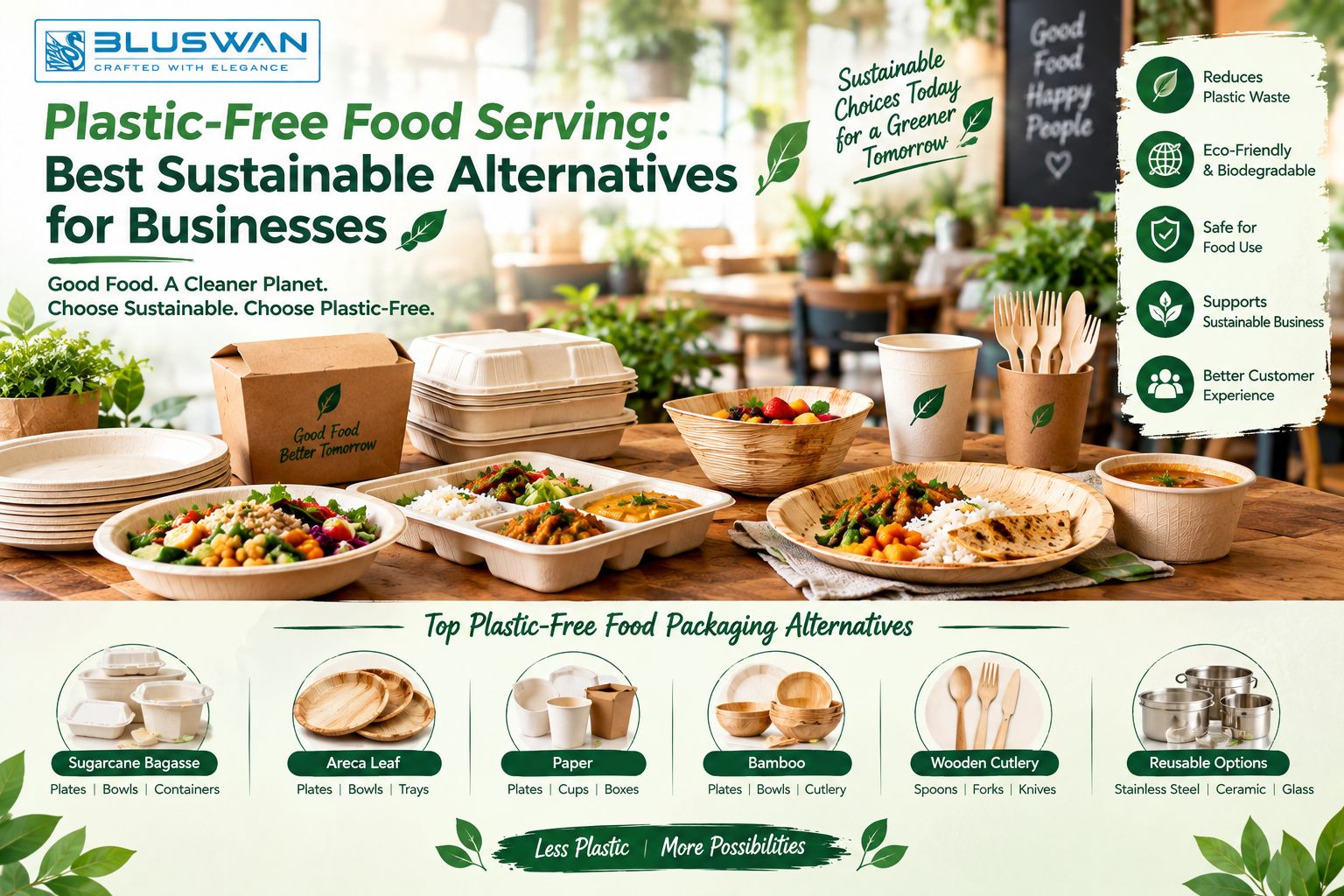
The food-service industry is changing quickly. Restaurants, cafés, caterers, cloud kitchens, food trucks, hotels, and event organizers are looking for practical ways to reduce their dependence on conventional plastic products.
One of the most visible changes is the move toward plastic-free food packaging and sustainable food-serving products.
From plates and bowls to takeaway containers and cutlery, businesses now have several alternatives made from plant-based and renewable materials. Sugarcane bagasse, areca leaf, paper, bamboo, wood, and other fibre-based materials can provide useful options for different food-service requirements.
Going plastic-free does not mean that every business has to completely change its operations overnight. A better approach is to identify where plastic is being used most and replace suitable products step by step.
In this blog, we explore the best sustainable alternatives for plastic-free food serving, their benefits, applications, and important factors businesses should consider before making the switch.
Plastic-free food packaging refers to food-serving and packaging products designed without conventional plastic as the primary material.
Depending on the product, alternatives may be made from:
These materials can be used to manufacture plates, bowls, trays, takeaway boxes, cups, containers, and cutlery.
However, businesses should look beyond the term "eco-friendly" when choosing products. Different materials have different properties, disposal requirements, food-contact specifications, and environmental impacts.
The best solution is the one that matches the food, serving method, budget, and local waste-management system.
Plastic has traditionally been popular because it is lightweight, inexpensive, durable, and convenient.
The problem is that many disposable plastic food-service products are designed for very short periods of use. A plate or container may be used for only a few minutes before becoming waste.
This has encouraged restaurants and other food businesses to explore alternatives.
Customers are also becoming more interested in sustainable packaging. A restaurant that uses plant-based plates or responsible takeaway packaging can communicate its sustainability efforts as part of its brand identity.
For businesses, the transition can provide several advantages:
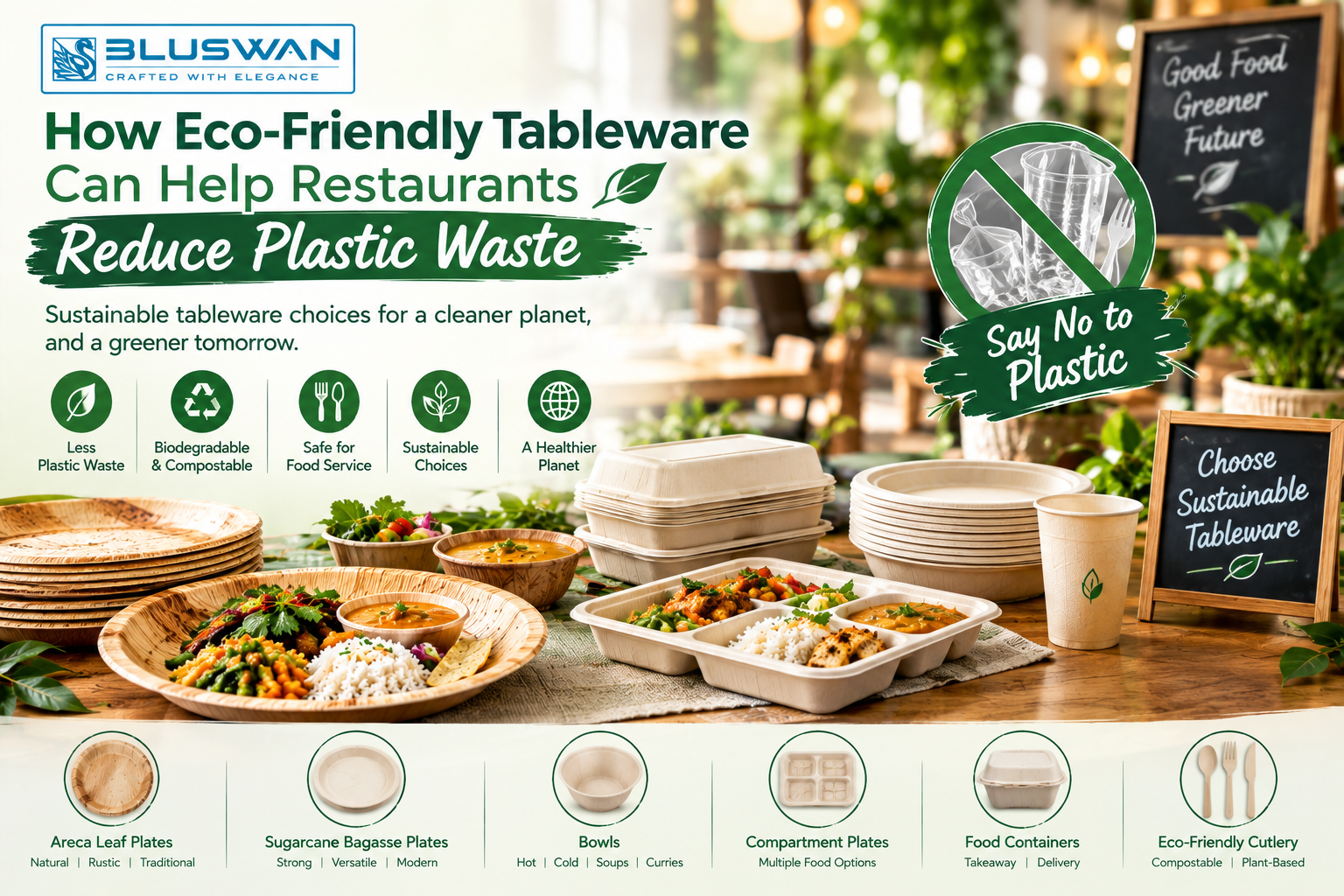
Sugarcane bagasse is one of the most popular alternatives for disposable food-service products.
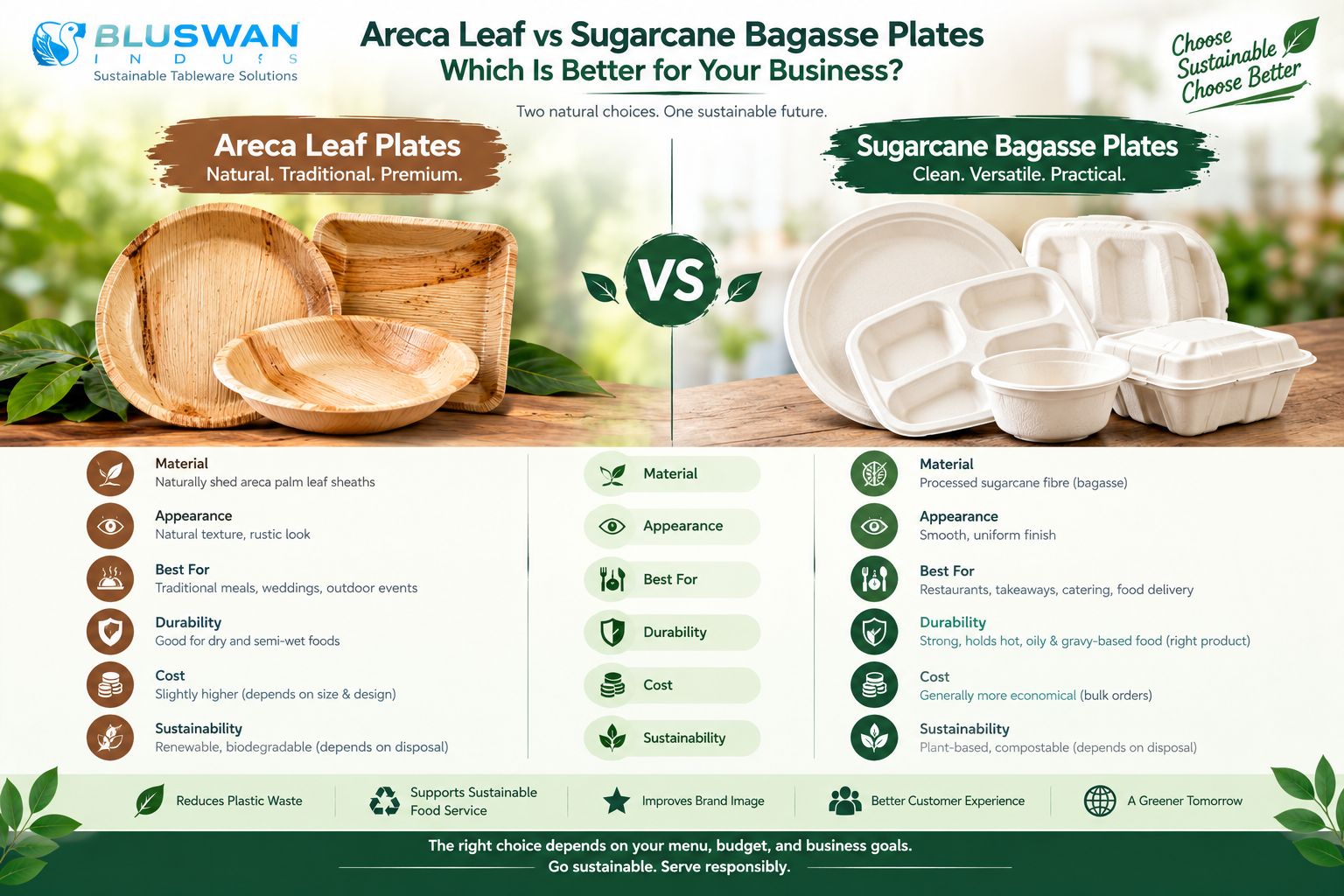
Bagasse is the fibrous material left after sugarcane is processed for juice or sugar. This fibre can be processed and moulded into plates, bowls, trays, and takeaway containers.
Bagasse products can offer a clean, modern appearance while providing practical food-serving solutions.
They are available in various designs, including:
Bagasse products are commonly considered for restaurants, catering companies, food delivery businesses, corporate events, and large gatherings.
For businesses serving rice, curries, snacks, salads, or takeaway meals, selecting the appropriate bagasse product can provide a convenient alternative to conventional plastic tableware.
Areca leaf plates are another popular sustainable food-serving option.
They are made from naturally shed areca palm leaf sheaths that are collected, cleaned, dried, and formed into tableware.
One of their biggest advantages is their natural appearance.
The visible texture of the leaf gives the plates a distinctive look that works particularly well for:
Areca leaf plates can make food presentation feel more natural and premium.
They are especially useful for businesses that want their tableware itself to communicate a connection with nature.
Paper remains one of the most familiar alternatives to plastic.
Paper-based products are available as:
However, businesses should pay attention to how paper products are manufactured and coated.
Not every paper product is automatically plastic-free or compostable. Some food-service paper products may contain coatings or linings designed to provide moisture or grease resistance.
Therefore, businesses should ask suppliers about the material composition and disposal requirements before purchasing in bulk.
Bamboo is a rapidly renewable plant material and is used for several food-service products.
Bamboo can be used to produce items such as:
Bamboo products can be particularly attractive for restaurants that want a natural or premium presentation.
They can work well in cafés, resorts, restaurants, outdoor events, and specialty food businesses.
The exact environmental performance depends on how the product is manufactured, transported, used, and disposed of, so businesses should consider the complete product lifecycle.
Plastic spoons, forks, and knives are common in takeaway and catering operations.
Wooden alternatives can provide a simple way to reduce conventional plastic cutlery.
Wooden cutlery can include:
These products can pair well with bagasse plates and areca leaf tableware.
For restaurants offering takeaway meals, replacing plastic cutlery with suitable wood-based alternatives can also improve the overall appearance of the packaging.
Takeaway packaging is another major area where restaurants can reduce their dependence on conventional plastic.
Businesses can explore fibre-based containers for:
Different foods require different packaging properties.
For example, oily foods and gravies need containers designed to handle moisture and grease. Hot foods require packaging suitable for the expected temperature.
Therefore, businesses should test packaging with their actual menu before switching completely.
A container that works perfectly for a sandwich may not necessarily be suitable for a hot curry.
Compostable food containers are another option businesses may consider.
These products are designed to break down under specified composting conditions. However, businesses should understand the difference between biodegradable and compostable products.
"Compostable" generally refers to products designed to break down under defined composting conditions, while "biodegradable" is a broader term.
A product's disposal route matters.
If a restaurant uses compostable containers but sends them to a waste stream where suitable composting is unavailable, the intended environmental benefit may not be fully achieved.
Therefore, businesses should consider both product selection and local waste infrastructure.
Bowls and trays are essential for many food businesses.
Restaurants serving soups, curries, rice bowls, salads, desserts, and combination meals can explore plant-fibre alternatives to conventional plastic bowls and trays.
Bagasse bowls and trays can provide a practical solution for many applications.
Compartment trays are particularly useful for meals containing several components.
For example, an Indian meal may include:
A compartment tray can keep different foods separated while making serving easier.
Going plastic-free does not always mean replacing plastic with another disposable product.
For dine-in restaurants, reusable tableware can sometimes be the better solution.
Businesses can use:
Reusable products can reduce the need for single-use tableware when the business has suitable washing, storage, and sanitation facilities.
A restaurant should compare the operational requirements of reusable products with disposable alternatives.
For takeaway and large outdoor events, disposable plant-based products may be more practical. For regular dine-in service, reusable tableware may make more sense.
Food delivery has created a major demand for convenient packaging.
Cloud kitchens and restaurants need containers that are:
Businesses can consider fibre-based containers and other suitable alternatives instead of conventional plastic containers.
However, food delivery packaging should always be tested under real conditions.
A restaurant should test the packaging for:
A sustainable package that fails during delivery can result in food spills, customer complaints, and unnecessary waste.
Switching to sustainable packaging should be a planned business decision.
Here are some important factors to consider.
Start with your menu.
Ask:
This will help determine the right packaging material.
A plate or container should be strong enough for the food it is intended to carry.
Test products before ordering large quantities.
Food packaging should be intended for food contact and should meet applicable food-safety requirements.
Businesses should request relevant product information and compliance documentation from suppliers where appropriate.
Don't select a product simply because it says "eco-friendly."
Ask:
Understanding the end-of-life process is an important part of sustainable packaging.
The cheapest product may not always be the most economical.
Consider:
A reliable product that performs consistently can provide better overall value.
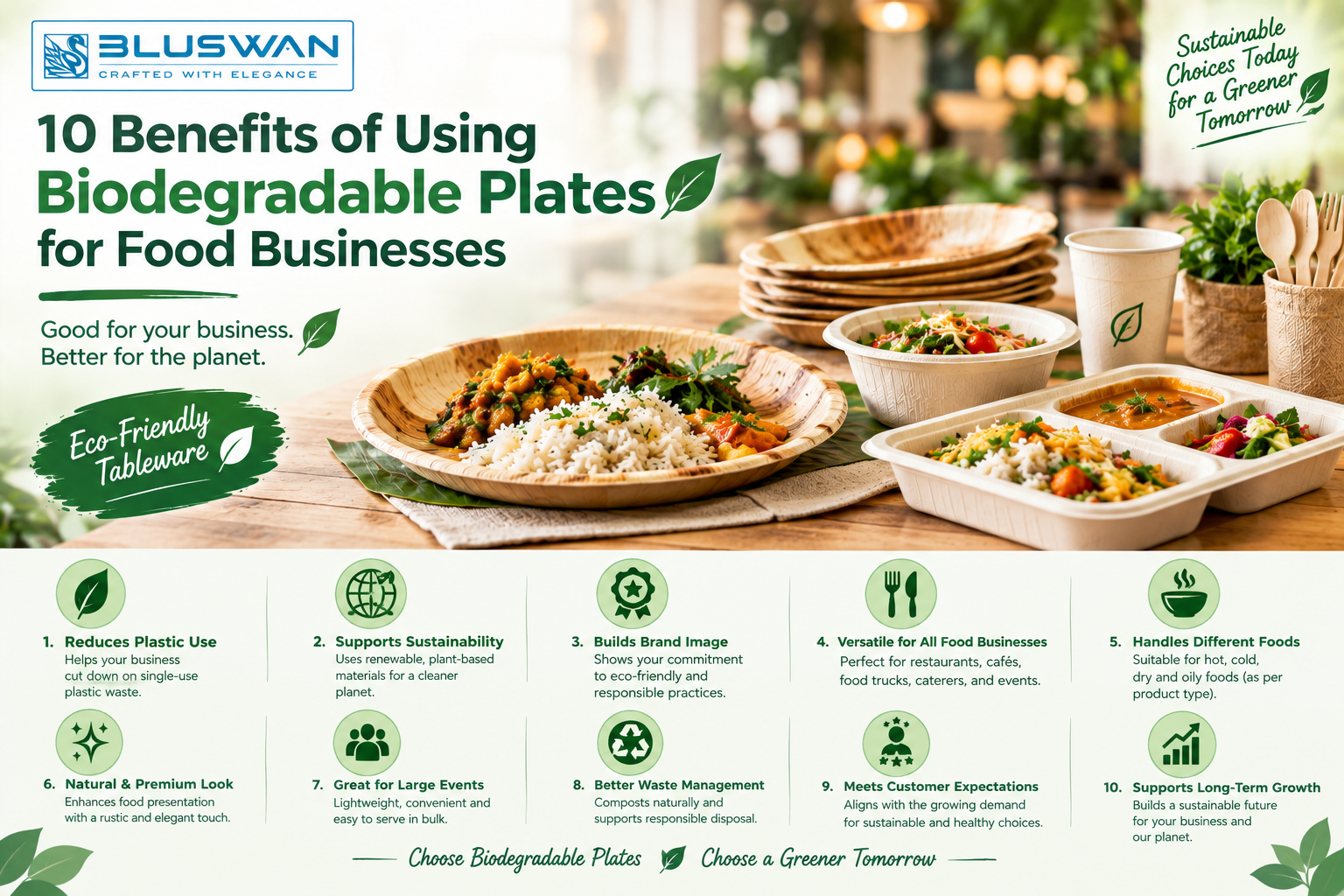
Switching suitable food-service products away from conventional plastic can offer several benefits.
Businesses can demonstrate practical efforts toward reducing conventional plastic use.
Sustainable packaging can appeal to customers who value environmentally responsible choices.
Natural materials such as areca leaf and bagasse can create an attractive food presentation.
Plant-based tableware is available for restaurants, catering, events, takeaway, and delivery.
Businesses can communicate their sustainability efforts through social media, packaging, menus, and marketing campaigns.
Businesses should be careful when promoting sustainable packaging.
Simply calling a product "100ìo-friendly" does not explain its complete environmental impact.
Instead, communicate specific information.
For example:
"We use sugarcane bagasse containers for selected takeaway meals."
This is more informative than making a broad environmental claim.
Businesses should also avoid claiming that every biodegradable product will disappear quickly in normal surroundings. Disposal conditions can vary significantly between materials and products.
Honest communication builds more trust with customers.
For restaurants, caterers, event organizers, food-service businesses, and other organizations looking for alternatives to conventional disposable plastic, Bluswan Indus offers sustainable tableware solutions.
Its product range can help businesses explore options such as:
The right choice depends on the type of food, serving method, expected usage, budget, and disposal system.
Businesses should select products based on actual operational requirements rather than choosing a product simply because it is marketed as sustainable.
Moving toward plastic-free food packaging is becoming an important consideration for modern food businesses.
Restaurants, cafés, caterers, cloud kitchens, food trucks, hotels, and event organizers have several alternatives available, from sugarcane bagasse and areca leaf to paper, bamboo, wood, and reusable tableware.
The most effective approach is not simply to replace one disposable product with another. Businesses should look at the entire process—from sourcing and food service to transportation, customer use, and final disposal.
Start with the products where plastic use is highest. Test sustainable alternatives with your actual menu, train employees, communicate your choices honestly, and build a waste-management system that supports those products.
With the right planning, businesses can reduce their reliance on conventional plastic while maintaining food quality, convenience, presentation, and customer satisfaction.
Choose smarter packaging. Serve responsibly. Build a more sustainable food business.
2026 © All rights reserved by Bluswan indus Pvt Ltd
Powered by : Innoplus TechnologiesYour item has already added in wishlist successfully


