Welcome to our Organic store Bluswan Indus Pvt Ltd! | +91 9346545670 (Main Office) | +91 7794920404 (Machines)
Welcome to our Organic store Bluswan Indus Pvt Ltd! | +91 9346545670 (Main Office) | +91 7794920404 (Machines)
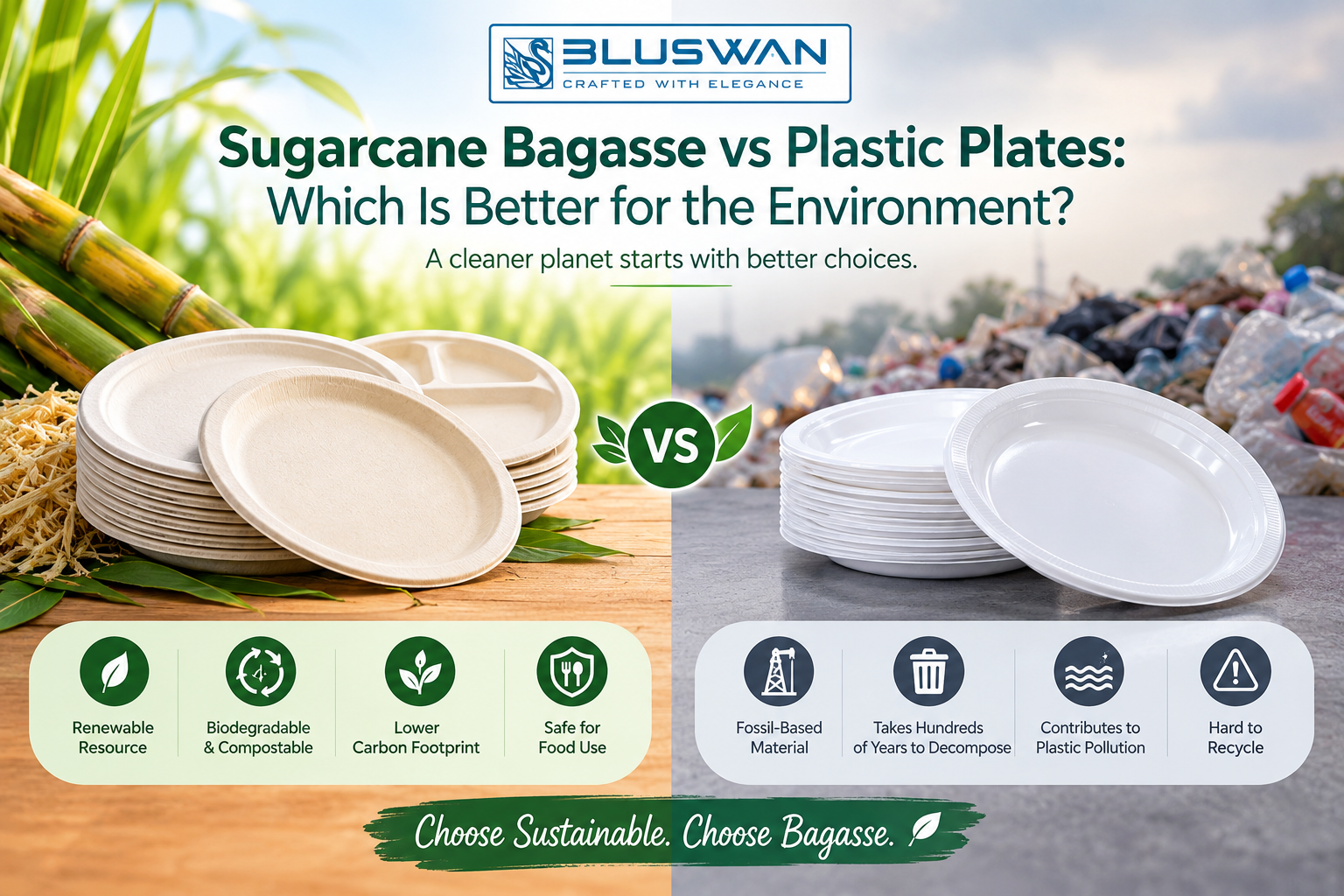
When restaurants, cafés, caterers, and food-service businesses choose disposable plates, convenience is only one part of the decision. The material used for those plates can also affect how waste is managed after the food has been served.
For years, plastic plates have been a common choice because they are lightweight, inexpensive, and convenient. However, the environmental concerns associated with single-use plastic have encouraged businesses to explore alternatives made from renewable or plant-based materials.
One increasingly popular option is sugarcane bagasse plates.
Sugarcane bagasse is the fibrous material left after sugarcane is processed for juice or sugar. It can be converted into food-service products such as plates, bowls, trays, and containers. This gives businesses an alternative to conventional fossil-fuel-based plastic tableware.
But does that automatically make bagasse better for the environment?
The answer depends on several factors, including how the product is manufactured, how it is used, and what happens to it after disposal. Life-cycle research shows that the environmental performance of disposable tableware depends heavily on production and end-of-life systems.
Let's compare sugarcane bagasse plates vs plastic plates in more detail.
Sugarcane bagasse is the fibrous residue left after extracting juice from sugarcane. Instead of treating this material simply as waste, manufacturers can use it as a raw material for molded food-service products.
Bagasse can be processed into plates with different shapes, sizes, and compartment designs.
The use of agricultural by-products in tableware is one reason bagasse has attracted attention as an alternative to conventional plastic products.
Plastic plates are generally made from synthetic polymers produced from petrochemical feedstocks. They are widely used because plastic can be lightweight, durable, inexpensive, and resistant to moisture.
These characteristics have made plastic popular in food-service applications.
However, the same durability that makes plastic useful also creates a waste-management challenge when products are designed for only one use. UNEP identifies the growth of single-use plastic waste as a significant environmental challenge and highlights the importance of reducing unnecessary single-use products and improving waste-management systems.
| Feature | Sugarcane Bagasse Plates | Plastic Plates |
|---|---|---|
| Main material | Sugarcane fiber | Synthetic plastic polymers |
| Material source | Agricultural by-product | Primarily fossil-based feedstocks |
| Typical use | Food service and catering | Food service and catering |
| End-of-life options | Can be suitable for composting where facilities accept the product | Usually managed through conventional waste systems |
| Appearance | Natural, fiber-based appearance | Smooth plastic appearance |
| Sustainability potential | Stronger when suitable composting systems are available | Limited by persistence of plastic waste |
| Suitable for food service | Yes | Yes |
| Disposal requirements | Depends on local composting infrastructure | Depends on local waste-management infrastructure |
The table shows why bagasse can be attractive, but it is important not to assume that every product labeled "eco-friendly" automatically has the same environmental performance.
One major difference is where the materials come from.
Sugarcane bagasse comes from the fibrous portion of sugarcane left after juice extraction. Turning this material into useful products can create another use for an agricultural by-product.
Plastic, on the other hand, is produced from synthetic polymers, with conventional plastics largely linked to fossil-based feedstocks.
This difference in material origin is one reason plant-based tableware has become increasingly popular among businesses looking for alternatives to conventional disposable plastics.
One of the biggest differences between bagasse and plastic is what can happen after the product has been used.
A compostable bagasse product may be able to enter an appropriate composting system, depending on the product specifications and local facility requirements.
However, compostable does not mean that the product will automatically disappear anywhere it is thrown away.
The U.S. Federal Trade Commission states that compostable claims should be supported by reliable evidence and that claims should be qualified when appropriate composting facilities are not available.
This is an important point for restaurants.
A restaurant choosing bagasse plates should also consider whether suitable organic-waste or composting infrastructure exists in its area.
Plastic's durability is useful during its intended use, but it becomes a challenge when plastic products are discarded incorrectly.
UNEP reports that plastic pollution is a major global environmental issue, with large quantities of plastic waste ending up in landfills or being mismanaged.
Single-use plastic products are particularly challenging because they may be used for only a short period before becoming waste.
This is why reducing unnecessary single-use products and improving waste-management systems are important parts of addressing plastic pollution.
One of the biggest potential advantages of sugarcane bagasse plates is their compatibility with appropriate organic-waste management systems.
Research examining compostable food-service tableware has found that compostable tableware combined with organic recycling can have environmental advantages compared with certain fossil-based disposable tableware scenarios.
But the disposal system matters.
If a compostable product is sent to a waste stream that cannot process it appropriately, its environmental benefits may not be fully realized.
Therefore, businesses should look beyond the label and understand how the product should actually be disposed of.
There isn't one universal answer for every situation.
Environmental performance depends on the entire life cycle of a product, including raw materials, manufacturing, transportation, use, and disposal.
Research comparing disposable tableware systems has found that compostable systems can perform better than fossil-based plastic systems under certain assumptions, particularly when composting or organic recycling is available.
At the same time, UNEP's life-cycle work emphasizes that single-use itself is an important part of the environmental equation. In some situations, reusable products can avoid the need to manufacture and dispose of a new item for every meal.
So the practical comparison is not simply:
Bagasse = good
Plastic = bad
Instead, businesses should consider the complete product life cycle and the waste system available to them.
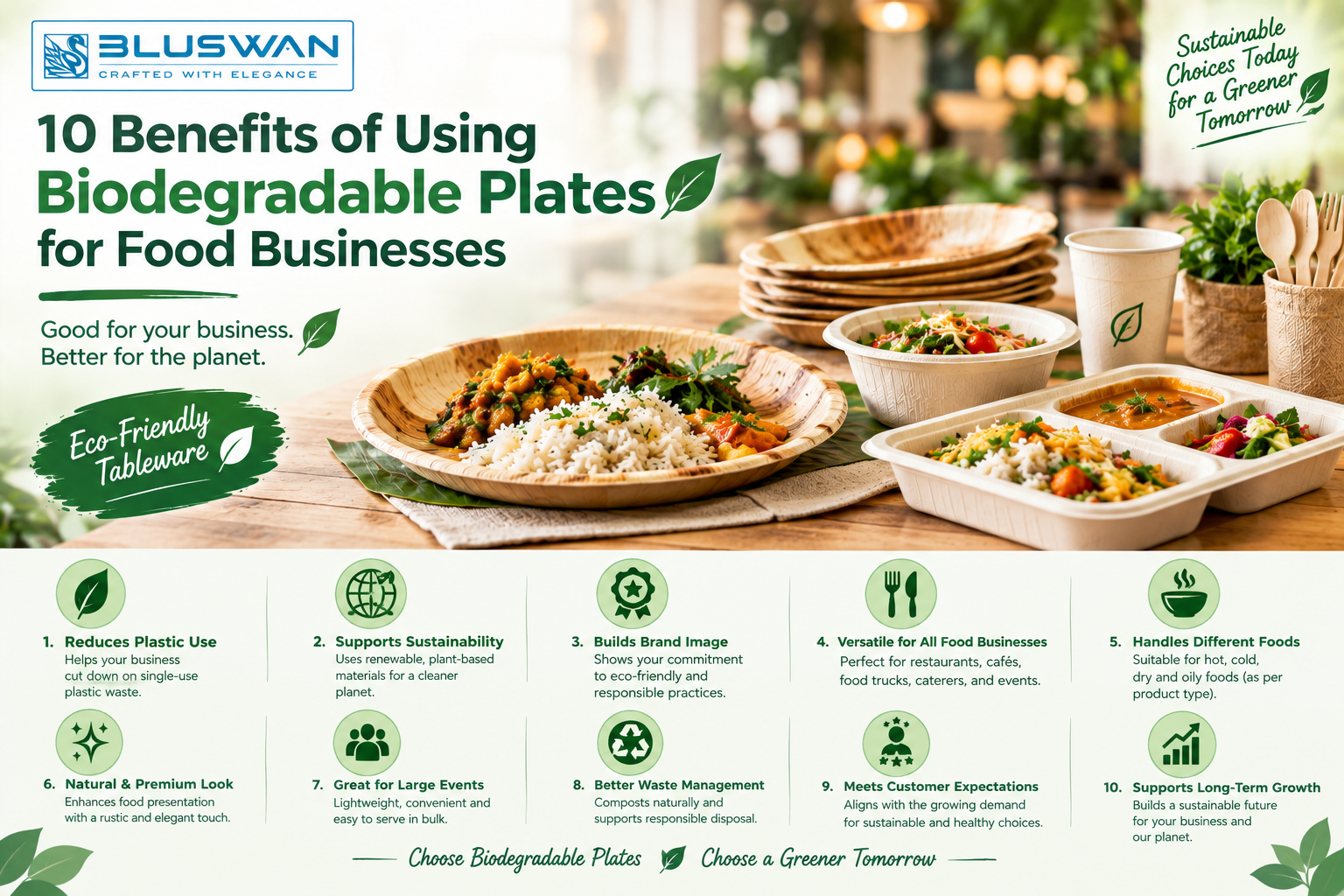
For restaurants and catering businesses, bagasse plates can provide several practical advantages.
Bagasse uses sugarcane fiber, giving businesses an alternative to conventional plastic tableware.
Bagasse plates are available in various sizes and formats, making them suitable for meals, snacks, catering, events, and takeaway service.
The light, natural appearance of bagasse can complement restaurants and events that want a more sustainable or minimal presentation.
Large events often require hundreds or thousands of disposable plates. Bagasse can be considered for weddings, parties, corporate events, festivals, and outdoor catering.
Where suitable composting infrastructure exists and the specific product is certified or accepted by that system, bagasse products may be directed toward organic waste processing rather than conventional plastic waste streams.
Choosing a plant-based plate does not remove every environmental concern.
A compostable product needs an appropriate composting environment to achieve its intended end-of-life outcome.
Like every manufactured product, bagasse plates require raw materials, manufacturing, packaging, and transportation. These stages all contribute to the product's overall environmental footprint.
Products can differ in materials, coatings, manufacturing processes, certifications, and disposal requirements.
Businesses should check the manufacturer's specifications instead of relying only on general terms such as "green" or "eco-friendly."
Restaurants should understand whether their local waste-management provider accepts the specific product.
Restaurants looking to reduce their environmental impact can take several practical steps.
A restaurant serving curries and complete meals may need a sturdy compartment plate, while a café serving desserts may need a smaller plate.
Choosing the correct product can prevent unnecessary material use.
If a supplier describes a product as compostable or biodegradable, ask for supporting certifications or documentation.
The FTC recommends that environmental claims be supported by competent and reliable evidence.
Before purchasing large quantities, check whether local waste-management or composting facilities accept the product.
Restaurants should consider product quality, material specifications, packaging, delivery, consistency, and supply capacity when selecting a supplier.
Disposable alternatives can reduce certain waste-management challenges, but reusable tableware can also be appropriate in settings where washing, storage, and repeated use are practical.
UNEP's life-cycle analysis emphasizes that replacing unnecessary single-use products with reusable systems can be an important part of moving toward a more circular economy.
Restaurants are under increasing pressure to balance convenience, customer expectations, operating costs, and sustainability.
Sugarcane bagasse offers a plant-based alternative that can fit many food-service applications.
Its biggest appeal is that it combines the convenience of disposable tableware with a material derived from sugarcane processing rather than conventional plastic.
For businesses that already use disposable plates, moving toward appropriate bagasse products can be one option to explore as part of a broader waste-reduction strategy.
Bagasse plates can be used across a wide range of food-service settings.
Restaurants can use different sizes of bagasse plates for starters, meals, desserts, and takeaway service.
Catering companies can use disposable plates for weddings, parties, corporate events, and large gatherings.
Food businesses focused on delivery can consider plant-based tableware alongside other sustainable packaging options.
For outdoor functions where washing and storing reusable plates may be difficult, disposable alternatives can offer convenience.
Businesses organizing conferences, meetings, workshops, and employee events can consider sustainable food-service products as part of their event planning.
Bluswan Indus offers sustainable tableware options designed for food-service applications.
Its range includes products made from materials such as Sugarcane Bagasse, Areca Leaf, Rice Bran, and Wheat Bran.
For restaurants, catering companies, event organizers, and food businesses exploring alternatives to conventional plastic tableware, choosing the right material and format is an important first step.
Businesses should consider their menu, serving requirements, order quantities, disposal system, and product specifications before making a purchase.
The comparison between sugarcane bagasse plates and plastic plates is not simply about choosing one material and declaring it universally better.
Plastic remains useful in many applications, but the environmental problems associated with poorly managed single-use plastic waste are well documented.
Sugarcane bagasse provides a plant-based alternative that can offer environmental advantages in the right production and waste-management conditions. Research indicates that compostable food-service systems can perform favorably in certain life-cycle scenarios, particularly when organic recycling is available.
For restaurants considering a switch, the best approach is to look at the complete picture: material, product quality, food requirements, manufacturing, transportation, disposal, and local composting infrastructure.
If your business is looking for an alternative to conventional plastic disposable plates, sugarcane bagasse plates are worth considering as part of a broader sustainable food-service strategy.
Sugarcane bagasse plates can have environmental advantages over fossil-based plastic tableware in certain life-cycle and disposal scenarios, particularly when suitable composting or organic recycling is available. The exact comparison depends on the products and waste systems being compared.
They are made from the fibrous residue left after sugarcane juice is extracted. This material can be processed into disposable food-service products.
Some bagasse plates are designed and certified as compostable, but businesses should check the specific manufacturer's certification and disposal instructions. Compostability depends on the product and appropriate composting conditions.
Yes. Bagasse plates are used for a range of food-service applications, including restaurants, catering, events, takeaway, and food delivery.
Many food-service bagasse products are designed for serving meals, but restaurants should always check the manufacturer's specifications for temperature, moisture, oil, and food compatibility.
Restaurants should check the plate size, strength, food compatibility, certifications, packaging, pricing, supplier reliability, and local disposal or composting options.
No. Every manufactured product has an environmental footprint. Raw-material processing, manufacturing, transportation, and disposal all matter. The goal is to compare the complete life cycle rather than assuming that any single material has zero environmental impact.

2026 © All rights reserved by Bluswan indus Pvt Ltd
Powered by : Innoplus TechnologiesYour item has already added in wishlist successfully


