Welcome to our Organic store Bluswan Indus Pvt Ltd! | +91 9346545670 (Main Office) | +91 7794920404 (Machines)
Welcome to our Organic store Bluswan Indus Pvt Ltd! | +91 9346545670 (Main Office) | +91 7794920404 (Machines)
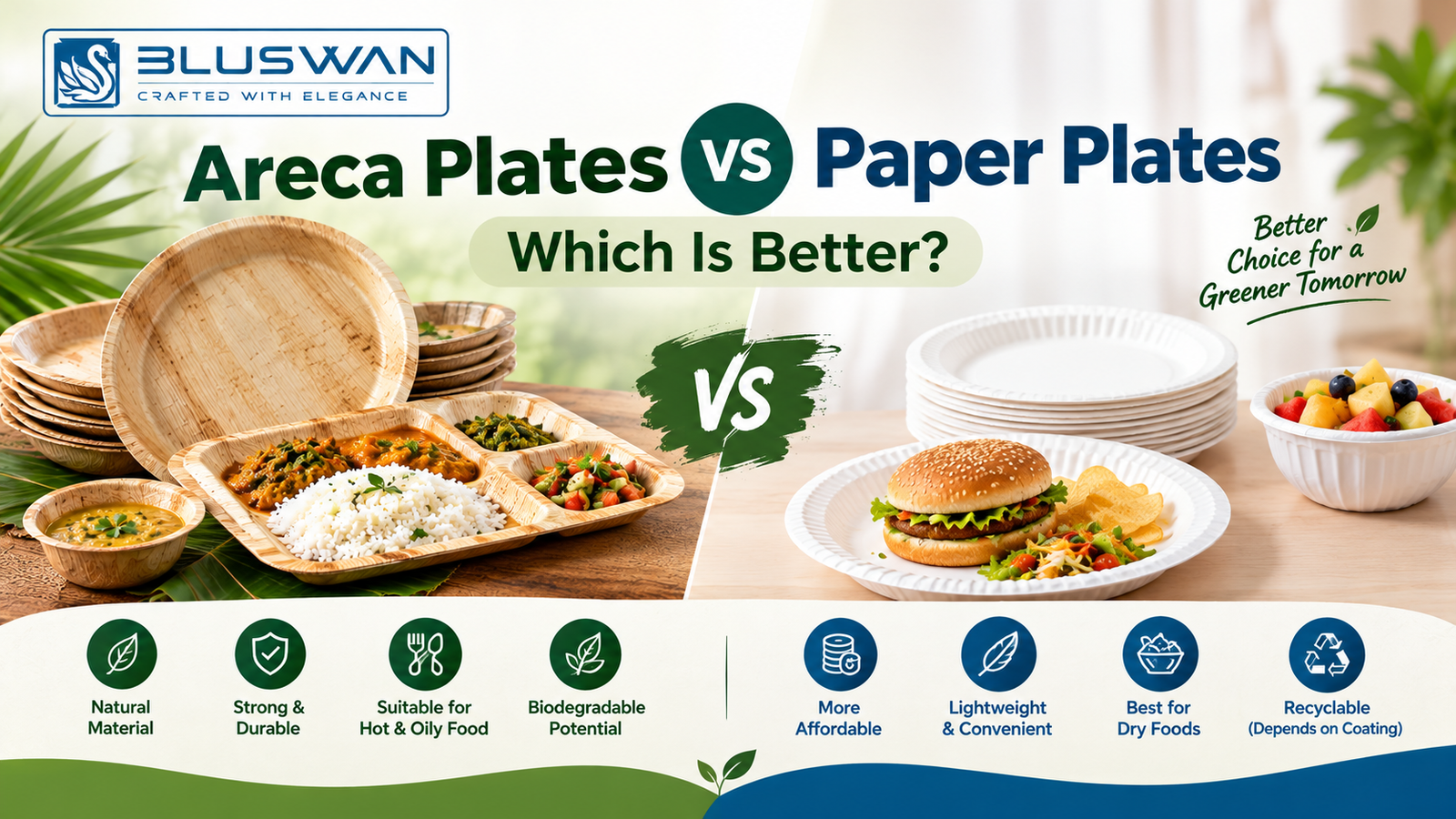
Choosing the right disposable plates is important for households, restaurants, caterers, event planners, and businesses looking for convenient food-serving solutions. Two popular options are areca leaf plates and paper plates. Both are widely used for serving food, but they differ in strength, appearance, price, food suitability, and environmental impact.
Areca leaf plates are made from naturally fallen areca palm leaf sheaths, while paper plates are manufactured from processed paper pulp. Some paper plates are uncoated, while others have a wax or plastic-based coating to improve moisture resistance.
So, which is better: areca plates or paper plates?
The answer depends on how you plan to use them. Areca plates are generally a strong choice for hot meals, oily foods, weddings, and premium catering. Paper plates can be suitable for light snacks, dry foods, and situations where low upfront cost is the main priority.
In this guide, we compare both options to help you make an informed decision.
Areca leaf plates are disposable tableware made from the naturally shed leaf sheaths of areca palm trees. These fallen sheaths are collected, cleaned, dried, and shaped into plates, bowls, and trays using heat and moulds.
Unlike conventional paper plates, areca leaf plates can retain the natural texture and appearance of the leaf. Their colour, grain, and patterns may vary slightly, making each plate distinctive.
Natural appearance: Their earthy colour and texture create an attractive dining presentation.
Good strength: Quality plates can support substantial portions of food.
Suitable for many Indian dishes: They are often suitable for rice, curries, snacks, and oily foods.
No added coating required: Properly manufactured products can be made without plastic or wax linings.
Biodegradable potential: Uncoated plates can break down under suitable composting conditions.
Areca leaf plates are commonly used at weddings, festivals, family functions, outdoor events, restaurants, and catering services.
Paper plates are disposable plates made from paper or paperboard produced using processed wood pulp or other suitable paper fibres. They are manufactured in different shapes, sizes, thicknesses, and designs.
Some paper plates are plain and uncoated, while others contain a moisture-resistant lining or coating. These differences affect how well they hold wet food and whether they can be recycled or composted.
Lightweight and convenient: They are easy to transport, store, and distribute.
Widely available: Many sizes and designs are available through retail and wholesale channels.
Often economical: Basic paper plates can have a lower upfront price than some natural-leaf alternatives.
Suitable for dry foods: They work well for snacks, biscuits, sandwiches, cakes, and other light servings.
Available in multiple designs: Printed and plain options suit different occasions.
Paper plates are popular at office meetings, birthday parties, small gatherings, snack counters, and informal events.
The following comparison highlights the main factors to consider before choosing between the two products.
| Feature | Areca Leaf Plates | Paper Plates |
|---|---|---|
| Raw material | Naturally fallen areca palm leaf sheaths | Processed paper or paperboard |
| Appearance | Natural, textured finish | Usually smooth and uniform |
| Strength | Generally sturdy when well made | Depends on thickness and construction |
| Hot food | Suitable for many hot meals | Depends on the plate's specifications |
| Oily food | Generally handles oily dishes well | Can soften or stain, especially when uncoated |
| Wet food | Often suitable for typical meal servings | Performance varies with coating and thickness |
| Purchase price | Often higher than basic paper plates | Often lower for basic varieties |
| Compostability | Uncoated plates can be compostable under suitable conditions | Depends on fibres, coatings, and local facilities |
| Storage | Keep dry and protected from moisture | Keep dry and protected from moisture |
| Best use | Full meals, catering, weddings, premium events | Snacks, dry foods, quick and casual serving |
Important: Product quality matters. Not every areca plate has the same load capacity, and not every paper plate performs poorly with wet food. Always test the specific product you intend to purchase.
Strength is an important consideration when serving a complete meal. A plate should hold food without bending excessively, leaking, or becoming uncomfortable to carry.
Areca leaf plates are often rigid and suitable for serving rice, vegetables, curries, snacks, and other meal components. Their moulded structure makes them a practical option for catering services and events where guests carry their plates.
Their performance still depends on the plate's size, thickness, manufacturing quality, and the weight of the food being served.
Paper plates vary considerably in strength. Thin, uncoated plates may bend or become soft when exposed to moisture and oily food. Thicker paperboard plates or properly designed coated plates can provide better support.
For example, a paper plate may work perfectly well for a slice of cake but may not be the best option for a large serving of rice and curry.
Winner for heavier meals: Areca leaf plates are generally the better starting point for full meals, provided the product is appropriately sized and well manufactured.
Food compatibility is particularly important in India, where disposable plates may be used for rice, dal, sambar, curries, biryani, snacks, and other dishes containing oil or moisture.
Areca plates are a practical choice for serving many traditional Indian dishes. Their natural structure and rigidity make them useful for meals containing rice, vegetables, and oily preparations.
They are suitable for many catering applications, although extremely liquid-heavy servings and long holding times should be tested with the specific plate.
Paper plates are convenient for serving dry snacks, biscuits, sandwiches, pastries, and similar foods. Their performance with wet or oily dishes depends on thickness and the type of coating used.
A coated paper plate may resist moisture better than an uncoated one. However, a coating can also change how the product should be disposed of after use.
Practical recommendation: For a full meal or buffet, consider areca plates. For dry snacks and brief serving occasions, paper plates may be sufficient.
Environmental impact is one of the biggest reasons people compare these two products. However, the word “eco-friendly” should not be judged by appearance alone.
Areca plates can use naturally fallen leaf sheaths as their main raw material. This can make use of an agricultural resource that might otherwise be discarded.
When produced without synthetic coatings and managed through suitable composting systems, these plates can offer an alternative to conventional disposable tableware.
Their actual environmental impact also depends on manufacturing energy, water use, packaging, transportation, and end-of-life treatment.
Paper plates are made from processed fibres, so their production involves pulping, shaping, and often other processing steps.
Uncoated paper plates may be easier to recycle or compost where appropriate facilities exist. However, plates contaminated with food can be unsuitable for some recycling systems.
Paper plates with plastic-based coatings can be more difficult to recycle and may not be suitable for ordinary composting. Wax-coated products also need to be assessed according to their actual composition and the capabilities of the disposal facility.
There is no universal winner for every supply chain. A life-cycle assessment comparing leaf and paper plates found that transportation distance and manufacturing energy could significantly influence the results. In that study, the leaf plates had a higher carbon footprint than the paper plates under the specific conditions assessed.
This means buyers should consider where a product is manufactured, how far it travels, what energy is used in production, and how it will be disposed of—not just its raw material.
Environmental takeaway: Choose an uncoated, well-documented product and confirm that suitable composting or waste-management facilities are available. A product's real environmental benefits depend on its full life cycle.
Cost is a major factor for restaurants, caterers, wholesalers, and event organisers purchasing plates in large quantities.
Areca leaf plates may have a higher upfront cost than basic paper plates. The final price depends on:
Plate size and shape
Thickness and overall quality
Order quantity
Supplier and manufacturing location
Packaging and shipping
Taxes and other applicable charges
For bulk buyers, comparing multiple suppliers and requesting samples can help identify the right balance between price and performance.
Basic paper plates are often an economical option, especially for lightweight serving needs. However, thicker paperboard plates and specialised coated varieties may cost more than standard options.
A low-cost plate may not provide the best value if it bends, leaks, or needs to be replaced during service.
When evaluating a purchase, consider the cost per usable plate, the suitability for your menu, packaging expenses, delivery charges, and the quantity required.
Best for a tight upfront budget: Basic paper plates may be the better option for dry snacks.
Best for durability-focused serving: Areca leaf plates may offer better value for full meals and events when their strength suits the application.
The appearance of a disposable plate can influence the dining experience, particularly at weddings, celebrations, restaurants, and corporate events.
Areca plates have a distinctive natural texture and warm, earthy colour. Their appearance can complement traditional Indian meals, outdoor celebrations, eco-conscious events, and rustic or premium dining themes.
They are particularly useful when presentation is part of the overall customer experience.
Paper plates generally have a more uniform finish and are available in plain colours, patterns, and printed designs. They can suit birthdays, office gatherings, school events, and casual celebrations.
Winner for natural presentation: Areca leaf plates are generally the stronger choice for a distinctive, nature-inspired dining setup.
Areca plates are suitable for a variety of food-service applications, including:
Weddings and family functions: Serve meals with a natural presentation.
Catering businesses: Use sturdy plates for buffets and outdoor events.
Restaurants and food stalls: Serve selected meals and snacks in a natural-looking format.
Festivals and community gatherings: Provide convenient disposable tableware.
Corporate events: Support events where appearance and material choice matter.
Eco-conscious businesses: Offer an alternative to conventional disposable plates.
Before placing a bulk order, confirm the plate dimensions, portion capacity, packaging, and availability.
Paper plates remain useful for many everyday occasions, particularly when serving requirements are simple.
They can be a good option for:
Birthday parties and casual gatherings
Office meetings and conferences
Dry snacks and bakery products
Biscuits, sandwiches, and light refreshments
School functions and community activities
Short-duration food service where cost is a priority
For meals containing gravy, oil, or heavy portions, test the exact plate before purchasing large quantities.
If you are buying disposable plates for a restaurant, catering business, retail shop, or wholesale operation, follow these steps.
List the main dishes and consider their weight, moisture, oil content, and serving duration.
Choose plate dimensions according to your portion sizes. Small plates may suit snacks, while larger plates may be more practical for full meals.
Test samples with the actual food you plan to serve. Check rigidity, moisture resistance, ease of handling, and overall appearance.
Review product specifications, available quantities, packaging, delivery schedules, and customer support.
For areca plates, confirm whether the product is uncoated. For paper plates, ask whether they contain wax or plastic-based coatings and whether the product is suitable for the disposal system available to you.
Compare the price per plate alongside shipping, packaging, taxes, storage, and the potential cost of damaged or unsuitable products.
Before committing to a large purchase, confirm that the plates perform well in actual use and that the supplier can maintain consistent quality.
Areca leaf plates are generally better for heavier meals, oily food, and natural presentation. Paper plates can be more economical for dry snacks and short-duration serving. The best choice depends on the food, product quality, and budget.
Uncoated areca leaf plates can biodegrade and may be compostable under suitable conditions. The time required depends on moisture, temperature, microorganisms, plate construction, and composting conditions.
Some paper plates can hold hot food, but performance depends on the paperboard thickness and coating. Check the manufacturer's instructions and test the product with your intended food.
Basic paper plates are often cheaper upfront, but prices vary by size, thickness, quality, quantity, and supplier. Compare current quotations rather than assuming every paper plate costs less.
Areca leaf plates are a strong option for weddings and catering events where durability and natural presentation are priorities. Paper plates can be appropriate for refreshments and lighter food service.
Many quality areca plates are suitable for typical oily dishes. Performance depends on the plate's construction, food type, serving duration, and portion size, so testing is recommended.
Store both types in a clean, dry place away from moisture, pests, and direct contamination. Follow the supplier's storage guidance, particularly when buying in bulk.
Both areca leaf plates and paper plates have practical uses, but they serve different needs.
Choose areca leaf plates when you want sturdy tableware for many hot and oily meals, natural presentation, and an alternative made from fallen palm leaf sheaths.
Choose paper plates when you need a convenient, often economical option for dry snacks, light refreshments, and casual events. Check the coating and disposal requirements before making environmental claims.
For restaurants, caterers, event planners, and wholesale buyers, the best decision comes from balancing food performance, appearance, total cost, supplier reliability, and end-of-life disposal.
At BLUSWAN, explore tableware options suited to your business requirements. Compare product specifications, sizes, quality, and bulk-order availability before selecting the right solution for your customers.
Make your next tableware purchase with a focus on quality, practicality, and informed material choices.
2026 © All rights reserved by Bluswan indus Pvt Ltd
Powered by : Innoplus TechnologiesYour item has already added in wishlist successfully


